I still remember the first time someone told me Hangzhou food was “too mild” and “nothing special” compared to Sichuan or Cantonese cooking. That person had clearly never sat down at a lakeside restaurant on a rainy afternoon and had a bowl of Dongpo pork slowly melt on their tongue, or slurped a plate of noodles that somehow tasted like spring itself. Hangzhou cuisine doesn’t shout at you the way spicy hot pot does. It whispers. And once you learn to listen, it’s hard to go back. It’s the kind of food that rewards a slower kind of eating, the sort where you actually notice how a dish was seasoned instead of just registering “spicy” or “not spicy” and moving on.
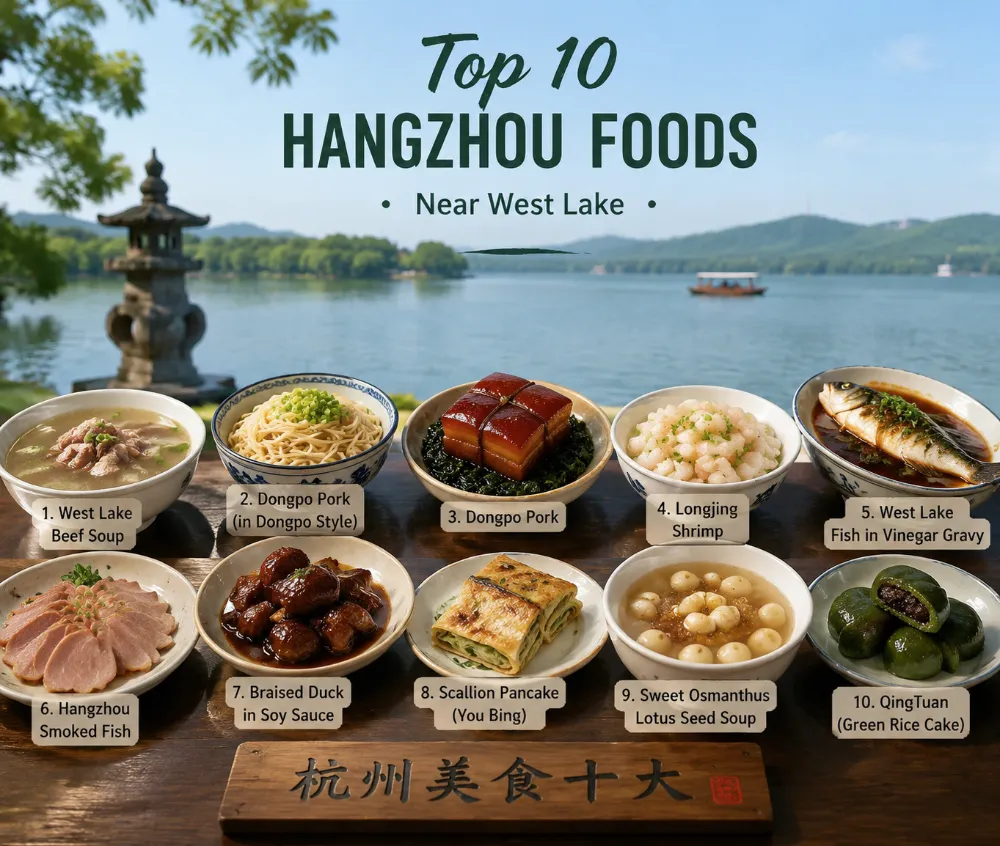
As the capital of Zhejiang province and the birthplace of what food historians call Zhe cuisine, Hangzhou has spent over a thousand years perfecting a style of cooking built around freshness, seasonality, and a light touch with sugar, vinegar, and rice wine rather than chili or heavy oil. Much of it grew up around West Lake itself, which explains why so many of the city’s signature dishes carry the lake’s name. This guide walks through the ten dishes I’d tell any first-time visitor not to skip, along with where to find good versions of them, what makes each one worth the calories, and enough background so you’re not just eating blind when the dish lands on your table.
Understanding Hangzhou Cuisine Before You Start Eating
Before diving into the list, it helps to understand why Hangzhou food tastes the way it does, because almost nothing on this list makes sense without a bit of context. Zhe cuisine is one of China’s eight major culinary traditions, and within it, Hangzhou-style cooking (sometimes just called Hangbang cuisine) is considered the most refined and historically significant branch. A lot of that comes down to timing: when the Southern Song dynasty moved its capital to Hangzhou in 1127, the city suddenly had to feed an imperial court, and recipes had to become more elaborate, more seasonal, and more presentation-focused almost overnight.
、、、‘’Three ingredients show up again and again across this list, and it’s worth knowing why. The first is West Lake itself, which for centuries supplied freshwater fish, shrimp, and aquatic plants like water shield directly to local kitchens. The second is Longjing tea, grown in the hills just southwest of the city, which shows up not just as a drink but as an actual cooking ingredient. The third is a specific combination of sugar, rice vinegar, and shaoxing wine, used in proportions that create sweetness without ever tipping into the syrupy territory you might associate with Cantonese sweet and sour dishes. Once you notice this pattern, the whole cuisine starts to make a lot more sense, and you’ll start predicting flavors before the dish even arrives.
1. West Lake Fish in Vinegar Sauce (西湖醋鱼, Xīhú Cùyú)
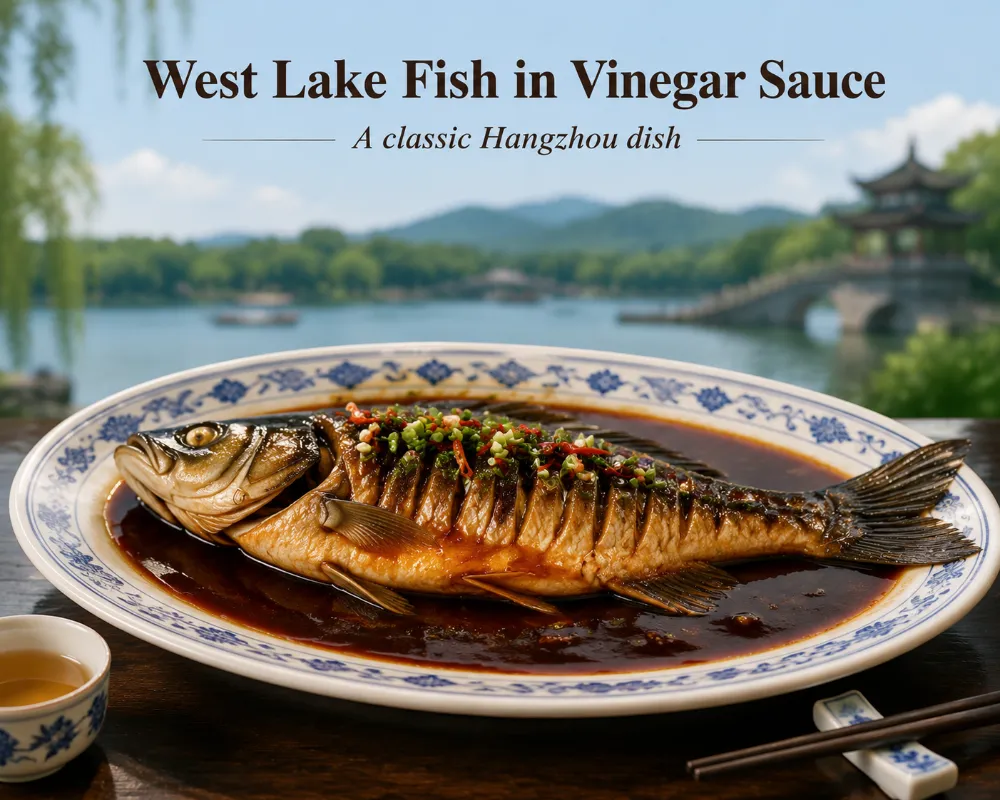
If Hangzhou had to pick one dish to put on a postcard, this would be it. West Lake Fish in Vinegar Sauce is made from freshwater grass carp, traditionally caught from West Lake itself, though these days most restaurants source it from nearby fish farms to protect the lake’s ecosystem. The fish is gently poached rather than fried, then topped with a glossy sauce built from rice vinegar, sugar, and a touch of ginger and shaoxing wine.
The result is a dish that sounds strange on paper — sweet and sour fish that isn’t crispy or battered — but tastes remarkably clean. The fish should have almost no fishy smell, and the flesh should separate easily from the bone in soft, silky flakes. Locals judge a restaurant’s skill by how well they can debone the fish tableside without tearing the meat. There’s a well-known story tied to this dish about two sisters-in-law from the Song dynasty, one of whom cooked this recipe for her husband before he left to take the imperial exam, adding extra sugar and vinegar so he wouldn’t forget home. Whether or not you believe the legend, it’s a nice thought to have while you eat.
Where to try it: Louwailou, right by West Lake, is the most famous (and most touristy) option — go early to avoid the queue. For a slightly quieter experience with the same quality, look for smaller family-run restaurants along Nanshan Road.
One thing worth knowing before you order: this dish is polarizing among first-time visitors specifically because it isn’t sweet and sour in the Western Chinese-takeout sense. There’s no thick orange glaze, no deep frying, no crunch. It’s closer in spirit to a delicately poached fish finished with a bright, tangy pan sauce, which means people expecting something closer to General Tso’s chicken are sometimes caught off guard. Go in expecting subtlety rather than punch, and it tends to land a lot better.
2. Dongpo Pork (东坡肉, Dōngpō Ròu)
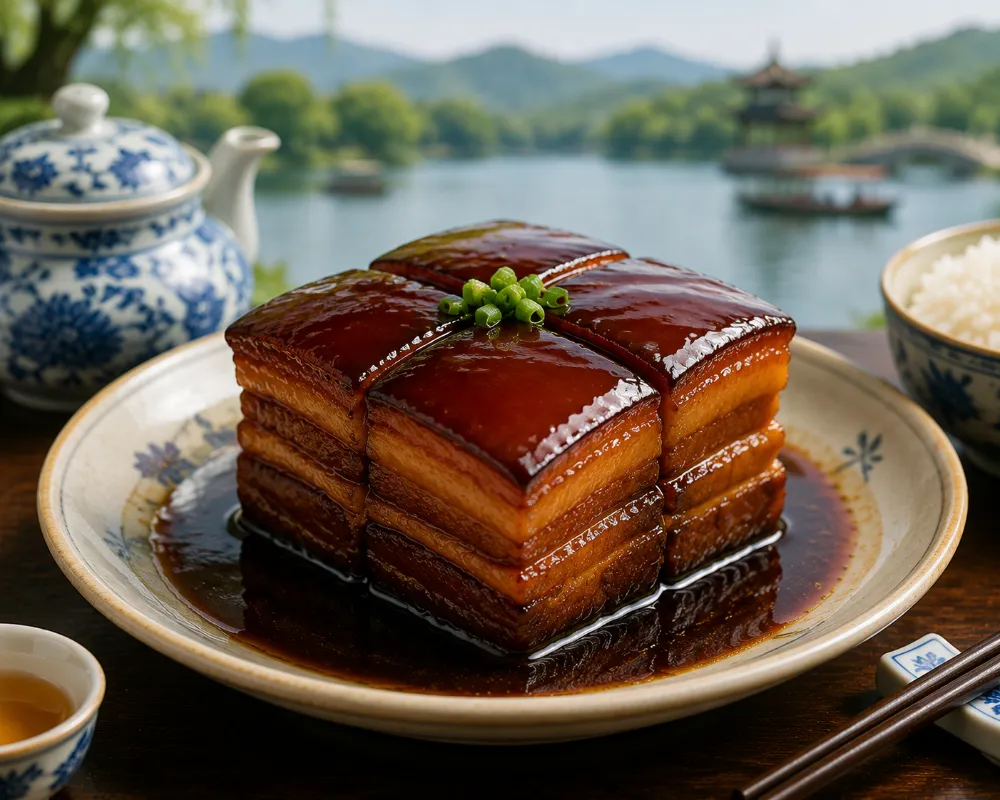
Named after the Song dynasty poet and gourmet Su Dongpo, who apparently invented this recipe while serving as a local official in Hangzhou, this is the dish most likely to convert a skeptic into a Hangzhou food fan within one bite. A thick block of pork belly, skin still on, is braised for hours in a mixture of shaoxing wine, soy sauce, rock sugar, and ginger until the fat turns translucent and the meat becomes so tender a chopstick can cut through it.
What separates good Dongpo pork from mediocre versions is the fat-to-meat ratio and how the dish is finished. A well-made piece should hold its square shape when it arrives at the table, glistening with a dark, slightly sticky glaze, and should not taste greasy despite being, quite frankly, mostly fat and skin. The sweetness is there to balance the richness, not to dominate it. Some restaurants serve it with a small bowl of rice specifically so you can spoon the braising liquid over it, which honestly might be the best part of the whole dish.
Where to try it: Zhiweiguan, an old Hangzhou institution near Hefang Street, does a version that’s been recommended by generations of locals. Expect to pay somewhere between 40 and 80 RMB depending on portion size.
There’s a small ongoing debate among Hangzhou cooks about whether the “real” version should be steamed the entire time or braised on the stove before a final steaming stage, and honestly, both camps produce excellent results. What matters more than the exact method is patience — anything less than two to three hours of gentle cooking tends to leave the skin chewy rather than soft, and a rushed version is usually the giveaway that you’ve wandered into a restaurant coasting on the dish’s reputation rather than actually cooking it properly.
3. Longjing Shrimp (龙井虾仁, Lóngjǐng Xiārén)
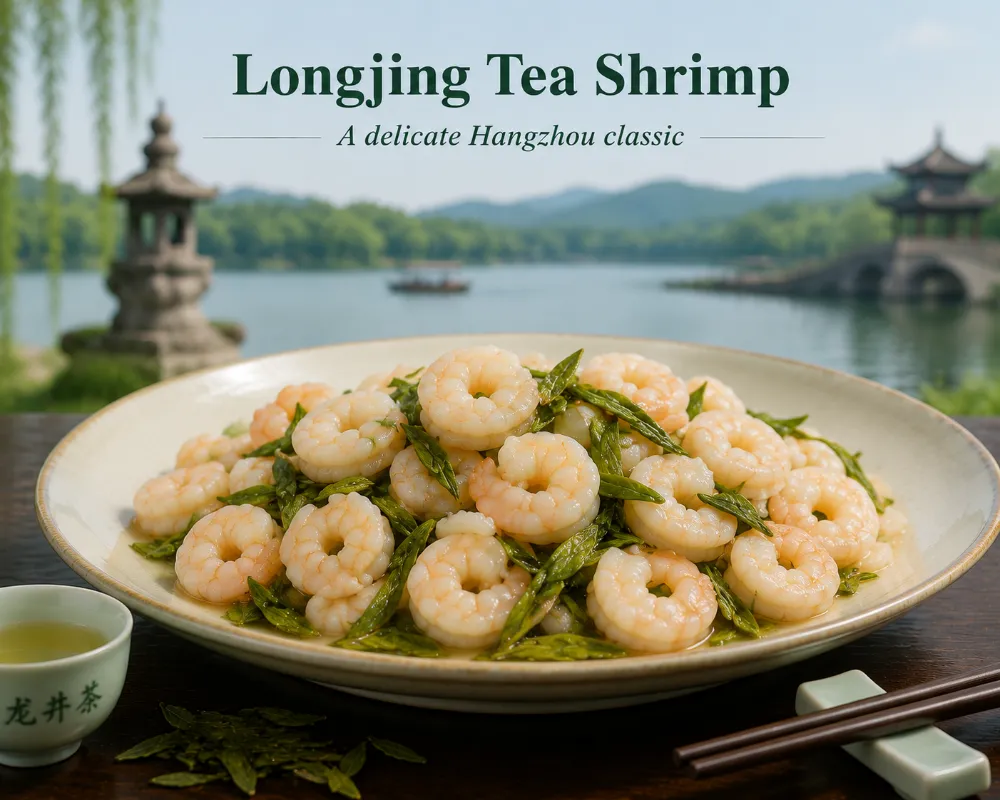
Hangzhou is famous for two things that don’t obviously belong together: freshwater shrimp and Longjing tea, grown in the hills just west of the city. This dish exists because someone, at some point, decided to combine them, and the result became one of the region’s defining recipes. Small river shrimp are stir-fried very briefly in a light oil, then tossed with freshly brewed Longjing tea leaves and a splash of the tea liquid itself.
The shrimp stay pale, almost white, rather than turning the orange-pink color you’d expect from shrimp cooked in soy-based sauces, because there’s barely any sauce here at all. What you’re tasting is the shrimp’s natural sweetness against the faintly grassy, slightly nutty flavor of the tea leaves. It’s a subtle dish, and it’s exactly the kind of thing that convinces you Hangzhou cooking is about restraint rather than a lack of ambition.
Best season to try it: Late March through April, when the year’s first Longjing tea harvest (known as Mingqian tea) is at its peak, gives you the freshest, most fragrant version of this dish.
A quick word of caution: this is one of the more frequently faked dishes on the tourist circuit, mainly because good Longjing tea is genuinely expensive, and it’s easy for a restaurant to swap in cheaper green tea leaves that look similar but lack the aroma. If the tea leaves in your dish taste flat or slightly bitter rather than sweet and chestnut-like, you’re probably not getting the real thing, which is one more reason to eat this dish at an established restaurant rather than a random storefront near the train station.
4. Beggar’s Chicken (叫化鸡, Jiàohuà Jī)
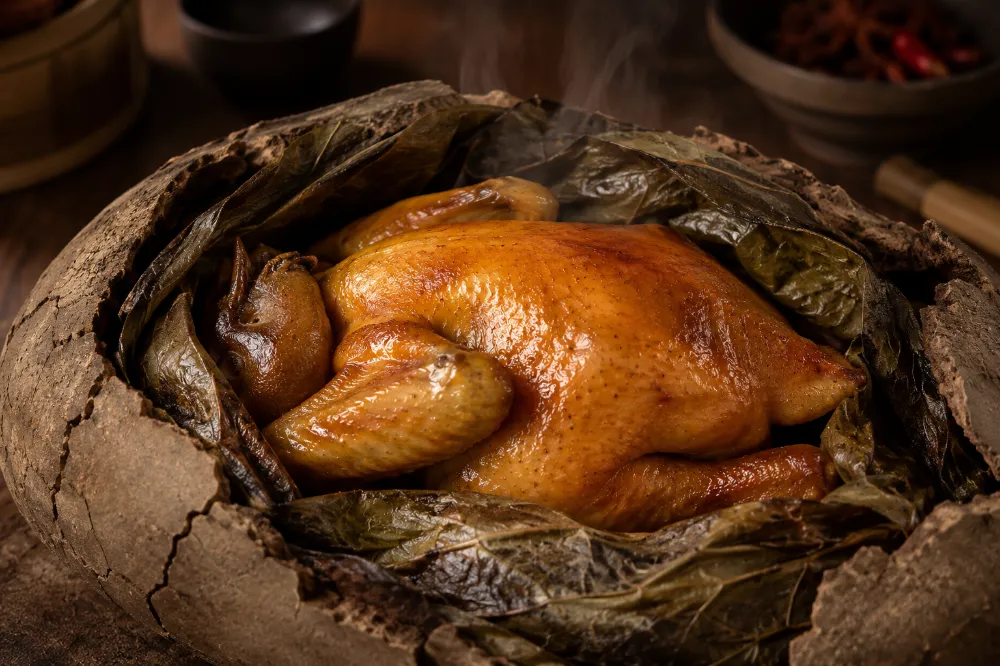
Every food culture has a dish with a good origin story, and this one belongs to Hangzhou. Legend has it that a beggar, having stolen a chicken with nothing to cook it in, wrapped the bird in lotus leaves and clay and buried it in hot coals. When he dug it up, the chicken had somehow steamed inside its own natural oven, and the aroma reportedly caught the attention of a passing emperor, who declared it fit for the palace.
Whatever the true history, the modern version is a genuine showstopper. A whole chicken is stuffed with mushrooms, ham, and scallions, wrapped tightly in lotus leaves, then encased in a shell of clay or dough and baked for several hours. The presentation at the table is half the fun — the server cracks the hardened clay shell open in front of you, releasing a cloud of steam and the smell of lotus leaf, ham, and slow-cooked chicken all at once. The meat underneath is fall-apart tender and deeply infused with the aromatics from inside.
A quick tip: This dish usually needs to be ordered in advance since the cooking time runs several hours, so it’s worth calling ahead if you’re planning to have it at a specific restaurant.
Because of the long cook time and the theatrical cracking-open moment, this has become something of a special-occasion or group dish rather than an everyday order, similar to how a whole roast duck works in Beijing. If you’re travelling solo, it might be worth pairing up with other diners at your hotel or hostel to justify ordering a whole bird, since splitting it four or five ways is really the intended way to enjoy it anyway.
5. Sister Song’s Fish Soup (宋嫂鱼羹, Sòngsǎo Yúgēng)
This is one of those dishes that looks unassuming in a bowl but carries a surprising amount of history. Also tied to a Song dynasty legend, the story goes that a woman named Song, cooking for her ailing brother-in-law, created this soup using whatever fish she had on hand, thickened it, and seasoned it with vinegar and ginger to help with his recovery. An emperor supposedly tasted it during a visit to Hangzhou and was impressed enough that the recipe stuck around for the better part of a millennium.
The modern dish is a smooth, slightly thickened soup made with shredded fish (often mandarin fish or similar white fish), bamboo shoots, mushrooms, and sometimes a hint of egg white for texture, finished with a touch of vinegar and white pepper. It’s often compared to a lighter, more refined version of hot and sour soup, without the heavy chili or excessive vinegar punch. It’s frequently served as a starter before richer dishes like Dongpo pork, which makes sense given how gently it treats your palate before the heavier courses arrive.
What I find interesting about this dish is how it demonstrates a broader philosophy in Hangzhou cooking: using humble, everyday ingredients and technique alone to create something that tastes far more expensive than its component parts. There’s no exotic seafood here, no rare cut of meat, just careful knife work, a well-balanced broth, and precise seasoning. If you want a single dish that sums up what separates refined home cooking from restaurant-level Hangzhou cuisine, this soup is a strong candidate.
6. West Lake Water Shield Soup (西湖莼菜汤, Xīhú Chúncài Tāng)
Water shield, or chun cai, is an aquatic plant with small, jelly-coated leaves that grows in ponds around Hangzhou, and it has a texture unlike almost anything else you’ll eat in China — slippery, faintly gelatinous, with a mild, almost neutral flavor that takes on whatever broth surrounds it. This soup typically combines water shield with chicken or ham broth, sometimes with slivers of ham and a few slices of bamboo shoot floating alongside.
Texture is really the whole point of this dish. If you’ve never had water shield before, the sensation can be a little unusual on the first spoonful, similar to how some people react the first time they try okra or aloe vera. Give it a second try before deciding you don’t like it — most people who grew up eating this soup describe the slipperiness as comforting rather than strange, and it’s considered a refined, almost delicate addition to a proper Hangzhou banquet.
Water shield is also harvested by hand, which is part of why it commands a slightly higher price than you might expect for a plant-based soup. The traditional harvesting method involves workers wading through shallow ponds and picking the young, still-curled leaves one at a time before they mature and lose their signature jelly coating, a labor-intensive process that hasn’t changed much in centuries and helps explain why this dish still feels a bit special rather than everyday.
7. Fried River Shrimp (油爆虾, Yóubào Xiā)
Where Longjing shrimp is quiet and refined, this dish is the loud, crispy cousin. Small river shrimp, shell still on, are flash-fried at high heat until the shells turn a deep reddish-brown and go completely crisp, then tossed in a glaze of sugar, soy sauce, and a bit of rice wine. The result is sweet, salty, faintly caramelized, and meant to be eaten shell and all — the shells become thin and crunchy enough that most people don’t bother peeling them.
This is very much a beer dish, the kind of thing Hangzhou locals order at casual dinners alongside a few cold Tsingtaos rather than at a formal banquet. It’s also one of the more affordable options on this list, typically priced well under 50 RMB, which makes it an easy one to try alongside a few other smaller plates rather than committing a whole meal to it.
If you’ve never eaten shell-on shrimp before, don’t overthink the technique. Most locals just pop the whole thing in their mouth, give it a few chews to crush the crisped shell, and swallow the lot without bothering to spit anything out, similar to how you’d eat a soft-shell crab. The shells are fried long enough that they lose any hard, sharp edges, so there’s little risk of anything getting stuck the way you might worry with a raw shrimp shell.
8. Hangzhou-Style Noodles: Pian Er Chuan (片儿川)
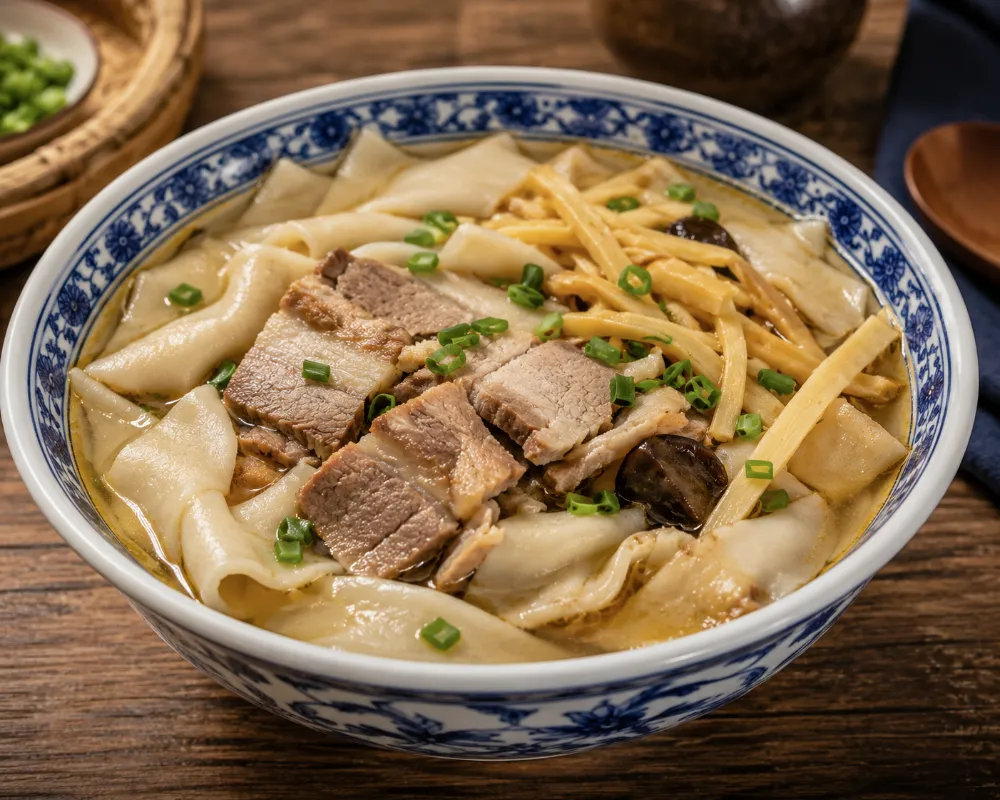
Every food-loving city needs a good breakfast or lunch noodle, and in Hangzhou, that dish is pian er chuan. The name roughly translates to “sliced pieces in a river,” referring to the thin slices of pork loin that float through the broth alongside bamboo shoots, pickled mustard greens, and wide, chewy noodles. The broth itself is usually a savory pork stock brightened by the tang of the pickled greens, giving the whole bowl a sourness that cuts through the richness of the pork.
What makes this dish distinctly Hangzhou rather than a generic regional noodle soup is the combination of bamboo shoots and pickled mustard greens together, a pairing that shows up throughout Zhejiang cooking. Locals eat this any time of day, but it’s especially popular as a mid-morning meal, often at old-school noodle shops that have been serving the same recipe for decades with barely any changes to the menu.
Where to try it: Kuiyuanguan, a century-old noodle chain with several branches around the city, is considered the benchmark version most locals compare everything else to.
Prices for a bowl generally sit somewhere between 15 and 30 RMB, making this one of the most budget-friendly ways to sample authentic Hangzhou flavors without committing to a full sit-down meal. It’s also a great option if you’re traveling on a tighter schedule, since most noodle shops serve quickly and don’t expect you to linger the way a formal restaurant might. Order a side of pickled greens or a soft-boiled egg on top if the shop offers it — both are common add-ons that locals swear by.
9. Wensi Tofu (文思豆腐, Wénsī Dòufu)
This dish exists mainly to prove a point: that a chef’s knife skills can turn something as plain as tofu into a genuine spectacle. A single block of soft tofu is sliced into threads so thin they’re almost translucent, sometimes numbering in the thousands from one block, then gently lowered into a delicate chicken or vegetable broth where the strands spread out like a fine mist suspended in the liquid.
The taste is intentionally subtle — silky tofu against a light, clear broth, sometimes with a few strands of mushroom or ham for color and depth. But the real reason this dish has survived for centuries and made it onto banquet menus across the country isn’t really about flavor at all. It’s a demonstration piece, a way for a kitchen to show off technical skill in front of guests, and watching a chef prepare it (some restaurants do this tableside) is genuinely impressive even if you’ve never cared about knife work in your life.
The dish is named after a Qing dynasty monk, Wensi, who was reportedly so skilled with a blade that this style of ultra-fine cutting became attributed to him and eventually made its way into formal Chinese culinary training. Modern chefs sometimes practice this knife work for years before attempting it in front of paying customers, and a few high-end restaurants in Hangzhou will let you watch the prep from a nearby table if you ask politely, which is worth doing at least once even if you don’t fully appreciate the difficulty involved.
10. Congbao Kuai’er (葱包桧儿, Cōngbāo Kuàir)
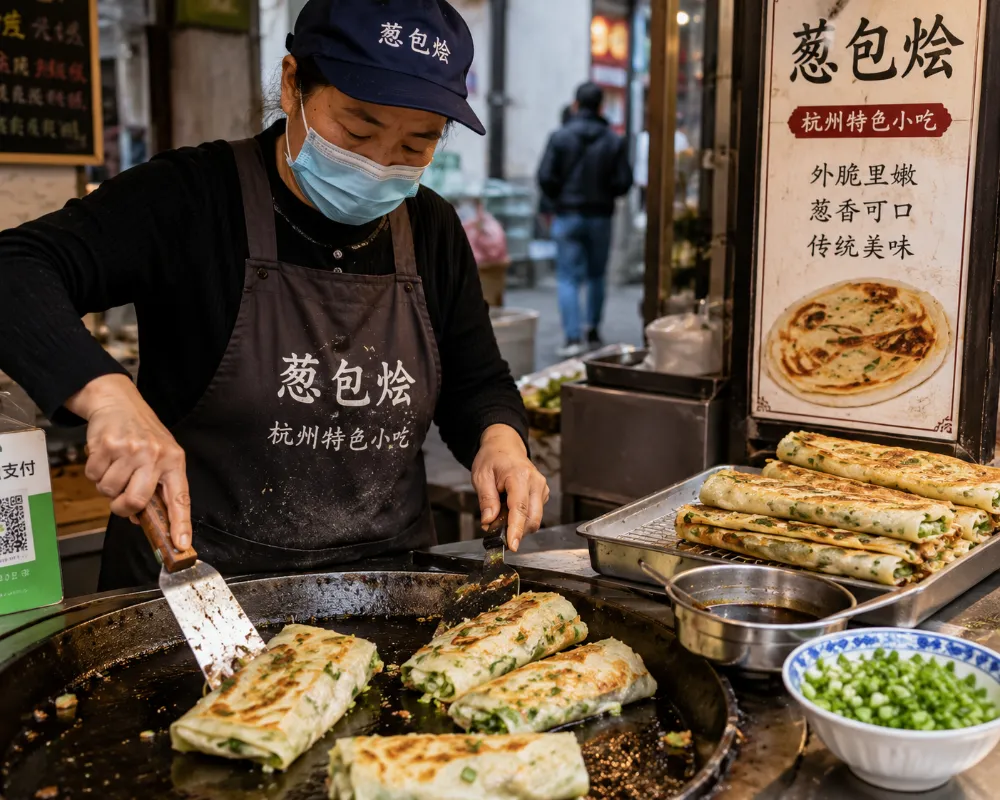
Save room for this one, because it’s the cheapest, most casual item on the list, and also one with the most politically loaded backstory in Chinese food culture. This street snack consists of a thin, flatbread-like wrapper folded around a piece of deep-fried dough (similar to youtiao) and fresh scallions, then pressed flat on a griddle until crispy and slightly charred, and finally brushed with a sweet bean sauce or hoisin-style sauce.
The name translates loosely to “scallion-wrapped Kuai,” and the “Kuai” refers to Qin Kuai, a Song dynasty official widely blamed for the execution of the patriotic general Yue Fei on false charges of treason. According to local lore, the deep-fried dough sticks were originally shaped like two figures — representing Qin Kuai and his wife — being fried together as a form of public mockery, which is also why deep-fried dough sticks in Chinese are sometimes called youtiao, meaning “oil-fried devil.” Whether you care about the seven-hundred-year-old grudge or not, the snack itself is crunchy, savory-sweet, and costs only a few RMB from most street stalls around Hefang Street.
How Hangzhou Cuisine Compares to Other Chinese Regional Styles
If you’ve traveled around China before, or even just eaten at a variety of Chinese restaurants back home, it helps to place Hangzhou food on a mental map next to the styles you might already know. This isn’t just trivia — understanding the contrast actually makes it easier to appreciate what Hangzhou cooks are going for, especially if your palate has been trained by spicier or heavier regional cuisines.
Compared to Sichuan cuisine, which builds flavor through numbing Sichuan peppercorns and generous chili oil, Hangzhou food can feel almost restrained on first bite. There’s no tingling sensation, no lingering heat, and dishes rarely arrive glistening in red oil. Where Sichuan cooking wants to overwhelm your palate in the best possible way, Hangzhou cooking wants to let a single ingredient’s natural flavor come through clearly, which is why so much attention goes into ingredient freshness rather than sauce complexity.
Against Cantonese cuisine, the comparison is a bit closer, since both traditions value freshness and lighter cooking techniques like steaming and quick stir-frying. But Cantonese cooking tends to lean savory and umami-forward, built around soy sauce, oyster sauce, and stock reductions, while Hangzhou dishes lean into a sweet-sour-savory triangle built around sugar, vinegar, and rice wine. You can taste this difference directly if you compare Cantonese sweet and sour pork to West Lake Fish in Vinegar Sauce — both are technically “sweet and sour,” but they land on the tongue in completely different ways.
And compared to Northern Chinese cuisine, which relies more heavily on wheat-based staples, garlic, and vinegar used in a punchier, more assertive way (think dumplings and cold noodle dishes from Beijing or Xi’an), Hangzhou cooking feels distinctly southern: rice-based rather than wheat-based for the most part, built around freshwater ingredients rather than heavier meats, and generally gentler in how strong flavors are deployed. None of this makes one tradition better than another, but it does explain why Hangzhou food sometimes surprises visitors who arrive expecting the bolder flavors they associate with Chinese food more broadly.
A Sample One-Day Food Itinerary in Hangzhou
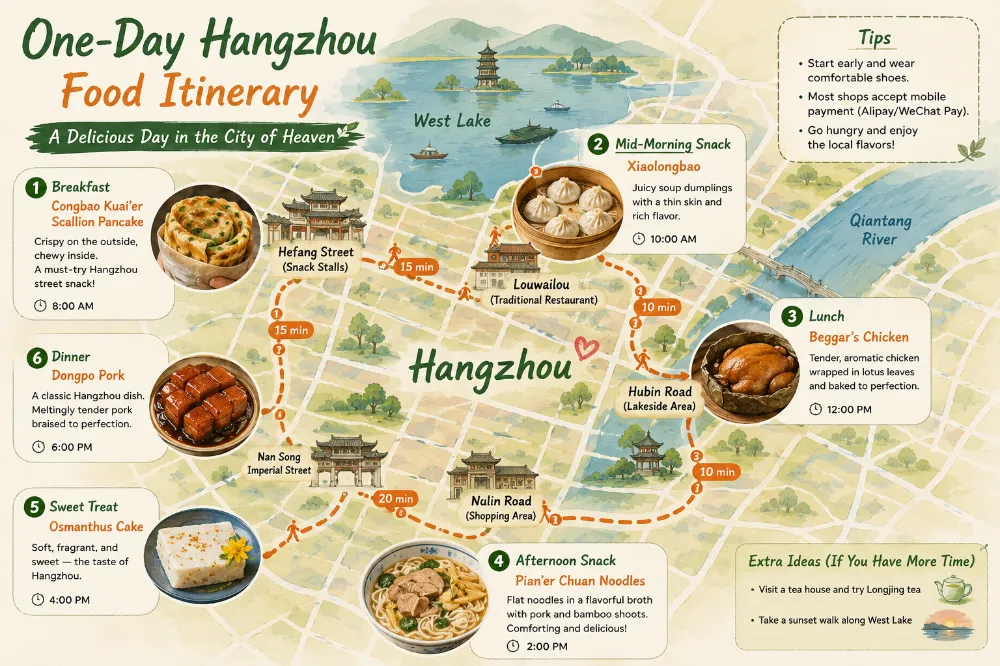
If you only have one day to eat your way through this list, here’s roughly how I’d structure it, based on how these dishes are traditionally eaten and where they’re clustered around the city.
Morning: Start with a bowl of Pian Er Chuan at Kuiyuanguan, ideally around 8 or 9am before the shop fills up with the lunch crowd. It’s a light, savory way to start the day and won’t leave you too full before the rest of your eating plans.
Late morning: Walk over to Hefang Street and grab a Congbao Kuai’er from one of the street stalls as a snack while you browse the shops. This is also a good time to pick up a small tin of Longjing tea if you want to bring some home.
Lunch: Head toward West Lake for a proper sit-down meal. This is the time to order West Lake Fish in Vinegar Sauce, Dongpo Pork, and Longjing Shrimp together, sharing all three across the table if you’re with other people. Ask for a pot of Longjing tea to go alongside it.
Afternoon: Take a slow walk or boat ride around West Lake to let lunch settle. This is also when many restaurants are quieter, so if you didn’t manage a reservation for Beggar’s Chicken earlier, this is a good window to call ahead for dinner.
Evening: For dinner, go somewhere that can prepare Beggar’s Chicken (call ahead, as mentioned earlier), and round out the table with Sister Song’s Fish Soup or West Lake Water Shield Soup as a starter, plus a plate of Fried River Shrimp if you’re still hungry. Save Wensi Tofu for a special dinner at a higher-end restaurant, since it’s less commonly found at casual spots and pairs well with a slightly more formal meal.
Obviously you don’t need to cram every single dish into 24 hours — most visitors spread this list across two or three days, which also gives your stomach a bit of a break between the richer dishes like Dongpo Pork and Beggar’s Chicken.
Practical Tips for Eating Your Way Through Hangzhou
A few things I always tell first-time visitors before they start their Hangzhou food tour:
- Best areas to eat: Hefang Street is touristy but genuinely useful for trying several street snacks in one walk. For sit-down restaurant meals, the area around West Lake’s southern shore (Nanshan Road) has a good mix of famous names and quieter local spots.
- Timing matters: Restaurants like Louwailou get extremely crowded during lunch and dinner rush on weekends. Going right when they open, or slightly off-peak around 2pm or 5pm, saves you a long wait.
- Don’t skip the tea pairing: Given how many dishes on this list either use Longjing tea directly or are meant to be eaten alongside it, it’s worth ordering a pot of local tea rather than a soft drink when you sit down for a proper meal.
- Portion sizes: Most Hangzhou dishes are designed to be shared across a table rather than eaten individually, so if you’re travelling with a group, ordering four or five of these dishes together and sharing is the more authentic way to experience the cuisine.
- Seasonality: A few dishes on this list, especially Longjing shrimp and water shield soup, taste noticeably better in spring when both key ingredients are freshest. If your trip timing is flexible, late March to early May is considered the ideal food season in Hangzhou.
- Reservations for special dishes: As mentioned earlier, Beggar’s Chicken often requires advance notice because of the long cooking time, so it’s worth messaging or calling the restaurant a day ahead if it’s on your must-try list.
- Language barrier: Many of the more famous restaurants around West Lake have English menus or picture menus, but smaller noodle shops and street stalls often don’t. Saving photos of the Chinese names used in this article on your phone can make ordering much smoother.
- Budgeting for a food-focused day: A rough estimate for a full day of eating through most of this list, including a sit-down lunch and dinner, tends to land somewhere between 150 and 300 RMB per person, depending on how many higher-end dishes like Beggar’s Chicken or Wensi Tofu you include.
None of these tips are meant to make Hangzhou food sound complicated or intimidating — quite the opposite. Once you know roughly what to expect from each dish and where the good versions tend to be found, the whole experience becomes a lot more relaxed, and you can spend your energy actually enjoying the food rather than worrying about getting it wrong.
Bringing Hangzhou Flavors Home With You
Not every dish on this list travels well, obviously — you’re not packing a whole Beggar’s Chicken in your suitcase. But a few things are worth picking up before you leave if you want a small piece of the trip to follow you home. Longjing tea is the obvious one, and buying it directly from shops near the tea plantations southwest of the city (rather than souvenir stalls closer to West Lake) tends to get you better quality for a similar price. Look for tea labeled with the specific harvest picking, since pre-Qingming (Mingqian) tea picked before early April is considered the best of the year and commands a noticeably higher price than later harvests.
Shaoxing wine, used throughout many of the dishes on this list, is also widely available in sealed bottles and makes a decent gift or cooking souvenir for anyone back home who likes to experiment with Chinese cooking. A few shops around Hefang Street sell smaller, travel-friendly bottles specifically packaged for tourists, which avoids the awkwardness of hauling a full-sized bottle through airport security liquid restrictions.
If you really want to recreate a taste of Hangzhou once you’re home, Dongpo Pork and Pian Er Chuan are both dishes that translate reasonably well to a home kitchen outside China, since the ingredients (pork belly, soy sauce, rice wine, noodles) are increasingly easy to find at larger Asian grocery stores in most countries. The trickier dishes to recreate are the ones dependent on hyper-local ingredients like West Lake water shield or genuinely fresh Longjing tea leaves cooked into the dish itself, since substitutes rarely capture quite the same flavor or texture.
Frequently Asked Questions
What is Hangzhou’s most famous dish?
Dongpo Pork and West Lake Fish in Vinegar Sauce are generally considered the two most iconic dishes, with Dongpo Pork being the more widely recognized outside of Zhejiang province.
Is Hangzhou food spicy?
No, Hangzhou cuisine is known for being mild and light, relying on natural sweetness, vinegar, rice wine, and fresh ingredients rather than chili for flavor, which sets it apart from Sichuan or Hunan cooking.
What is the best time of year to try Hangzhou food?
Spring, particularly late March through April, is considered ideal because it coincides with the fresh Longjing tea harvest and the peak season for river shrimp, both of which feature heavily in local specialties.
Where should first-time visitors eat in Hangzhou?
Hefang Street is a good starting point for street snacks, while Louwailou near West Lake and Zhiweiguan near the old town are reliable choices for sit-down meals featuring the classic dishes on this list.
Is Hangzhou food good for vegetarians?
While many signature dishes are fish or meat-based, Wensi Tofu and West Lake Water Shield Soup are both suitable for vegetarians, and most restaurants can adjust broths on request.
How much does a typical Hangzhou meal cost?
A shared meal covering two or three signature dishes plus rice and tea usually costs between 100 and 250 RMB per person at a mid-range restaurant, while street snacks like Congbao Kuai’er can cost just a few RMB each.
Can I find these dishes outside of Hangzhou?
Some, like Dongpo Pork, have spread widely and appear on menus across China and in Chinese restaurants abroad, but dishes tied directly to West Lake ingredients, such as the fish, shrimp, and water shield dishes, taste noticeably better when eaten fresh in Hangzhou itself.