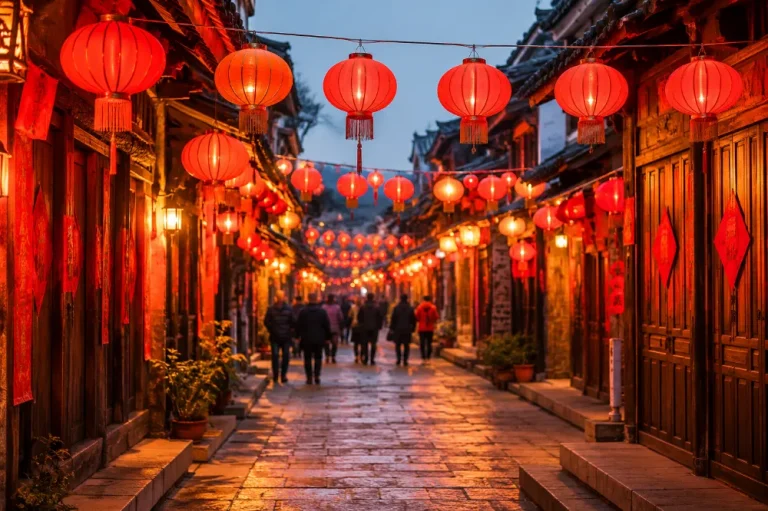
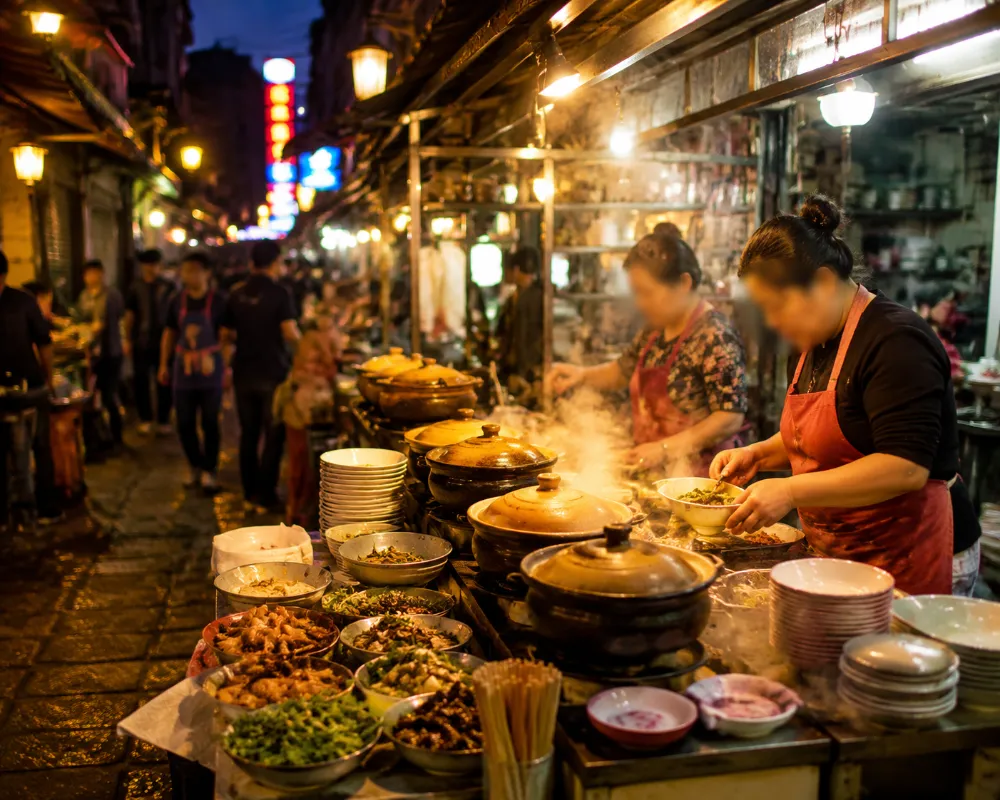
There’s a particular kind of chaos that greets you the moment you turn off Chaozhou’s main tourist drag and step into one of the narrower lanes behind Paifang Street around seven in the evening. Vendors are lifting lids off clay pots, stacks of rice-flour wrappers are being folded with practiced speed, and somewhere nearby a braise pot has been going all day, releasing the kind of layered, soy-and-spice fragrance that attaches itself to your memory in ways that are difficult to shake. Teochew snacks are not particularly showy. They don’t announce themselves with loud spices or theatrical preparation. What they do instead is demonstrate, very quietly, an extraordinary level of accumulated technique applied to ingredients that might seem humble on paper.
This guide covers the most important Teochew snacks you’ll encounter on Chaozhou streets, explains what makes each one distinctive, tells you roughly where to find the best versions, and gives you enough background on the cuisine’s philosophy to help you eat thoughtfully rather than just checking boxes.
What Makes Teochew Street Food Different From Other Chinese Cuisines
Before diving into individual dishes, it helps to understand the underlying logic of Teochew cooking, because it shapes everything about how snacks taste, how they’re seasoned, and how they’re meant to be eaten.
Teochew cuisine, sometimes spelled Chiuchow or Chaozhou cuisine, originated in the Chaoshan region of eastern Guangdong province, which encompasses Chaozhou, Shantou, and Jieyang. The region has always been coastal, always been fishing-dependent, and has always had one eye on freshness as the primary variable in a dish’s success or failure. The cuisine has affinities with both Fujian and Cantonese cooking, sharing the southern emphasis on seafood, light seasoning, and technical precision while developing its own set of tools: a specific relationship with braising, a heavy reliance on fish sauce as a seasoning base, an almost ceremonial seriousness around Gongfu tea service, and a tradition of congee eating that is distinct enough from Cantonese porridge to deserve its own category.
The defining characteristic of Teochew cooking is restraint. Oil is used in smaller quantities than in most Chinese regional cuisines. Steaming and poaching are preferred over frying when the ingredient warrants it. Spicing is careful rather than aggressive. The goal, consistently, is to let the primary ingredient’s own flavor come forward, supported by condiments and sauces that frame rather than dominate. This philosophy shows up in everything from a bowl of beef soup at a street stall to a braised whole goose at a proper restaurant, and it’s the quality that makes Teochew snacks so immediately satisfying to people who didn’t grow up eating this way: nothing is fighting for attention, and the total effect is clarity.
Fish sauce is worth a particular mention because it functions as Teochew cuisine’s defining flavor backbone in the way that soy sauce does for northern Chinese cooking or shrimp paste does for Southeast Asian traditions. Made from fermented anchovies, it provides a specific kind of deep, savory, slightly sweet funkiness that you’ll encounter repeatedly as a dipping condiment throughout any Chaozhou street food session. Once you’ve tasted it a few times, it becomes the marker by which you start to calibrate whether something is genuinely Teochew or a regional approximation.
Oyster Omelette (蚝烙 / Háo Luò): The Street Food Everyone Points To First
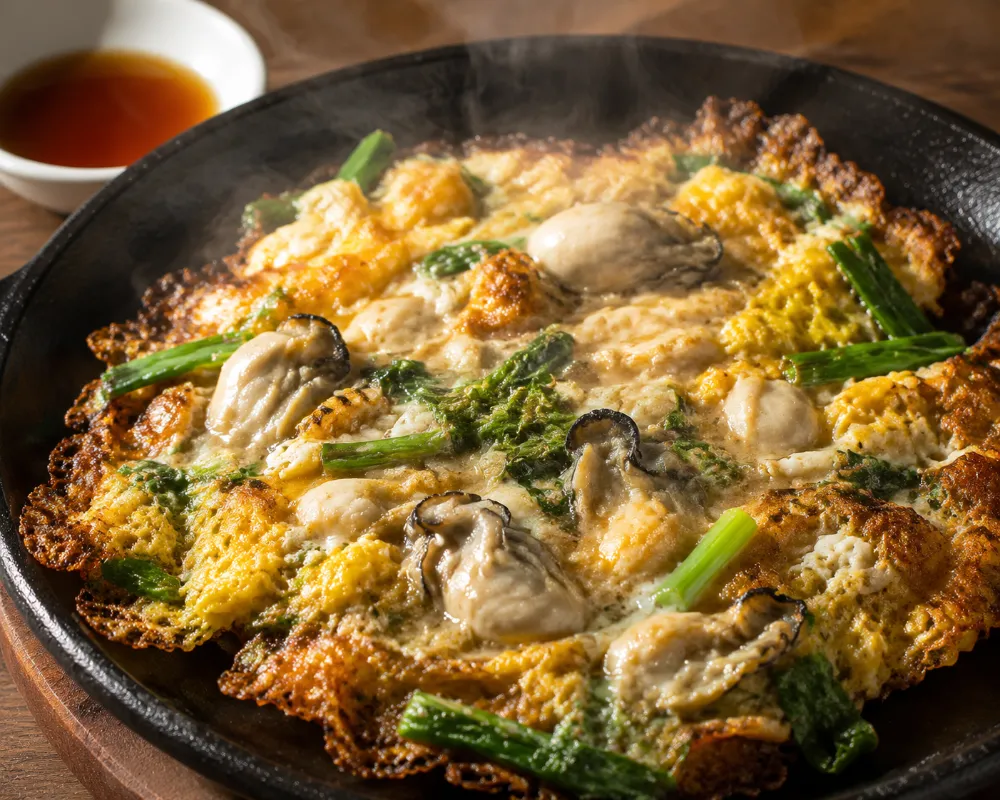
If you ask anyone who’s eaten through Chaozhou to name the one snack they’d send a friend back to find, this is usually the answer. The oyster omelette, called háo luò in Mandarin and orh luak in the Teochew dialect, is what happens when fresh oysters, egg, and sweet potato starch collide in a well-seasoned, very hot pan. The result is not a uniform omelette in the Western sense: the egg and starch create a hybrid texture where some parts are crisped and almost lacy at the edges while others remain custardy and yielding inside, the oysters distributed throughout in varying states of doneness depending on how long they’ve been in contact with the heat.
The version sold at roadside stalls in Chaozhou is typically eaten with fish sauce on the side, drizzled from a small pour bottle at the table. The combination makes immediate sense: the brininess of the oysters plus the umami depth of fish sauce, tempered by the slightly starchy sweetness of the base and the richness of the egg. Getting a good one means getting it from a stall that’s selling enough volume to keep the pan genuinely hot, because oyster omelette suffers immediately when the pan isn’t up to temperature. The edges go soft, the starch gets gluey, and the whole thing collapses into something that tastes technically correct but texturally wrong.
The best versions in Chaozhou can be found on Changsheng Lane and around the food streets near the old city walls after about six in the evening. Look for stalls with a queue and a pan that’s audibly crackling from ten feet away.
Teochew Beef Balls (牛肉丸 / Niúròu Wán): The Bouncy Standard
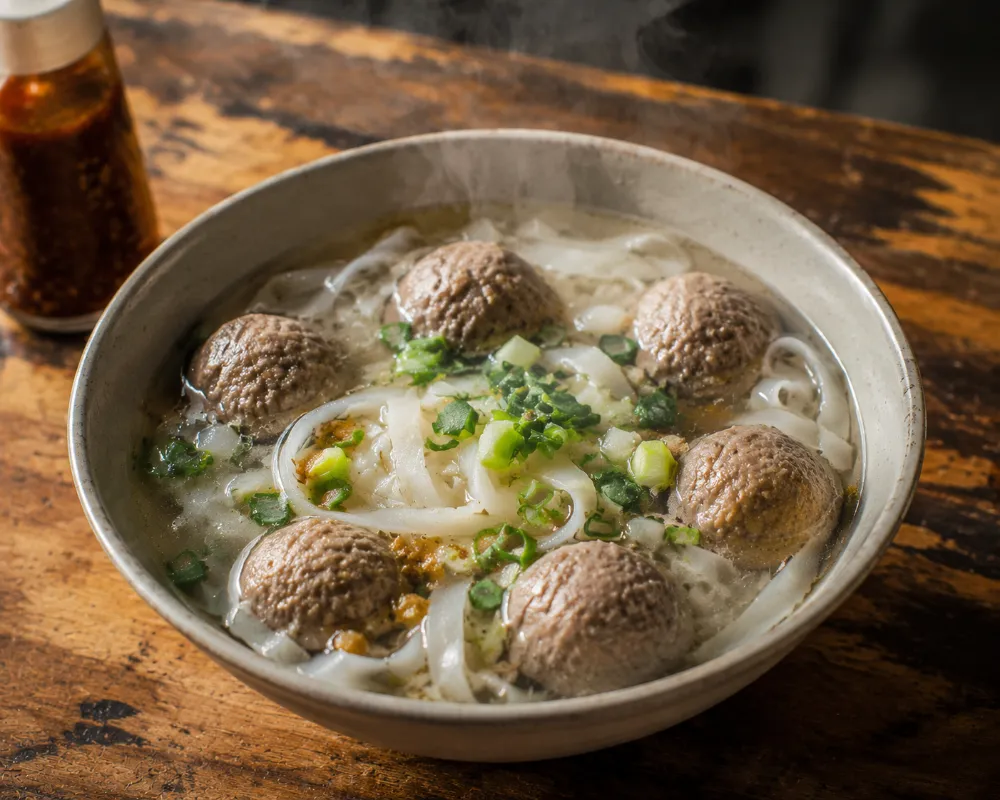
Teochew beef balls have a reputation that precedes them, and for once, the reputation is accurate. These are not the same thing as the generic beef balls that turn up in Southeast Asian noodle soups across the region, even though Teochew diaspora communities are largely responsible for spreading that category throughout Malaysia, Singapore, Thailand, and Vietnam. The authentic Chaozhou version is made by hand-beating fresh beef for extended periods, sometimes thirty minutes or more, until the proteins align in a way that creates an almost springy, bouncy texture when the balls are formed and cooked. A properly made Teochew beef ball shouldn’t yield softly when you bite it; it should resist your teeth for a fraction of a second before giving way cleanly, releasing a rush of concentrated beef juice from the inside.
On the street, beef balls are typically served in a clear, lightly seasoned bone broth with rice noodles (kueh teow), a scattering of green onion, and sometimes a small dish of preserved vegetables on the side. The soup itself is not supposed to be heavily flavored: it’s a vehicle for the beef balls and noodles, not a destination on its own. Fish sauce and white pepper are the standard table condiments. The contrast between the delicate broth and the intensely flavored balls is deliberate and represents the kind of textural and flavor balancing that characterizes Teochew cooking broadly.
The production method for hand-beaten beef balls is genuinely labor-intensive, and there’s an ongoing tension in Chaozhou between older producers who maintain the traditional approach and newer operations that use mechanical beating to speed up the process. The textural difference is detectable: machine-beaten beef balls tend to be uniform and slightly springy, while the hand-beaten version has a more complex internal texture with some variation between the outer edge and the center. If you find yourself at a stall where the proprietor is actively demonstrating or discussing the production method, that’s usually a good sign.
Teochew Porridge (潮州糜 / Cháozhōu Mí): Understanding How Breakfast Works Here
Teochew mue, the local congee, is an entirely different animal from the thick Cantonese congee that most Westerners encounter first. Where Cantonese congee is cooked until the rice breaks down into a smooth, creamy consistency, Teochew mue is essentially watery rice: the grains stay largely intact, the liquid is very thin, and the whole bowl is considerably more austere in flavor than a Cantonese equivalent would be. This is not a flaw. It’s a deliberate design choice that reflects the role congee plays in the meal: it’s the neutral base around which a whole constellation of small accompanying dishes rotates.
Those accompanying dishes are where the real interest lies. A typical Teochew mue setup involves a plain bowl of rice porridge surrounded by small plates of various pickled, braised, steamed, and preserved items: salted vegetables, marinated tofu, braised pork belly, preserved radish, pickled cucumber, dried fish, braised egg. Each is intensely flavored on its own, meant to be eaten in small quantities against the neutral backdrop of the congee. The logic is one of contrast and balance rather than layering: strong against mild, preserved against fresh, rich against plain.
This is both a street food and an at-home staple, and the distinction between the two isn’t always sharp. Many of the best mue stalls in Chaozhou operate in the early morning and late evening, reflecting the tradition’s role as a comfort food eaten at the edges of the day when something restorative and uncomplicated is wanted. The food streets around West Lake Park are particularly associated with good mue setups.
Braised Goose (卤水狮头鹅 / Lǔshuǐ Shītóu É): The Most Celebrated Teochew Product
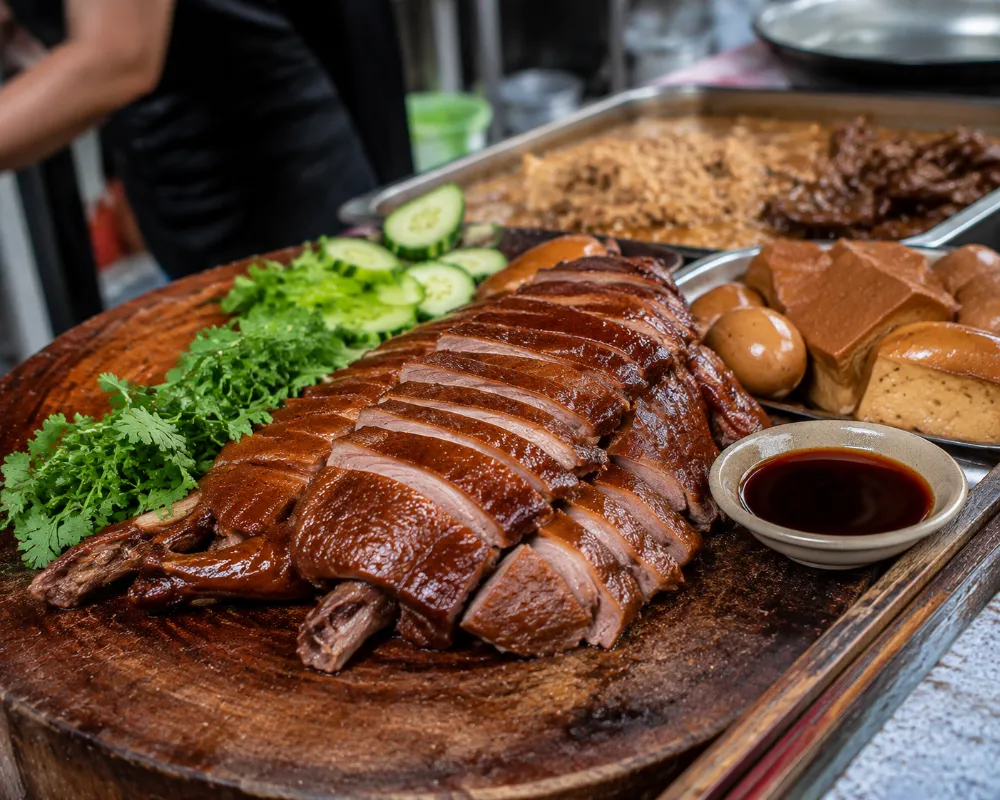
Calling braised goose a “street food” is a slight stretch, since the most revered versions are served in proper restaurants. But braised goose appears at street level too, sold cold from braise pots at market stalls, and it represents such a fundamental expression of Teochew culinary values that no guide to Teochew snacks would be complete without addressing it.
The goose used is the lion-head goose, a breed specific to the Chaoshan region, notably larger than standard goose breeds and prized for its head and neck sections which develop an unusually deep, gelatinous richness when braised. The braise itself is built from a foundation of light soy sauce, dark soy, rock sugar, rice wine, and a supporting structure of star anise, cinnamon, galangal, and a few other aromatics, cooked in what is often called a perpetual braise: a pot that has been maintained continuously for months or years, its flavor deepening with each addition of new goose and regular replenishment of liquid. The resulting meat is tender without being soft, deeply savory without being salty, and carries the accumulated complexity of a braise that has been active for a long time.
At street stalls, braised goose is sold by weight, sliced to order, and typically accompanied by a thick, concentrated braise reduction poured over the top plus small dishes of braised tofu, braised egg, braised intestine, or braised trotter. The goose head and neck sections command premium prices because the gelatinous collagen content makes them particularly prized. A five-year-old lion-head goose head can sell for over 1,200 yuan while the body itself costs only around 300 yuan, which gives some sense of how specifically the local market values these anatomical details.
Png Kueh (粿 / Guǒ): Rice Dumplings That Tell the Cultural Story
The Teochew category of guǒ, rice-flour dumplings and cakes of various kinds, represents one of the most distinctive and culturally loaded aspects of the food tradition. Png kueh, also written as pâng-guê, are steamed glutinous rice dumplings typically filled with peanuts, mushrooms, shrimp, garlic chives, or sweet filling depending on the specific variety, wrapped in a translucent rice-flour skin and often pressed in wooden molds that give them a characteristic floral or geometric shape.
What makes them more than just a food item is their role in local ritual life. Png kueh are central to ancestral worship offerings, temple festivals, and celebratory meals, and the specific shapes and fillings often carry symbolic meanings tied to prosperity, longevity, or specific seasonal celebrations. You’ll see them piled in temple offerings throughout Chaozhou and hear vendors explain their cultural significance with a fluency that reflects how deeply this knowledge is embedded in daily life rather than learned for tourism purposes.
The skin texture, when well-made, is delicate and slightly chewy without being gummy, and the whole thing has a subtler quality than many Southeast Asian rice dumplings: where Malaysian or Singaporean versions of related dishes tend toward stronger flavors and more assertive seasonings, the Chaozhou original tends toward the restrained end of the flavor spectrum. They’re available throughout the day at snack stalls in the old city, and the morning markets near the city gate are usually a good place to find freshly steamed versions.
Marinated Raw Seafood (腌制海鲜 / Yānzhì Hǎixiān): The Dish That Requires Some Commitment
This is the Chaozhou dish that earns the local nickname “Chaoshan poison”: so called because many people approach it with significant hesitation, try a small amount to be polite, and then find themselves ordering it repeatedly for the rest of their time in the city. Raw crab or raw shrimp marinated in garlic, chili, soy sauce, and sometimes additional aromatics, served cold. The texture is unlike anything that cooking produces: soft, jellylike in places, with the natural sweetness of fresh seafood running through every bite, and the marinade providing a controlled sharpness that makes the whole thing feel intentional rather than undercooked.
The dish requires premium-quality, absolutely fresh seafood, which is why Chaozhou has always been one of the places most associated with it: the Chaoshan coast’s fishing tradition and the tight relationship between local fishermen and local restaurants means that the supply chain is short and the freshness is verifiable. This is not something to attempt at a stall that doesn’t look busy or that seems to be selling it as a novelty. It should be offered at places where locals are actively ordering it, ideally where the proprietor can point to where the seafood came from that morning. The standard approach for first-timers is to have it with plain Teochew porridge, which tempers the intensity and provides a stomach-friendly counterpoint.
Teochew Beef Hotpot (牛肉火锅 / Niúròu Huǒguō): The Evening Institution
Teochew beef hotpot is less a snack than a full meal format, but it appears extensively in street-level contexts and night market settings that make it relevant here. The setup involves a small gas-heated clay pot of clear, lightly flavored broth, a plate of thinly sliced fresh beef, and a rotating series of dipping sauces: fish sauce, shacha sauce (a complex condiment made from soybean oil, garlic, dried seafood, and chili), and sometimes a simple soy-ginger combination.
The beef is sliced extremely thin and cooked very briefly, ten to fifteen seconds in actively simmering broth for most cuts. This matters enormously: overcooked Teochew beef becomes tough and loses the clean, fresh-beef flavor that makes the dish work. The best spots in Chaozhou know this and may display signs or advice about cooking times for different cuts. Common cuts include thin slices of brisket, ribeye cap, and various offal preparations that carry different textures and cooking requirements. A note from practical experience: avoid having beef hotpot immediately after eating braised olives or other olive preparations, as the combination is said to upset the stomach, and locals take this warning seriously enough that many hotpot stalls post it explicitly.
Gongfu Tea: The Ritual That Frames Every Street Food Session
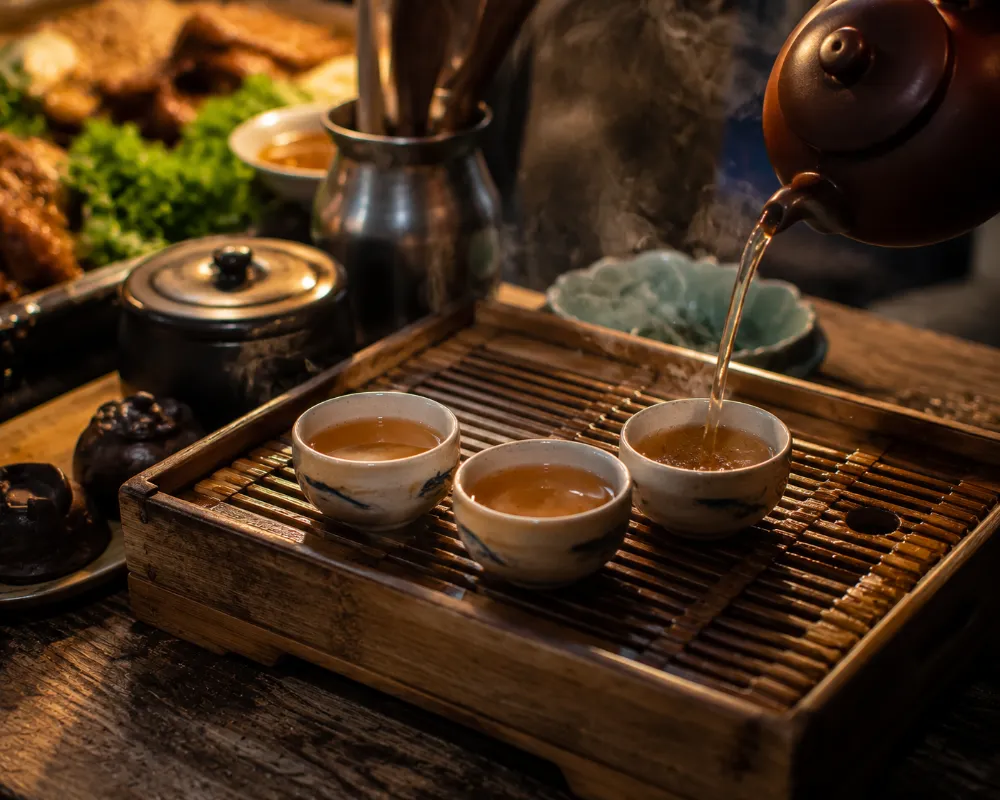
Teochew snacks don’t exist in isolation from tea. The Gongfu tea tradition, centered on a concentrated brewing method using small clay teapots, miniature cups, and very high leaf-to-water ratios, is so deeply embedded in Chaozhou daily life that trying to understand the food without it misses a significant dimension of how eating is experienced here. Gongfu cha, which translates roughly as “skillful tea” or “tea with effort,” involves pouring small quantities of strong oolong (typically Tieguanyin or a local variety) through a sequence of steeps that produces an evolving flavor profile across the session. The first pour is often discarded as a warm-up; subsequent pours vary in strength and character depending on the leaf.
The function of tea in a Teochew snack session is palate-cleansing and digestive: the tannins cut through the richness of braised dishes, the bitterness resets the mouth after something sweet, and the warmth of the cup between bites provides a kind of punctuation to the meal that slows down the experience and creates something more contemplative than a rushed street food session might otherwise be. Many snack stalls maintain a tea setup alongside the food, and being offered tea at a stall is a normal hospitality gesture rather than a commercial one.
Where to Find Teochew Snacks: Streets and Neighborhoods Worth Knowing
In Chaozhou proper, the old city area around Paifang Street (牌坊街, also called Archway Street) is the most obvious starting point. The street itself is busy and commercial, with stalls concentrated and accessible, though locals will often direct you to the parallel lanes (Yi’an Road, Changli Road, Xi’ma Road) where the food is considered more authentic and the crowds thinner. The morning market near Chaozhou’s west gate is active from around five in the morning and is where locals do their actual daily provisioning, with fresh-cooked snacks running alongside raw ingredient vendors.
The area around West Lake Park offers a quieter, more neighborhood-scale snack scene, with a few specific stalls that have maintained loyal local followings for decades rather than pivoting to accommodate tourist expectations. Xie Huailiang’s sesame tea and fried tofu near the park is mentioned consistently enough in local food conversations to suggest it’s worth seeking specifically rather than stumbling across.
In Shantou, which sits south of Chaozhou and represents the other major Chaoshan food city, Zhenbang Road concentrates a higher density of time-honored snack shops than most other streets in the city. Beef balls and oyster omelette are particularly associated with this area. Longyan South Road runs a wider range of Chaoshan food across the meal spectrum and is worth a full evening walk.
Practical Notes for First-Time Visitors
Teochew snacks are almost universally served at tables that facilitate sharing, and the meal format is strongly collective rather than individual. Arriving solo at a street food session is fine, but the experience changes when multiple people are ordering across a wider range of items, since the contrast between dishes is part of the design. The combination of a braise plate, a bowl of congee, and one or two vegetable or pickled preparations is the standard structure of a Teochew snack meal rather than a sequence of courses.
Condiment fluency matters here more than in many cuisines. Fish sauce, shacha, garlic vinegar, and the specific sauces paired with individual dishes aren’t interchangeable; local vendors will usually indicate which condiment belongs with which dish, and following their lead is more likely to produce a coherent eating experience than improvising. This is particularly true for braise dishes, where the concentrated braise reduction that’s poured over sliced goose or duck is not a sauce you’d want on the oyster omelette.
Budget expectations: Teochew street food is extremely affordable by most standards. A full street snack session including beef ball soup, oyster omelette, a portion of braised items, and tea typically comes to between 30 and 80 yuan per person depending on which items and how much braised goose is involved. The lion-head goose head sections will push the budget upward significantly if ordered.
Frequently Asked Questions
What are the most famous Teochew snacks?
The most recognized Teochew snacks include the oyster omelette (háo luò), hand-beaten beef balls served in clear broth, Teochew porridge (mue) with accompanying small dishes, braised goose, png kueh rice dumplings, and marinated raw seafood. The beef hotpot, while a fuller meal format, is also essential to the Teochew street food experience.
Is Teochew food spicy?
Generally no. Teochew cuisine emphasizes freshness and natural flavors, and most dishes are mild by Chinese standards. Fish sauce provides a savory depth, shacha sauce adds a gentle complexity, and there may be chili in some dipping sauces, but the dominant flavor profile is clean and restrained rather than spicy or heavily seasoned. This is one of the features that distinguishes it from the cuisines of neighboring regions.
What is the difference between Teochew and Cantonese food?
Both cuisines share an emphasis on fresh ingredients and relatively light seasoning compared to other Chinese regional traditions, but Teochew cooking uses even less oil and has a stronger emphasis on braising, raw marinated preparations, and fish sauce as a primary condiment. Teochew porridge is notably different from Cantonese congee, and the perpetual braise technique used for duck and goose is distinctly Teochew.
Where is the best place to eat Teochew street food?
In Chaozhou, the old city area around Paifang Street and the lanes that run parallel to it are the most accessible. The West Lake Park area offers more local-facing options. In Shantou, Zhenbang Road and Longyan South Road are recommended. Looking for stalls where locals are actively eating, rather than stalls positioned specifically for tourist traffic, consistently produces better results.
What is Gongfu tea and why is it served with Teochew food?
Gongfu tea is a concentrated brewing method using small clay teapots and miniature cups, typically with oolong tea. It’s deeply embedded in Chaozhou daily life and accompanies meals as a palate cleanser and digestive aid. The bitterness of the tea cuts through rich braise flavors, the warmth provides comfort between dishes, and the ceremonial aspect slows the eating experience down in a way locals consider integral to eating well.