Ask ten different Hong Kong locals when the best month to visit the city is, and you’ll get “November” from at least seven of them. That’s not a coincidence, and it’s not just civic pride talking. November sits in the narrow sweet spot between the sticky, typhoon-prone summer and the occasional damp chill of deep winter, and the numbers back up the reputation: this is statistically the driest, sunniest, and most comfortable month on the Hong Kong Observatory’s calendar. If you’re trying to figure out what weather in Hong Kong, China in November actually looks like before you book flights, pack a suitcase, or plan a rooftop dinner, this guide walks through everything the data (and plenty of on-the-ground experience) can tell you.
We’ll cover average temperatures by day and by week, how much rain actually falls, humidity levels, sunshine hours, wind and sea conditions, the honest truth about typhoon risk this late in the season, and a practical packing list that accounts for Hong Kong’s odd habit of being warm outside and freezing cold inside thanks to aggressive air conditioning. There’s also a season-by-season comparison table near the end if you’re weighing November against October or December for your trip dates.
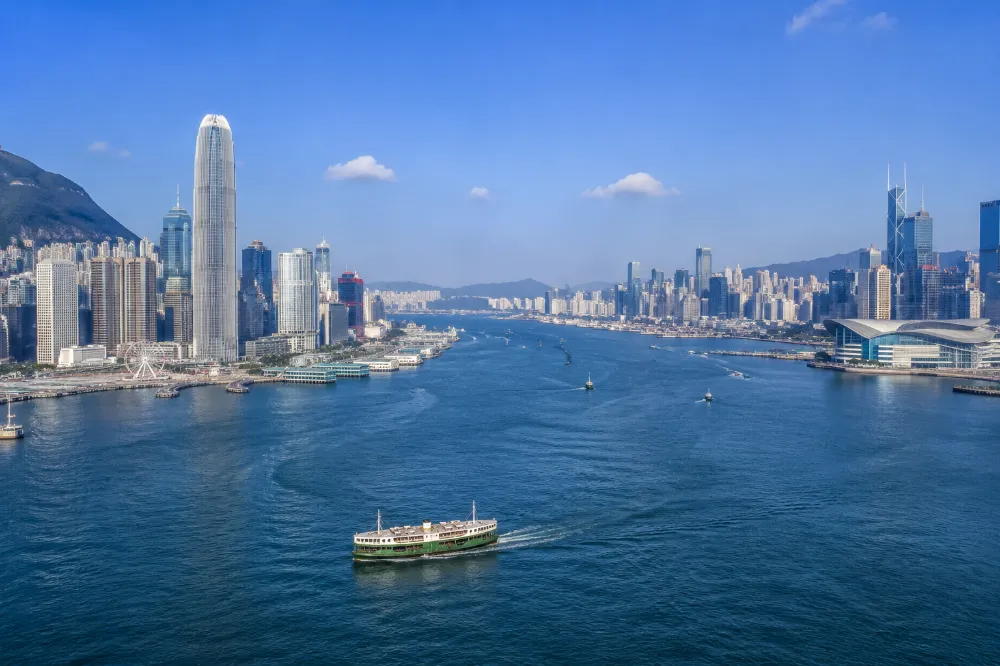
Hong Kong Weather in November at a Glance
If you only have thirty seconds, here’s the short version. Based on the Hong Kong Observatory’s official 1991–2020 climatological normals, November looks like this:
- Average high temperature: 24.5°C (76°F)
- Average temperature: 22.2°C (72°F)
- Average low temperature: 20.3°C (68.5°F)
- Total monthly rainfall: around 39.3mm (1.55 inches), among the lowest of any month
- Rainy days: roughly 5–6 days with measurable rain, and most of those are brief
- Average relative humidity: about 72%, down sharply from the 80%+ humidity of summer
- Sunshine: around 172 hours for the month, or roughly 5.5–6 hours of bright sunshine a day
- Sea surface temperature: around 23.6–24°C (74–75°F), still swimmable early in the month
- Typhoon risk: low, but not officially zero
In plain English: expect warm, dry, breezy days, cool evenings that call for a light layer, and a sky that’s blue far more often than it’s grey. Now let’s get into why, and what that actually feels like on the ground.
Why November Has a Reputation as Hong Kong’s Best Month
Hong Kong’s climate runs on two monsoons. The wet, humid, south-westerly monsoon dominates from May through September, dragging in the heat, the downpours, and the typhoon threat that defines a Hong Kong summer. Somewhere around mid-October, the wind pattern flips. The north-east monsoon takes over, pulling in drier air from inland China, and the whole city seems to exhale. Humidity drops, the haze that sometimes sits over Victoria Harbour in summer starts to clear, and temperatures settle into a range that’s genuinely pleasant rather than merely survivable.
November is when this transition is at its most complete. October can still carry leftover summer humidity and, occasionally, a late-season typhoon. December starts to introduce the first properly cold snaps, especially in the second half of the month when cold fronts from northern China begin sweeping through. November threads the needle: warm enough for short sleeves at midday, cool enough for a jacket after sunset, and dry enough that you can plan an entire week of outdoor activities without seriously worrying about rain wrecking your itinerary.
There’s also a practical, human reason November feels so good in Hong Kong: it’s the one month where the city’s brutal humidity mostly steps aside. Anyone who has walked from an air-conditioned MTR platform into the open air in July knows the sensation of a wall of wet heat hitting your face. In November, that wall simply isn’t there. The air feels lighter, breathing feels easier, and walking up a flight of outdoor stairs no longer feels like a workout.
Average Temperature in Hong Kong in November
Temperature is really the headline story here, so it’s worth breaking down properly. According to Observatory data collected at the main station over three decades, the mean daily maximum in November sits at 24.5°C (76°F), the overall monthly mean is 22.2°C (72°F), and the mean daily minimum is 20.3°C (68.5°F). Those are averages across the whole month, though, and November has a noticeably split personality depending on which week you land in.
| Period | Typical Daytime High | Typical Overnight Low | Feel |
|---|---|---|---|
| Early November (1st–10th) | 26–28°C (79–82°F) | 21–23°C (70–73°F) | Still summery; short sleeves, sandals, and a light breeze |
| Mid-November (11th–20th) | 24–26°C (75–79°F) | 19–21°C (66–70°F) | Warm afternoons, genuinely cool nights; a light jacket earns its place |
| Late November (21st–30th) | 21–24°C (70–75°F) | 16–19°C (61–66°F) | Proper autumn; scarves and closed shoes come out, especially after dark |
Notice how much ground gets covered in a single month. It’s entirely possible to arrive in Hong Kong on November 3rd wearing a t-shirt and shorts, and land on November 27th needing a light coat for the evening. This is one of the most common surprises for first-time visitors who pack based on a single “average” temperature they found online rather than accounting for the drift across the month. If your trip falls in the back half of November, don’t assume it will feel identical to the front half.
Year-to-year variation matters too. Because of natural climate variability, some Novembers run a degree or two warmer or cooler than the long-term normal, and cold surges from mainland China can occasionally arrive earlier than usual, pushing a few days in the second half of the month down into the mid-teens Celsius overnight. It doesn’t happen every year, but it happens often enough that a light jacket is a non-negotiable packing item, not an optional extra.
Rainfall and Humidity: The Dry Season Really Delivers
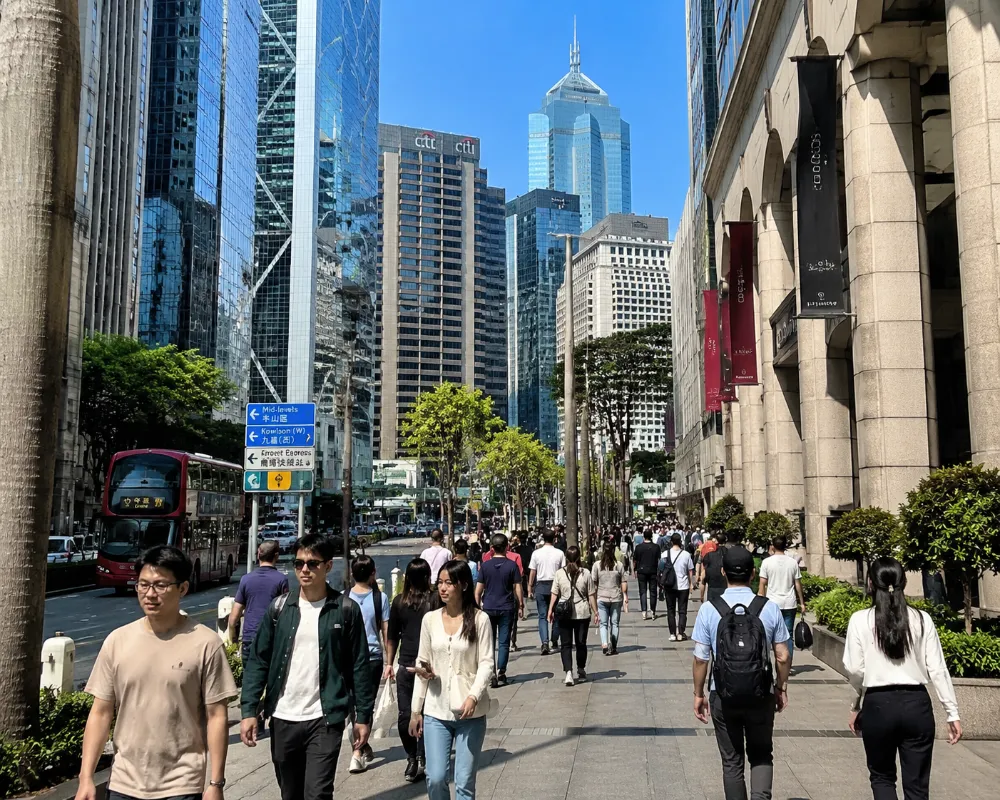
If Hong Kong’s summer is defined by rain, November is defined by its absence. The Observatory’s long-term data puts total November rainfall at just 39.3mm, spread across roughly 5.7 days with measurable precipitation. Compare that to June, which averages nearly 500mm, or even October, which still sees over 120mm, and the contrast is stark. Only January and December are drier than November across the entire calendar year.
What this means practically: on any given day in November, the odds are heavily in your favor for staying dry. When rain does show up, it tends to be a passing shower tied to a cold front pushing through, rather than the sustained, thunderous downpours typical of the summer wet season. Thunderstorms are almost a non-event in November — the Observatory records an average of less than a quarter of a day with thunderstorm activity for the entire month, essentially the quietest thunderstorm month of the year alongside December and January.
Humidity tells a similarly comfortable story. Average relative humidity for the month sits around 72%, and it swings noticeably across the day: mornings run damper, often near 77%, while afternoons dry out to somewhere around 65%. For context, summer humidity in Hong Kong routinely sits above 80% around the clock, which is what makes the city feel so oppressive between June and September. The drop to the low-to-mid 70s in November is the single biggest reason people describe the month as “finally breathable.”
One small side effect worth knowing about: lower humidity means drier skin and, for many visitors, drier sinuses than they’re used to in a subtropical city. It’s a minor thing, but a bit of moisturizer and lip balm in your day bag isn’t a bad idea, especially if you’re coming from a more humid climate and your skin isn’t used to the adjustment.
Sunshine, Sky Conditions, and UV Levels
November is one of the sunniest months on the Hong Kong calendar, trailing only October in terms of bright sunshine duration. The Observatory logs an average of about 172 hours of bright sunshine across the month, which works out to a little under six hours of genuine, unobstructed sun per day. Cloud cover averages around 58%, noticeably lower than the 70–80% range typical of spring and early summer, when low cloud, drizzle, and hill fog are common. In practice, this means more blue-sky days for harbour photos, clearer views from Victoria Peak, and a much better shot at catching an unobstructed sunset over the western hills.
UV exposure drops accordingly. November sits alongside January and December as one of the three months with the lowest average UV index of the year, typically peaking around a maximum of 7 rather than the 11–12 readings common in summer. Sunscreen is still worth applying if you’re spending hours outdoors at midday — Hong Kong’s latitude means the sun is never entirely gentle — but the burn risk is dramatically lower than it would be in July or August, and you’ll likely find you need far less reapplication over the course of a day.
Daylight hours run close to eleven hours in November, with sunrise typically somewhere around 6:40–6:50am and sunset landing between roughly 5:45 and 5:55pm depending on where in the month you are. That’s a meaningfully earlier sunset than visitors from summer-heavy travel seasons might expect, so if photography or golden-hour views from The Peak or the Star Ferry are on your list, plan your late-afternoon schedule accordingly rather than assuming you have until 7 or 8pm of usable light.
Wind, Sea Conditions, and Whether You Can Still Swim
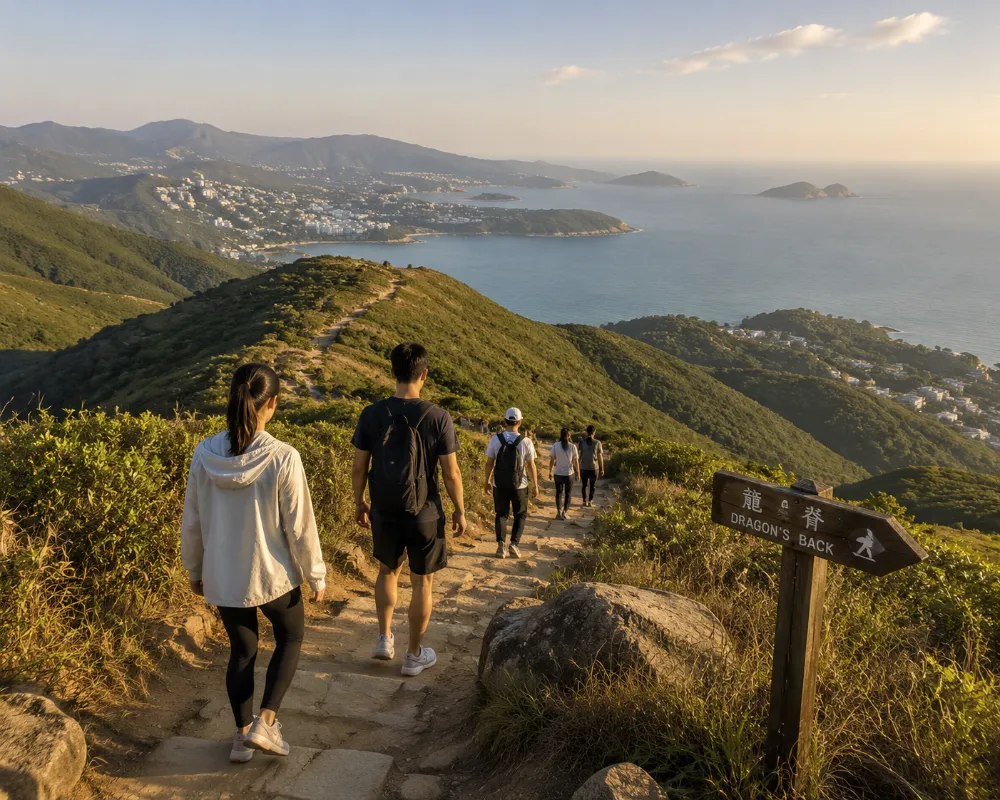
The north-east monsoon that defines Hong Kong’s autumn and winter brings a steady, noticeable breeze, generally blowing out of the east at around 10 km/h at the main Observatory station, though exposed coastal points like Waglan Island regularly see averages closer to 25–27 km/h. This isn’t storm-force wind by any stretch, but it’s enough to make outdoor dining feel pleasant rather than sticky, to occasionally rattle window units, and to make a light windbreaker genuinely useful on ferry rides or hikes along exposed ridgelines like Dragon’s Back or the MacLehose Trail.
There’s also a recurring weather phenomenon locally called the Strong Monsoon Signal, which the Observatory issues on average around 4.3 days in November, more than any other single month. This signal means sustained strong winds, usually from cold surges pushing down from the north, and it can affect outlying ferry schedules, high-rise construction work, and outdoor event planning. It’s not dangerous for typical sightseeing, but if you’re planning a day trip to one of the outer islands like Lamma or Cheung Chau, it’s worth a quick check of ferry status on days when a Strong Monsoon Signal is in effect, since sailings can occasionally be adjusted.
As for swimming: sea surface temperatures around Hong Kong average between roughly 23.6°C and 24°C in November, measured at monitoring points like North Point and Waglan Island. That’s still comfortably swimmable for most people, particularly in the first half of the month, though it’s noticeably cooler than the 26–27°C water of peak summer. Beaches like Repulse Bay and Shek O remain open, and you’ll still see swimmers, though the crowds thin out considerably compared to the July and August rush. By the back half of November, most casual swimmers switch to admiring the water rather than getting in it.
Typhoon Risk in November: What the Data Actually Shows
This is the question most people actually care about, so let’s answer it directly using the Observatory’s own numbers. Across the 1991–2020 normal period, Hong Kong averages just 0.57 days per November with any tropical cyclone warning signal in effect at all (that’s the lowest-level No. 1 standby signal or higher). The stronger No. 3 strong wind signal averages only 0.13 days. The more serious No. 8 gale or storm signal, the one that actually shuts down the city — closing schools, offices, and most public transport — averages effectively zero days in November based on three decades of data.
Put another way: in a typical year, November passes without any typhoon signal being hoisted at all. When something does develop, it’s far more likely to be a distant system that brushes past Hong Kong with a bit of wind and cloud than a direct, city-stopping hit. Compare that to August or September, where a No. 1 or higher signal is essentially expected in most years, and November looks like an entirely different season.
That said, “extremely low” isn’t the same as “impossible.” The South China Sea and western Pacific don’t strictly obey a calendar, and tropical systems have occasionally formed or lingered into November in the broader region, even if a direct hit on Hong Kong itself is rare this late in the year. If you’re the type of traveler who likes to plan for edge cases, it’s worth glancing at the Observatory’s tropical cyclone tracking page a few days before you fly, purely as a precaution rather than a genuine expectation. For the overwhelming majority of visitors, though, typhoon risk in November is a non-issue, and it’s one of the main reasons the month is so popular with both tour groups and independent travelers.
Week-by-Week: How the Weather Shifts Across the Month
Because November covers such a wide range of conditions, it helps to think of it in three distinct phases rather than one uniform “November weather.”
Early November: The Last Echo of Summer
The first ten days or so can still feel like an extension of October. Daytime highs frequently reach the high 20s Celsius, humidity hasn’t fully dropped off yet, and it’s entirely possible to spend an afternoon in a t-shirt without a second thought. This is a good window for beach days, outdoor markets, and anything involving a lot of walking in direct sun, since the heat is manageable without being oppressive.
Mid-November: Hong Kong’s Sweet Spot
This is the stretch most locals mean when they talk up November as the city’s best month. Days are warm without being hot, nights are cool enough to be genuinely refreshing, humidity has settled into a comfortable range, and rain is rare. It’s peak hiking season on trails like Dragon’s Back and Lion Rock, peak season for outdoor dining terraces, and generally the most forgiving stretch of weather for a jam-packed sightseeing itinerary.
Late November: Autumn Properly Arrives
By the last week or so of the month, the north-east monsoon is fully established, and the occasional cold surge from mainland China can drop overnight temperatures into the mid-to-high teens Celsius. Daytime highs are still pleasant, generally in the low-to-mid 20s, but the temperature swing between day and night becomes much more noticeable. This is when you’ll start seeing locals in scarves and light coats in the evenings, even if the afternoon still feels mild.
What to Wear in Hong Kong in November
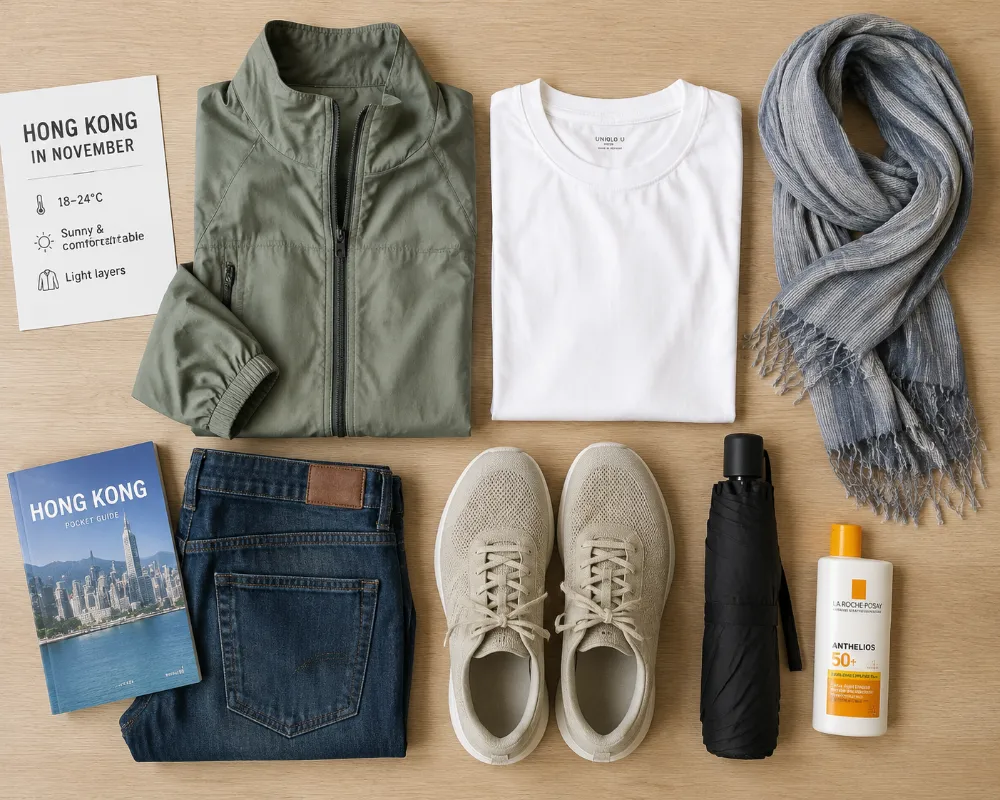
Packing for Hong Kong in November comes down to one word: layers. The temperature swing across a single day — let alone across the month — is wide enough that a single outfit rarely covers everything from a midday walk through Central to a rooftop dinner after sunset.
- Base layer: Short-sleeve shirts and breathable fabrics for daytime, especially early in the month when highs still push toward 27–28°C.
- Mid layer: A light long-sleeve shirt or thin sweater for evenings, when temperatures can drop 6–8°C from the daytime peak.
- Outer layer: A packable light jacket or windbreaker, particularly for late November or for evenings on the harbourfront where the breeze picks up.
- Footwear: Comfortable walking shoes for hilly terrain and long MTR-to-street transitions; sandals are fine early in the month but less practical after mid-November evenings cool down.
- Rain protection: A compact umbrella or light rain jacket is worth packing, but you likely won’t need it more than once or twice, if at all.
- Sun protection: Sunglasses and a light sunscreen, since UV is lower than summer but not absent, especially around midday.
- Indoor consideration: This one surprises a lot of visitors — Hong Kong’s shopping malls, restaurants, and the MTR often run air conditioning aggressively even once outdoor temperatures have cooled. A light cardigan or shawl in your day bag solves the “too cold indoors, too warm outdoors” problem that catches out a lot of first-time visitors.
If your trip spans both early and late November, pack for both. It sounds excessive to bring both a t-shirt and a proper jacket for a single trip, but given how much the month shifts, you genuinely might use both within the same 24 hours, especially if your itinerary includes an evening ferry ride or a sunset viewpoint where the wind picks up.
Best Things to Do in Hong Kong’s November Weather
The dry, mild, low-humidity conditions of November open up activities that are genuinely uncomfortable or risky during the summer months. If you’re building an itinerary around the weather rather than despite it, here’s where November conditions shine.
Hiking
Hong Kong has an outsized reputation among hikers for a city its size, and November is prime season for it. Trails like Dragon’s Back, the Wilson Trail, and sections of the MacLehose Trail that would be a sweaty, humid slog in July become genuinely enjoyable in November’s cooler, drier air. Visibility also improves as haze clears, which matters a lot on ridgeline trails where the entire appeal is the view.
Rooftop bars and outdoor dining
Hong Kong’s skyline-view rooftop bars and terraces are at their best in November. The heat and humidity that make outdoor seating unbearable in summer are gone, but it’s not yet cold enough to need heat lamps. Evening reservations on open-air terraces around Central and Tsim Sha Tsui are genuinely more pleasant this month than almost any other.
Harbourfront walks and photography
Clearer skies and lower humidity mean better visibility across Victoria Harbour, which translates directly into better photos from vantage points like the Tsim Sha Tsui promenade, Victoria Peak, or the Central and Western District waterfront. The Symphony of Lights show is also more visually striking on clear nights, which are far more common in November than in the hazier, more humid months.
Outlying island day trips
Lantau, Lamma, Cheung Chau, and Peng Chau are all considerably more appealing in November’s mild, dry conditions than in the sticky heat of summer. Cycling on Lamma, hiking the Cheung Chau family trail, or visiting the Big Buddha and Po Lin Monastery on Lantau are all activities that benefit enormously from lower humidity and a lower chance of a rain-soaked afternoon.
Events and Festivals Timed Around November’s Weather
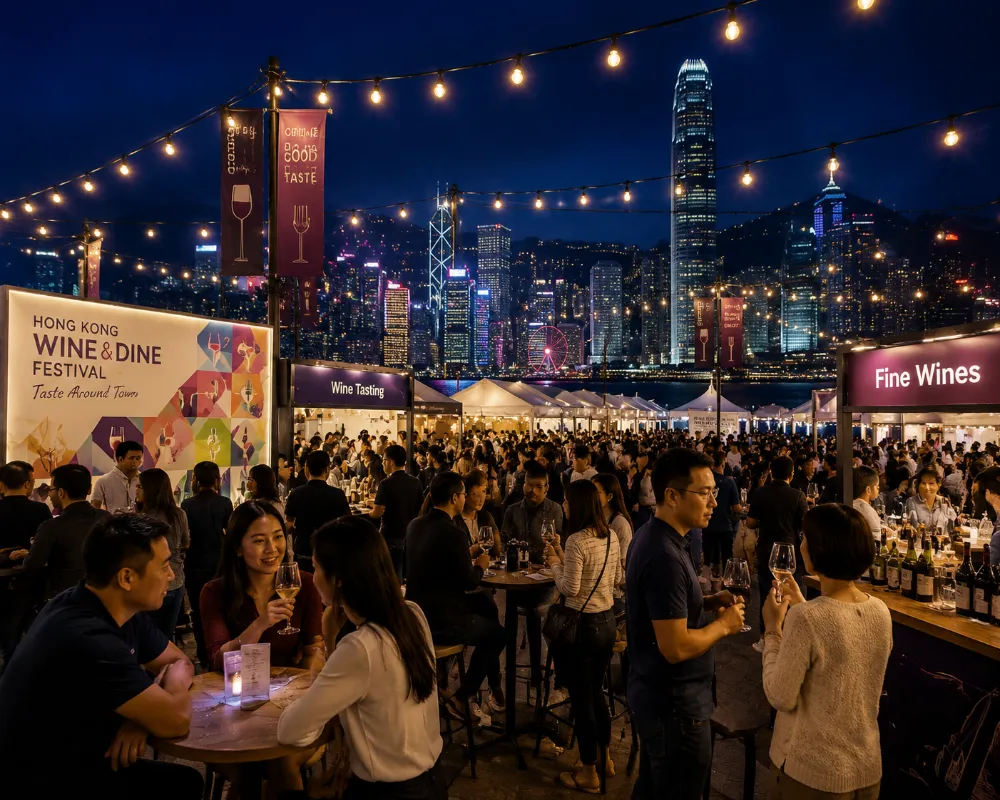
It’s not a coincidence that Hong Kong schedules a disproportionate number of its biggest outdoor events for November. Event organizers know exactly what the Observatory’s data shows, and they build around it.
The Hong Kong Wine & Dine Festival, one of the city’s signature culinary events, typically runs across the late October to early November window at the Central Harbourfront Event Space, bringing together hundreds of food and drink booths, live entertainment, and tasting workshops in an entirely outdoor setting that simply wouldn’t work in the humidity of a summer month. It’s usually followed by a city-wide “dining around town” promotion that stretches across much of November, with participating restaurants and bars throughout Hong Kong Island, Kowloon, and the New Territories offering special menus.
Trade events like the Hong Kong International Wine & Spirits Fair also land in early November, drawing exhibitors from dozens of countries to the Hong Kong Convention and Exhibition Centre. On the more active end of the spectrum, November’s dry, cool conditions make it a popular month for outdoor trail-running events across Lantau and the New Territories, along with open-air cultural programming at venues like the West Kowloon Cultural District, which relies on predictable, rain-free evenings for its outdoor performances and exhibitions.
If your travel dates are flexible, checking what’s on during your specific November week is worth the five minutes it takes, since Hong Kong’s outdoor event calendar is genuinely denser this month than in almost any other.
November vs. October vs. December: Which Should You Pick?
If you have some flexibility in your travel dates, it’s worth seeing how November stacks up against the months on either side of it.
| Factor | October | November | December |
|---|---|---|---|
| Average high | 28°C (82°F) | 24.5°C (76°F) | 20.4°C (69°F) |
| Average low | 23.9°C (75°F) | 20.3°C (68.5°F) | 16.2°C (61°F) |
| Rainfall | ~120mm | ~39mm | ~29mm |
| Humidity | ~73% | ~72% | ~70% |
| Typhoon risk | Low but real (still active season) | Very low | Essentially none |
| Crowds | High (Golden Week spillover, National Day holiday) | High but more spread out | High (Christmas, year-end lights) |
October is warmer and still carries a small residual typhoon risk, along with heavier crowds tied to China’s National Day Golden Week in the first week of the month. December is drier still and brings festive lighting displays across the city, but the cooler temperatures — especially overnight lows in the high teens or lower — mean you’ll want proper layers, and the second half of the month gets crowded around Christmas and New Year. November lands in between: warm enough to feel like a genuine holiday, cool enough to be comfortable for walking all day, and statistically the driest realistic window most travelers will find on the calendar.
Hong Kong vs. Nearby Mainland China in November
Because Hong Kong is a special administrative region of China, it’s worth a quick note on how its November weather compares to the mainland cities many travelers combine it with, since itineraries pairing Hong Kong with Shenzhen, Guangzhou, or a broader Guangdong loop are extremely common. Hong Kong’s coastal, subtropical position means it generally runs slightly milder and more humid than inland Guangdong cities at the same latitude. Guangzhou, for instance, tends to see a marginally wider day-to-night temperature swing in November and can dip a touch cooler overnight than Hong Kong, since the city sits further from the moderating effect of open ocean. Shenzhen, being just across the border and similarly coastal, tracks much closer to Hong Kong’s numbers, with only minor differences in rainfall and cloud cover.
If your trip includes a border crossing north into Guangdong province, the practical takeaway is simple: pack the same layering strategy recommended for Hong Kong, but expect mainland Guangdong cities to feel a degree or two cooler after dark, especially by late November when cold surges from further north in China start to make themselves felt more strongly inland than they do on Hong Kong’s coast.
Is Hong Kong’s November Weather Changing Over Time?
It’s a fair question, and the Observatory’s own long-term records give a clear answer: yes, gradually. When the Observatory updated its official climatological normals in 2021, shifting the 30-year reference period from 1981–2010 to 1991–2020, the comparison between the two datasets showed a statistically significant warming trend across the year as a whole, consistent with global warming and the added effect of local urbanization in a dense, high-rise city. Annual rainfall and relative humidity, by contrast, haven’t shifted by a statistically meaningful amount between those two periods.
What that means for a November trip specifically is fairly reassuring: the core character of the month — dry, mild, low-typhoon-risk — has held steady even as average temperatures have crept upward slightly over the decades. If anything, the trend suggests November in Hong Kong may continue running a touch warmer in the coming years rather than colder, which is worth keeping in mind if you’re used to older guidebook figures that may run a degree or so below current norms. The numbers used throughout this guide reflect the most recent official 1991–2020 normals, which is the current standard the Observatory itself uses for comparison.
Do Weather Conditions Vary Across Hong Kong?
Hong Kong’s terrain is unusually varied for its size, and that shows up in small but noticeable local weather differences even within November’s generally mild pattern. Victoria Peak, sitting at around 550 meters elevation, typically runs several degrees cooler than street level in Central, and the wind exposure up there is considerably stronger — a jacket that feels unnecessary on Nathan Road can feel very welcome at the Peak Tower viewing deck, especially after sunset.
The New Territories and outlying islands tend to see slightly more cloud and a touch more rain than the urban core, particularly around higher terrain like Tai Mo Shan, Hong Kong’s tallest peak, which pulls in noticeably more rainfall than the city center year-round. Coastal and harbour-facing areas, meanwhile, catch more of that steady north-east monsoon breeze than sheltered inland pockets of Kowloon, which is worth factoring in if you’re choosing between a harbourview hotel room and an inland one purely for comfort reasons — the harbour view usually wins on scenery, but expect a bit more wind noise on higher floors.
Practical Tips for Traveling in Hong Kong’s November Weather
- Check the humidity swing during the day, not just the forecast temperature. A forecast of 24°C can feel quite different at 77% humidity in the early morning versus 65% in the afternoon. Plan strenuous activities like hiking for mid-morning through early afternoon when conditions are driest.
- Carry a compact umbrella even though rain is unlikely. When November rain does show up, it tends to arrive suddenly with a cold front rather than building gradually, so a small umbrella tucked in your bag beats getting caught out.
- Book outdoor dining and rooftop reservations early. November’s pleasant evenings are exactly when everyone else wants a table on a terrace too, and good spots fill up quickly on weekends.
- Watch for Strong Monsoon Signal days if you’re island-hopping. These don’t cancel ferries outright, but schedules and sailing comfort can be affected, so it’s worth a quick check before a Lamma or Cheung Chau day trip.
- Don’t skip sunscreen just because it’s cooler. UV levels are lower than summer but still meaningful at midday, particularly on exposed hiking trails or harbourfront walks with no shade.
- Pack for indoor over-cooling. Malls, cinemas, and the MTR can run surprisingly cold air conditioning even in November. A light layer for indoor spaces is as important as your outdoor jacket.
Frequently Asked Questions
Is November a good time to visit Hong Kong?
Yes, and by most measures it’s the single best month to visit. November combines the driest conditions of the year outside of December and January, comfortable daytime temperatures in the low-to-mid 20s Celsius, low humidity, and the lowest realistic typhoon risk of any month besides the depths of winter.
What is the average temperature in Hong Kong in November?
Based on the Hong Kong Observatory’s 1991–2020 climatological normals, the average daily high is 24.5°C (76°F), the overall monthly mean is 22.2°C (72°F), and the average daily low is 20.3°C (68.5°F). Early November tends to run several degrees warmer than late November.
Does it rain a lot in Hong Kong in November?
No. November is one of the driest months of the year in Hong Kong, averaging only around 39.3mm of rainfall across roughly 5–6 rainy days for the entire month, compared to several hundred millimeters during peak summer months.
Is there a typhoon risk in Hong Kong in November?
The risk is very low. Long-term Observatory data shows that in most years, no tropical cyclone warning signal is hoisted at all during November, and the probability of a significant No. 8 or higher signal is close to zero based on three decades of records. It isn’t officially impossible, but it’s rare enough that most travelers don’t need to plan around it.
What should I pack for Hong Kong in November?
Pack in layers: short-sleeve clothing for warm afternoons, a light long-sleeve layer or thin sweater for cooler evenings, a packable jacket for late November or windy harbourfront areas, comfortable walking shoes, and a light layer for over-air-conditioned indoor spaces. A compact umbrella is worth including even though rain is unlikely.
Is it humid in Hong Kong in November?
Considerably less than the rest of the year. Average relative humidity drops to around 72% in November, down from over 80% during the summer wet season, which is a large part of why the month feels so much more comfortable for walking and outdoor activities.
Can you still swim in Hong Kong in November?
Yes, particularly in the first half of the month, when sea surface temperatures still average around 23.6–24°C (74–75°F). Public beaches remain open, though swimmer numbers drop off noticeably compared to peak summer as the water and air both cool.
Is November better than October to visit Hong Kong?
It depends on your priorities. October is a few degrees warmer and still has slightly more festival crowding around China’s National Day holiday, while carrying a small residual typhoon risk. November is drier, has a lower typhoon risk, and generally sees more consistent clear skies, making it the safer choice if avoiding rain and heat are your top priorities.
What is the coldest it gets in Hong Kong in November?
Most nights stay in the high teens to low twenties Celsius, but a strong cold surge from mainland China in the back half of the month can occasionally push overnight lows down into the mid-teens Celsius (roughly 59–61°F) for a day or two. Daytime temperatures typically recover quickly once the surge passes, so brief cold snaps rarely last more than a couple of days.
Final Thoughts
Weather rarely gets talked about as a genuine selling point for a destination, but Hong Kong in November earns that distinction fairly. The combination of low rainfall, manageable humidity, comfortable temperatures, clear skies, and a typhoon season that’s effectively wound down makes it about as close to a “safe bet” as subtropical weather gets. Pack layers, keep a small umbrella in your bag out of habit rather than necessity, and you’ll likely spend far more time enjoying Victoria Harbour, the hiking trails, and the rooftop terraces than checking a forecast app out of concern. If your travel dates are flexible at all, November is a genuinely strong choice — the data backs up the reputation, and the reputation, in this case, is well earned.
One last piece of practical advice: even the most reliable seasonal averages are still averages, built from three decades of daily readings rather than a guarantee for any single week. Check a short-range forecast a few days before you fly and again once you land, treat this guide as the framework for what to pack and expect rather than a locked-in promise, and you’ll be set up for one of the more comfortable weeks Hong Kong’s climate has to offer all year.