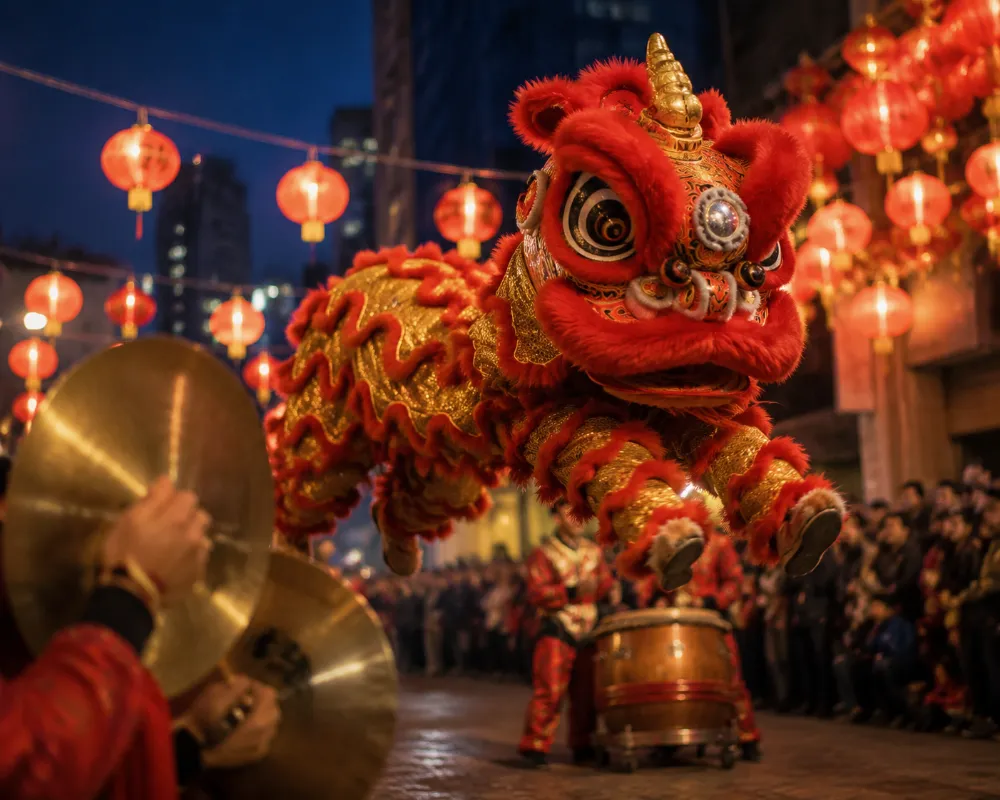
A Chinese lion dance is a martial-arts-rooted performance where two dancers operate a stylized lion costume — one for the head, one for the tail — to the rhythm of drums, cymbals, and gongs. It symbolizes the driving away of evil spirits, the welcoming of good fortune, and respect for tradition. The lion “eats” lettuce in a ritual called cai qing, and the colors of the lion, the movements, and the music all carry meaning.
I’ve watched maybe thirty lion dances over the years. The first was outside a dim sum place in Markham, Ontario when I was twelve — I didn’t understand what I was looking at, just that the lion’s head was bigger than I expected and the drums were louder than I expected. The most recent was a Hung Gar troupe performing on ten-foot poles in a Hong Kong parking lot last March, with a cauliflower hung from a wire twenty feet in the air and a crowd of a few hundred people holding up phones. Both were the same tradition, and both felt alive in the way that a parade or a street party feels alive — not staged, not rehearsed in the polished sense, just performed by people who knew what they were doing.
What I want to do in this guide is explain the lion dance for someone who has either never seen one, or has only seen the surface of one. There are two styles. There are specific color meanings. There is a ritual with a head of lettuce that everyone calls the same name. The drums and cymbals follow patterns that are not random. The two dancers inside the lion need to coordinate every step. And the whole thing is rooted in kung fu, not theater. I’ll go through all of it.
What a Chinese lion dance actually is (and what it isn’t)
Let’s start with what it is. A Chinese lion dance is a costumed performance where two performers — one operating the lion’s head, one operating the tail — move together as a single lion. They dance to the rhythm of a drummer and usually a cymbalist. The performance is choreographed but looks improvised. The lion “blinks” (the operator pulls strings on the head), “scratches,” “sleeps,” “wakes up,” “plays,” and “eats.” It bows to elders, deities, business owners, and red doors.
It is not the dragon dance. That’s the one with the long undulating body held up by poles, with ten or fifteen performers underneath. They share music and some shared cultural meaning, but they are different traditions. (More on that distinction below.)
It is not the Korean lion dance, which exists but is a different lineage. And it is not the same as a “lion costume” you might see at a Halloween parade or a Western event — the lion dance is a specific performance tradition with specific rules, a specific lineage back to Chinese martial arts schools, and a specific set of meanings embedded in every movement.
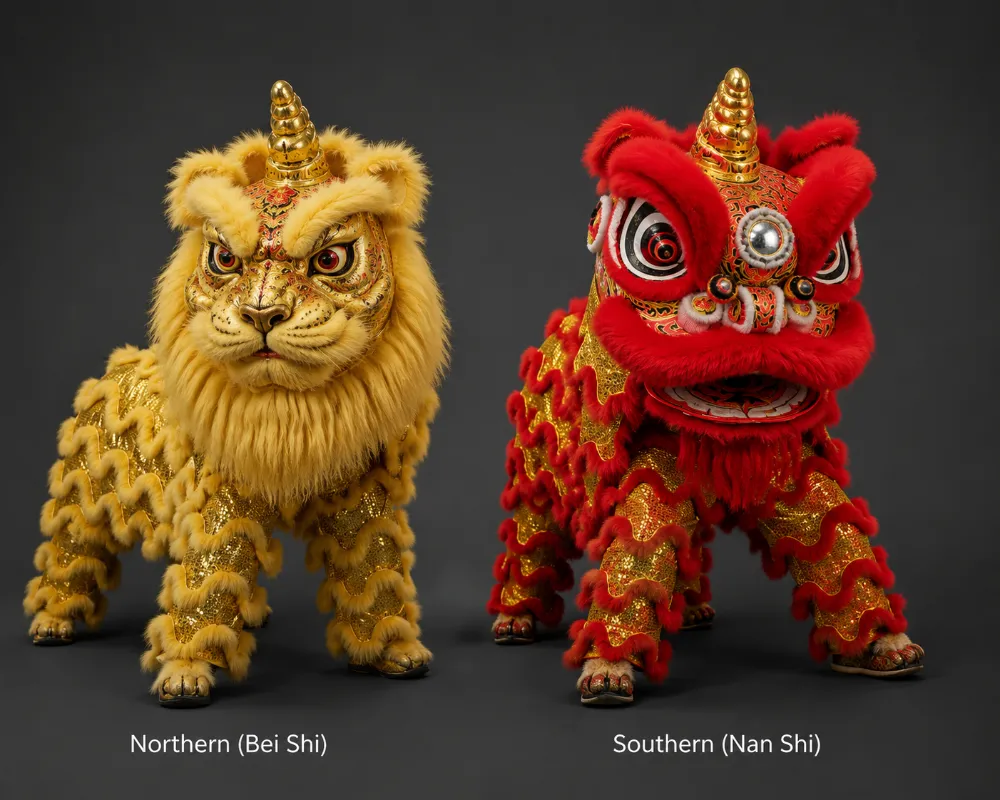
The lion itself is not a real lion. Lions aren’t native to China. The lion you see in a lion dance is an invented animal — a stylized guardian beast that draws on the lion imagery that came into China via the Silk Road from Central Asia and India, mixed with Chinese folk art traditions. The Northern style looks more like a real lion (furry, with a mane). The Southern style is a much more stylized, almost cartoonish creature with big eyes, a single horn, a mirror on the forehead, and a bright color palette. Both are clearly lions but in different ways.
And what the lion dance does, in plain terms, is this: it drives away bad energy (in Chinese, 邪氣 or “xieqi,” evil or inauspicious qi), and invites good energy (福氣 or “fuqi,” good fortune qi). It’s a blessing in motion. The lion is a guardian figure, not a performer — that’s why it bows to the door, eats the lettuce, and spits it out. The lion is doing something to the space, not entertaining the crowd. (The crowd is just there to witness.)
A brief, slightly messy history
The history is messier than most sources make it sound. The short version: the lion dance is somewhere between 1,000 and 1,500 years old, with roots in both the Tang Dynasty court and folk religion, and what we now call the lion dance is really a fusion of several traditions that got layered on top of each other over a long time.
Real lions never lived in China, but lion imagery did. Lions appear in Chinese art and Buddhism as early as the Han Dynasty (around 100 BCE to 200 CE), brought in via the Silk Road from Persia and India. The Buddhist version of the lion — a protector of the dharma, a guardian of temples and sacred spaces — became important in Chinese religious iconography. The earliest written records of what we could call a “lion dance” date to the Three Kingdoms period (220-280 CE), when the Wei emperor apparently had a lion brought in and a performer imitated it for entertainment. There’s a story about the emperor’s son being too young to have seen a real lion, so the court had someone costume up as one.
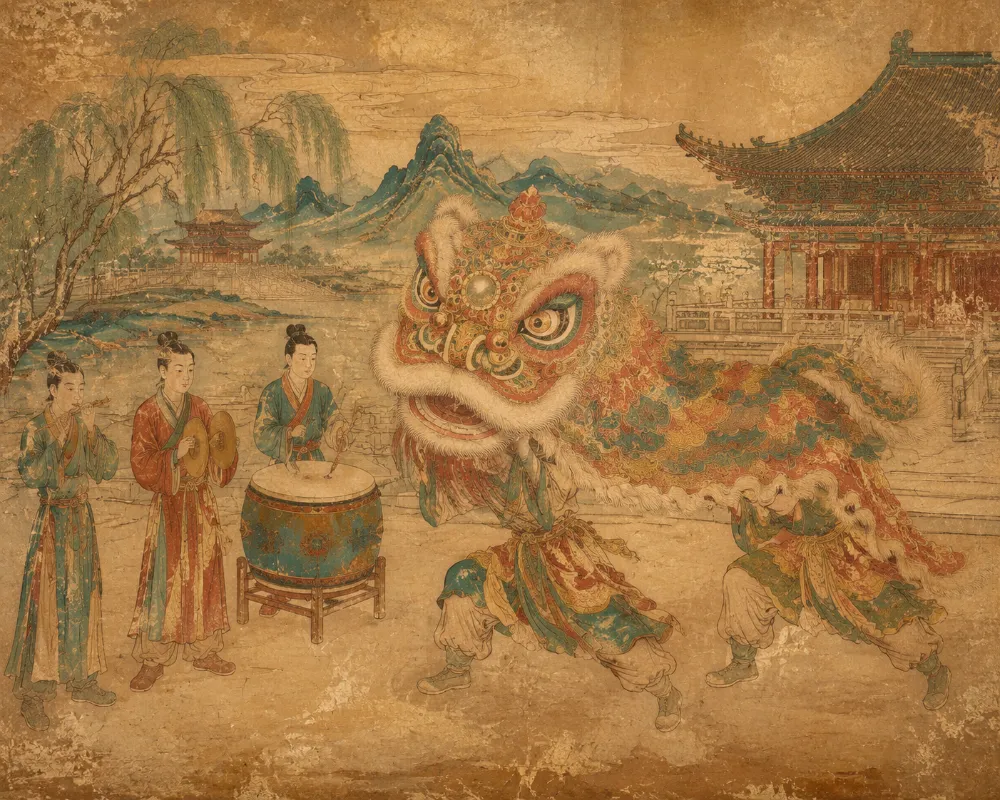
By the Tang Dynasty (618-907 CE), lion dances were a fixture of court entertainment and religious festivals. They were also part of imperial ceremonies. The Tang court had designated “lion dance performers” (獅子舞). The lion in these performances was large, sometimes operated by two performers, and accompanied by music.
What the dance became after the Tang is where things get complicated. The Northern style traces its lineage to Beijing opera and the court traditions of the Ming and Qing dynasties, when lion dances were performed at imperial banquets and religious festivals. The Southern style traces to the Guangdong and Fujian folk traditions, particularly the martial arts schools of the 19th century. By the 19th century, the Southern lion dance had become closely tied to kung fu schools — the Hung Gar schools, the Choy Li Fut schools, and the Wong Fei-hung lineage all developed lion dance as part of their training. The lion dance was both a public display of the school’s martial skill and a way to make money during festivals.
By the late 19th and early 20th centuries, the Southern lion dance had spread from Guangdong to Hong Kong, Macau, and the Chinese diaspora in Southeast Asia, North America, and Europe. The Northern style stayed more localized in northern China. Today, the Southern style is the dominant form globally, both because of the Chinese diaspora and because the Southern style is the one most associated with kung fu schools, which is what most international lion dance troupes are affiliated with.
One thing worth noting: the lion dance was banned at various points in Chinese history, most recently during the Cultural Revolution (1966-1976), when it was labeled feudal superstition. Many troupes went underground or dissolved. The revival after 1976 was real but not seamless — some lineages were lost, some troupes reconstituted with new members who had to be re-taught from scratch. The lion dance you see today in mainland China, Hong Kong, and the diaspora is the product of that post-1976 revival, mixed with continuous tradition in Hong Kong and Taiwan, which were never under Cultural Revolution-era restrictions.
Northern vs Southern: two different animals
If you’ve only ever seen one type of Chinese lion dance, it was almost certainly the Southern style. If you’ve seen two, you might have noticed they’re clearly different animals. The Northern and Southern styles are not just different in technique — they look like different creatures.
The Northern lion (北獅, běi shī)
The Northern lion looks more like a real big cat. It has a furry coat (long synthetic fur, often yellow or gold with a darker mane), four legs that move independently, and a face that’s more cat-like than cartoonish. It usually has a single horn on its head. Performers operating a Northern lion often imitate a real cat’s behavior — sleeping, yawning, scratching itself, playing with a ball. The Northern lion’s movements are more pantomimic and less acrobatic. The performer inside the head is usually the one in charge of the choreography.
Northern lions are common in Beijing, Tianjin, Hebei province, and the broader northern China region. They appear in temple fairs (廟會) in Beijing, especially during Chinese New Year. The style is less globally widespread than the Southern style, partly because the diaspora in Southeast Asia and North America comes mostly from southern China, and partly because the Northern style is harder to perform without the cultural context of northern Chinese opera and folk traditions.
The Southern lion (南獅, nán shī)
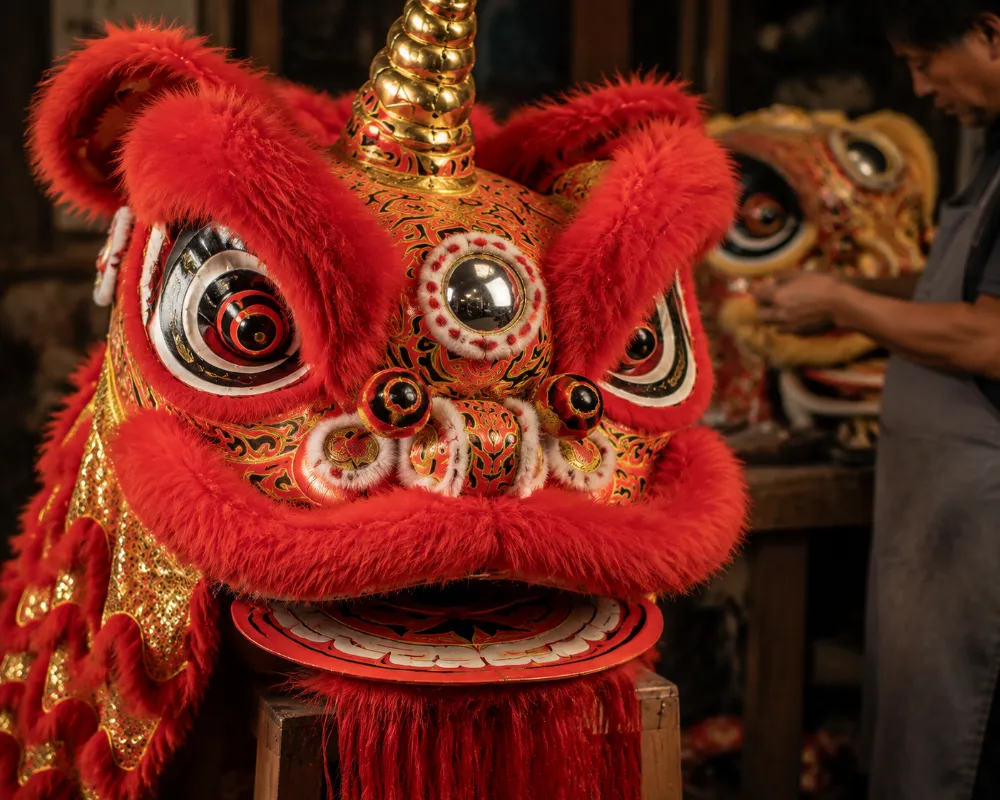
The Southern lion is the one you’re most likely to have seen in photographs, videos, and Chinatowns globally. It’s bright, colorful, and unmistakably stylized. A Southern lion has a single large head (operated by the head dancer) and a flexible body and tail (operated by the tail dancer). The head has a horn, a mirror on the forehead, big eyes that blink (operated by strings), a wide mouth that opens and closes, and a fringe of fur around the face.
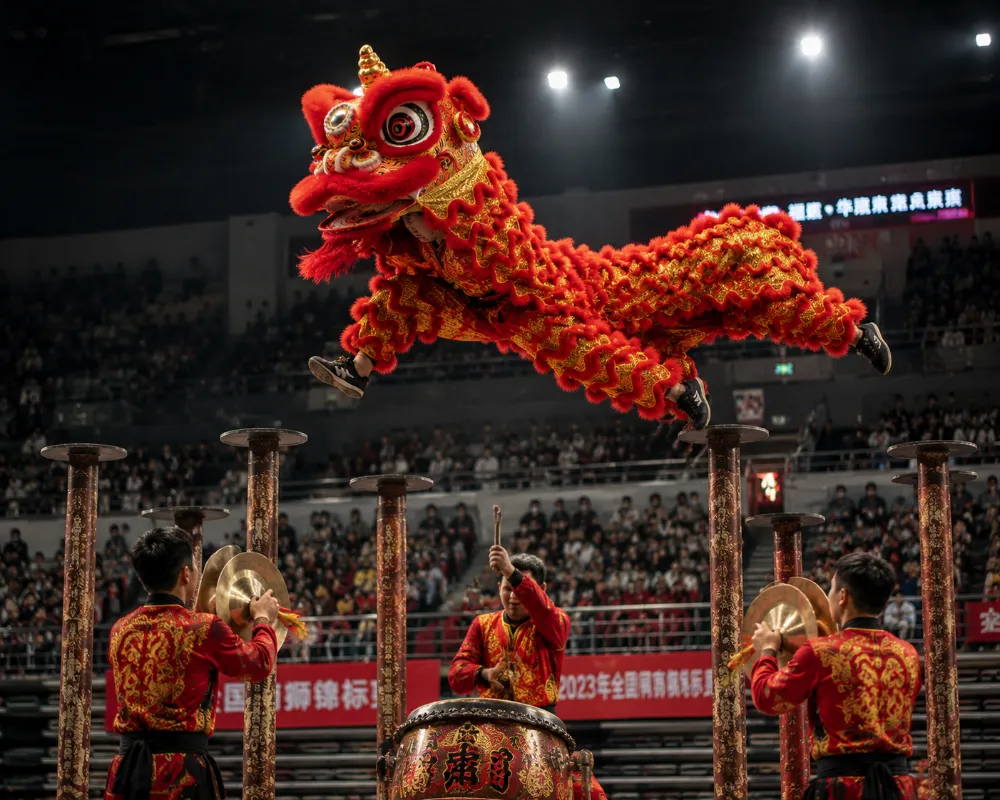
The Southern lion’s movements are more acrobatic than the Northern lion. The head dancer does most of the dramatic movement — leaping, shaking the head, blinking, opening the mouth. The tail dancer follows and supports. The Southern lion’s dance is more martial in feel, with sharper, more rhythmic movements, and it spends more time on cai qing (the lettuce ritual). It’s also more likely to appear on tall poles (梅花樁, méi huā zhuāng, “plum blossom poles”), where the lion leaps from pole to pole at heights of 6-12 feet.
Southern lions come from Guangdong province, Hong Kong, Macau, and the Chinese diaspora. They’re the style associated with most kung fu schools, including the Hung Gar lineage, Choy Li Fut, and the schools that grew out of the Foshan martial arts tradition.
Quick comparison
| Northern (Bei Shi) | Southern (Nan Shi) | |
|---|---|---|
| Look | Furry, more cat-like, single horn | Bright, stylized, horn + mirror |
| Movement | Pantomimic (sleep, play, scratch) | Acrobatic (leap, shake, cai qing) |
| Music | Drum, gong, cymbals, slower tempo | Drum, cymbal, faster, more rhythmic |
| Where | Beijing, Hebei, northern China | Guangdong, HK, Macau, diaspora |
| Pole performance | Rare | Common, especially in competition |
| Kung fu lineage | Beijing opera, imperial court | Hung Gar, Choy Li Fut, Foshan |
Fut San and Hok San: the two southern sub-styles
Within the Southern style, there are two main sub-styles that you can usually tell apart at a glance. They’re from two different cities in Guangdong, and they have distinct head shapes, movement styles, and cultural associations. Most international lion dance troupes perform one or the other.
Fut San (佛山獅)
The Fut San style is from Foshan (佛山), a city in central Guangdong province that’s been a center of Chinese martial arts for centuries. The Fut San lion has a rounder face, a more prominent forehead, a thicker body, and a more aggressive, forward-leaning posture. The mouth is wider, the eyes are bigger, and the eyebrows are typically higher and more pronounced. The Fut San lion’s movements are sharper, more martial, more aggressive. It looks like a fighter, not a dancer.
Fut San lions are common in Hong Kong, where the most famous troupes (Kun Seng Keng, Hong Kong Dragon and Lion) perform the Fut San style. The Fut San style is also the dominant style in international competition — most major world championship winners perform Fut San.
Hok San (鶴山獅)
The Hok San style is from Heshan (鶴山), a city near Foshan in Guangdong. The Hok San lion has a narrower, more elongated face, a flatter forehead, and a more cat-like, agile posture. The mouth is smaller, the eyes are more slanted, and the body is more flexible. The Hok San lion’s movements are quicker, more nimble, more playful. It looks like a cat, not a fighter.
Hok San lions are more common in Macau and in some Malaysian and Singaporean troupes. The Hok San style emphasizes speed and agility over aggression. Hok San troupes often perform more elaborate cai qing routines with more complex “spitting” patterns.
How to tell them apart
If you only see a lion for a few seconds, the easiest way to tell Fut San from Hok San is the forehead. A Fut San lion has a high, prominent forehead that curves up; a Hok San lion has a flatter, more sloping forehead. The mouth is also different — Fut San mouths are wider and more open, Hok San mouths are narrower. And the overall demeanor: Fut San looks like it’s about to fight, Hok San looks like it’s about to play.
It doesn’t really matter which one you like better — both are valid, both are traditional, both have their own lineages. If you watch enough lion dances, you’ll start having a preference. Most Westerners I know lean toward Fut San because it looks more dramatic. Most southern Chinese diaspora families lean toward whatever their local temple or kung fu school teaches, which is often Hok San.
The colors and what they actually mean
The colors of a lion aren’t just decorative. Each color has a specific meaning, and choosing the wrong color for the wrong occasion is a real cultural mistake. Troupes will sometimes refuse to perform a certain color at a certain event.
Red, gold, and yellow: the everyday blessing
Red, gold, and yellow are the most common and represent courage, vitality, joy, and general good fortune. The classic red-and-gold lion is the default choice for general blessings — Chinese New Year, business openings, weddings, temple festivals. If a customer doesn’t specify a color, this is what most troupes will bring.
Red is also the color of happiness in Chinese culture generally, so a red lion carries the general “good vibes” symbolism of red, on top of the lion’s specific protective symbolism.
Black: the fighter
Black represents bravery, strength, and martial prowess. A black lion is sometimes used at martial arts school events, at police or military celebrations, or at events associated with strength and authority. A black lion at a kung fu school opening means “this school is strong.” A black lion at a regular business opening is too aggressive — it would be a bad fit.
Black lions are also sometimes used at funerals of martial arts masters, as a sign of respect for the deceased’s fighting spirit. This is rare and specific.
White: the funeral lion
White represents old age, mourning, and the afterlife. A white lion is used at funerals, particularly of respected elders, kung fu masters, or community leaders. This is uncommon outside of Hong Kong, Macau, and southern Chinese diaspora communities, but if you see a white lion, the occasion is almost always a funeral.
A white lion at a wedding or business opening would be a major cultural mistake.
Gold and yellow: the wealth lion
Gold and yellow lions represent wealth and prosperity. They’re often used at the opening of banks, jewelry stores, or any business associated with money. A gold lion at a restaurant opening might be considered overkill (it’s not just about food), but a gold lion at the opening of a financial services firm is appropriate.
Yellow (separate from gold) represents the earth element and is associated with the center direction. Yellow lions are sometimes used at earth-related events or at certain temple ceremonies.
Multi-colored and special lions
Multi-colored lions are usually for festivals and special occasions. The colors don’t have one meaning — they’re celebratory. You might see a rainbow lion at a temple fair, at a school opening, or at a major public celebration.
There are also regional color traditions. Some Hong Kong temples have their own color preferences, and some kung fu schools have specific color combinations for their lions. If you’re commissioning a performance, the troupe leader will usually ask what color you want and recommend based on the occasion.
| Color | Meaning | When to use |
|---|---|---|
| Red / Gold | Courage, vitality, general good fortune | CNY, business openings, weddings, festivals |
| Black | Bravery, strength, martial prowess | Kung fu schools, military events, martial occasions |
| White | Mourning, old age, afterlife | Funerals of respected elders or masters |
| Gold / Yellow | Wealth, prosperity, earth | Banks, jewelry stores, wealth-related events |
| Multi-colored | Celebration, festival | Temple fairs, school events, public celebrations |
Why the lion has a mirror on its forehead
If you’ve looked closely at a Southern lion, you’ve probably noticed the small round mirror on the forehead, between the eyes. It’s not decoration. The mirror is there for a specific reason: to deflect evil spirits.
The mirror is meant to reflect back any evil qi directed at the lion (or, by extension, at the people or place the lion is blessing). In Chinese folk religion, mirrors have long been considered protective objects — they reflect not just light, but also the intentions of spirits. A mirror facing outward is a defensive barrier. A mirror on a guardian figure (a door god, a temple guardian, a lion) is the same idea, scaled up to a moving, performing figure.
The mirror also has a more specific meaning in the lion dance’s connection to Buddhism. In Buddhist iconography, the lion is a protector of the dharma (the Buddha’s teaching). The mirror represents the clarity of the dharma, the “mirror-like wisdom” (大圓鏡智) in Buddhist philosophy. The mirror on the lion’s forehead is a small statement that the lion is not just a guardian of physical space, but of spiritual space too.
And there’s a practical superstition: if you look into the lion’s eyes, you should not be able to see the reflection of the lion’s own operator. If you can, the operator has not “tamed” the lion. This is a piece of lore that varies by region and troupe, but it’s a real thing that some troupe leaders will mention.
Cai qing: the lettuce ritual, explained
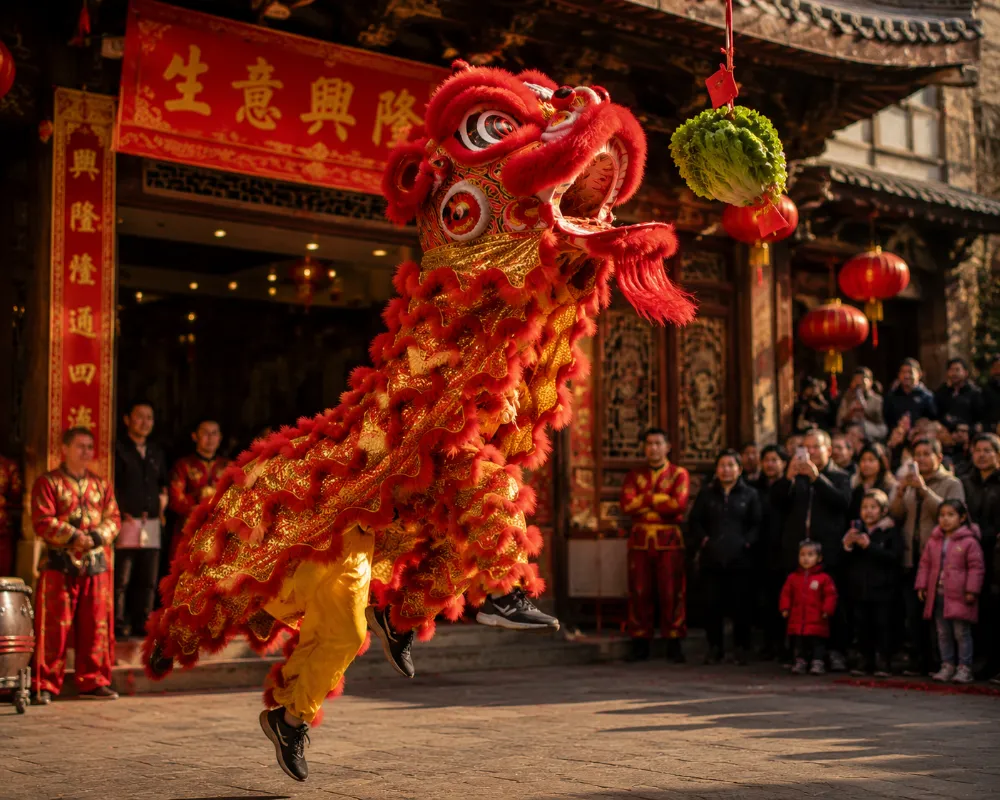
Cai qing (採青, “plucking the greens”) is the climactic moment of a lion dance. It’s the part where the lion “eats” something, and it’s almost always a head of lettuce — though it can be other green vegetables, or even a whole pile of fruit and vegetables arranged in a specific pattern. The cai qing is also usually the moment that draws the loudest applause and the most phone cameras.
The setup is something like this: the host of the event (whether a business owner opening a new shop, a family celebrating Chinese New Year, a temple at a festival) hangs a head of lettuce (or other green vegetable, or a more elaborate offering) at a high spot — sometimes at the top of a door, sometimes hanging from a string stretched across a street, sometimes at the top of a tall pole that the lion will have to climb. Usually, a red envelope (利是, lai shi, or 紅包, hong bao) is attached to the lettuce, containing money as a tip to the troupe.
Then the lion approaches. It looks up at the offering. It bows to it. It “thinks” about how to get it. And then it goes to work.
The lion might leap up to grab the lettuce. It might climb a pole, leap from pole to pole, and pluck the lettuce from a wire. It might do an elaborate sequence of martial arts movements before reaching the offering. The complexity of the cai qing depends on the occasion, the skill of the troupe, and the budget of the host. A simple cai qing for a small business opening might be a single leap. A competition cai qing on tall poles might be 10-15 minutes of intricate choreography.
Once the lion “eats” the lettuce (i.e., grabs it in its mouth), it chews. This is the most physically demanding part for the head dancer, who is making the lion’s mouth open and close with one hand while supporting the weight of the head with the other. Then the lion spits the lettuce out. The way the lion spits is also meaningful — in many traditions, the lion is supposed to spit the leaves in a specific pattern, sometimes spelling out a character like 福 (fu, fortune) or 財 (cai, wealth), or scattering them in a circle for general good luck.
The lion keeps the red envelope. That’s the troupe’s payment for the performance, on top of whatever flat fee was negotiated.
The symbolism of the lettuce is multilayered. The Cantonese pronunciation of “lettuce” (生菜, sang choi) sounds like “生財,” which means “to generate wealth.” So eating the lettuce is a symbolic act of generating wealth for the host. The red envelope represents the host’s generosity, and the lion taking it is a sign of the lion accepting the host’s blessing and returning it multiplied.
In some versions of the ritual, the lettuce is replaced with other things. I’ve seen oranges (which represent wealth and good fortune), pomelos, whole heads of cabbage, and once, memorably, a whole roasted pig. The roasted pig one was for the opening of a Cantonese barbecue restaurant in Queens. The lion ate the head (literally the head of the pig) and then the lion keepers split the rest of the pig with the restaurant staff. It was a long performance.
When lion dances actually happen (it’s not just Chinese New Year)
Chinese New Year is when most Westerners see a lion dance, but it’s far from the only time. The lion dance happens whenever blessing is needed — at the start of something new, at the celebration of something important, or at the end of a life well lived.
Chinese New Year
Chinese New Year is the peak season. The first three days of the new year (初一, 初二, 初三) are the busiest, especially 初二 (the second day, considered the day of the “god of wealth”). Troupes will have 5-10 performances a day during this period. You’ll see lion dances outside restaurants, malls, banks, grocery stores, and temples. Some of the best performances are at temple fairs (廟會) in Beijing, Guangzhou, Hong Kong, and other major cities. These are public, free, and often feature multiple troupes performing throughout the day. For more on the dates of CNY, our 2027 Chinese New Year guide has the full lunar calendar breakdown.
Business openings and grand openings
Any new business in a Chinese community — a restaurant, a bank, a real estate office, a grocery store — will have a lion dance at the opening. The lion blesses the space, the cai qing happens at the front door, the lion performs inside the shop, and the owner hands over the red envelope. This is so common that most new businesses in Chinatowns globally will have a lion dance in their first week. I’ve seen it at dim sum places, jewelry stores, and a dental office in Markham.
Weddings
Lion dances at weddings are common in southern Chinese communities, especially in Hong Kong, Macau, Guangdong, and the diaspora. The lion blesses the bride’s family home before the groom arrives, and sometimes at the wedding banquet venue. A red or gold lion is the standard color. The lion’s movements at a wedding are usually more gentle and ceremonial — less aggressive jumping, more bowing and blessing.
Religious festivals
Temple fairs (廟會) in Beijing, Guangzhou, Foshan, and Hong Kong feature multiple lion dance performances throughout the day. The Buddha’s Birthday (浴佛節, fourth day of the fourth lunar month), the Ghost Festival (中元節, seventh lunar month), and the Hungry Ghost Festival all feature lion dances at temples. The Dragon Boat Festival and Mid-Autumn Festival sometimes have lion dances too, though these are less lion-dance-heavy than CNY.
Public celebrations and grand openings
Chinatowns globally have lion dances at public celebrations — Chinese New Year parades, mid-autumn festivals, and community events. Sports victories (especially a Chinese team or athlete winning something major) often trigger spontaneous lion dances in Chinatowns. I’ve seen lion dances at a San Francisco Giants game celebrating the Year of the Dragon, and at a Toronto Raptors Chinese New Year night.
Funerals
White lions are used at funerals of respected community elders, kung fu masters, and important figures. This is more common in Hong Kong, Macau, and southern Chinese communities than in northern China. The lion dance at a funeral is solemn and slow, with no cai qing and no celebratory movements. It is a mark of respect, not a celebration.
What you won’t see
You won’t see lion dances at random public events that don’t have a specific blessing context. They’re not performed for general entertainment the way a dance troupe might perform at a corporate event. The lion dance is a ritual, and the ritual has a context. If you see a lion dance, there’s a reason — and the reason is usually one of the categories above.
The music: drums, cymbals, and the “three-star beat”
The music is not background. The music is the choreography. Every movement of the lion is timed to the drum, and the drummer is as important as the lion dancers in a good performance. If you’ve watched a lion dance where the lion’s movements seem random or uncoordinated with the music, that’s a sign of an amateur troupe. In a good troupe, the lion’s head bobs, the body sways, the blinking, the opening of the mouth, the leaping — all of it is locked to the drumbeat.
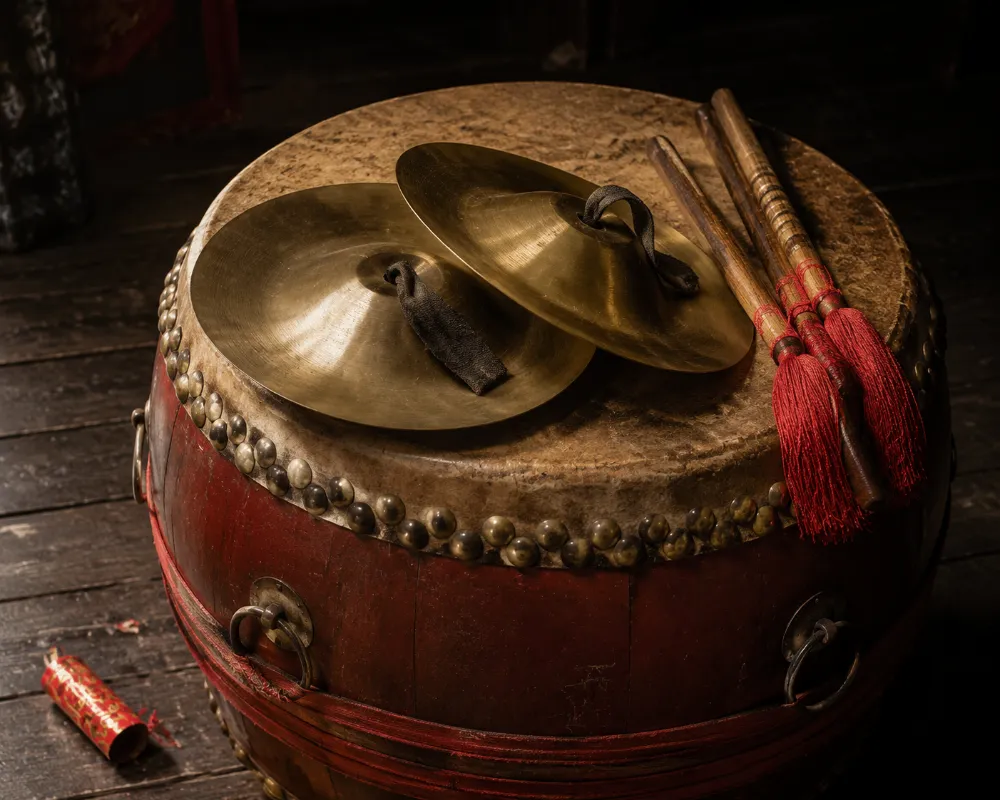
The three main instruments are the drum (鼓, gu), the cymbals (鈸, bo), and sometimes the gong (鑼, luo). In a small performance, you’ll have one drummer and one cymbalist. In a larger performance, you might have multiple cymbals and a gong player too. The instruments are loud — deliberately. The point is to drive away evil spirits with sound, and the music is supposed to be felt in your chest.
The drum patterns
Southern style has a few standard drum patterns that the lion dancers will recognize. The most common is the “three-star beat” (三星鼓, san xing gu), which is the basic pattern for most movements — a steady beat with a strong accent on every third hit. There’s also a faster pattern for jumps and a slower pattern for bowing and blessing.
Northern style has different patterns, generally slower and more deliberate. The Northern drum patterns reflect the pantomimic nature of the Northern lion — sleeping, scratching, playing — which needs slower, more sustained rhythm.
The cymbals
The cymbals in Southern style have two basic patterns: a closed clash (the two cymbals pressed together) and an open clash (the cymbals pulled apart and rung out). The closed clash is the “step” beat, used during walking and bowing. The open clash is the “punctuation” beat, used during big movements — leaps, head shakes, the lion waking up. A good cymbalist will vary the intensity and timing of the clashes to match the lion’s energy.
The cymbals are also used to count the lion in and out. The opening cymbal clash is the cue for the lion to start; the closing cymbal clash is the cue for the lion to finish. If the cymbals stop, the audience knows the performance is over.
Why the music is loud
This is worth saying clearly: the music is loud on purpose. It’s not a stylistic choice. The loudness is part of the ritual function. In Chinese folk religion, loud sounds drive away evil spirits. The louder the drums and cymbals, the more effective the blessing. Troupes that perform in residential areas will often have to negotiate with neighbors about noise, especially during evening performances. Some cities have noise restrictions that limit the time of day lion dances can be performed outdoors.
Inside the costume: what you’re looking at
The lion costume is a piece of craftsmanship. A good lion head, made by a skilled craftsman, takes 2-4 weeks to make and costs between $500 and $2,000 USD depending on the size, materials, and detail. The body and tail are simpler, but a full set of costume from a reputable maker in Foshan or Hong Kong will run you $1,500-$5,000 USD.
The head
The head is the most complex part. The frame is made of bamboo strips (traditionally) or rattan and wire (more modern), bent into shape over a wooden or papier-mâché form. The frame is then covered with paper, fabric, fur, paint, and decorations. The mouth opens and closes via a string or lever operated by the head dancer’s hand. The eyes blink via strings connected to the dancer’s fingers or wrist. The horn (in Southern style) is usually made of papier-mâché and painted with metallic gold or silver.
The mirror on the forehead is usually a small round piece of glass or polished metal, framed in red or gold. The fur around the face is typically long synthetic fur in red, gold, white, or another color depending on the lion’s color scheme. The ears are usually smaller and softer, often made of fabric and covered in fur.
The body
The body is a length of fabric (typically 4-6 feet long) connecting the head to the tail. It covers the head dancer’s torso and the tail dancer’s full body. The body is usually made of silk or satin, with a pattern that complements the head — scales, flames, clouds, or other auspicious motifs. Some bodies are simple and functional; others are elaborately embroidered and can cost almost as much as the head.
The tail
The tail is a separate piece attached to the back of the body. It’s usually a length of fur or fabric, sometimes shaped to look like a tuft or a tassel. The tail dancer holds the tail in one hand and uses it to add movement and personality to the lion’s actions — wagging, swinging, flicking.
How the dancers get in and out
The head dancer puts the head on over their head and shoulders. The head weighs between 5 and 15 pounds depending on the size and materials. The dancer’s body is visible only as the front legs of the lion (the dancer’s actual hands and feet) and as the lion’s body and tail (covered by fabric).
The tail dancer stands behind the head dancer, bent over at the waist, holding the body of the costume with both hands. The tail dancer’s legs are the back legs of the lion, and their right hand holds the tail.
Both dancers need to coordinate every step. The head dancer leads, the tail dancer follows. The two are usually in constant low-volume communication, with the head dancer calling out steps and the tail dancer responding. A good lion looks like one creature, not two people in a costume. A bad lion looks like exactly what it is.
The two dancers: how a lion walks
The lion dance is a martial art first and a performance second. The two dancers inside the lion need to move as one creature, which requires real skill, real training, and real communication. The head dancer does most of the dramatic work — blinking, opening the mouth, shaking the head, leaping. The tail dancer provides the body movement and the back legs.
The head dancer’s job
The head dancer carries the lion’s head on their shoulders, with their dominant hand operating the mouth and the strings for the eyes. Their other hand supports the back of the head. They lead the choreography — every step the lion takes, every movement, every bow. They need to be strong enough to hold the head steady through all the movements, and coordinated enough to time the mouth and eye movements with the music.
The head dancer’s other job is to be the lion’s “personality.” A good head dancer makes the lion feel like a creature with moods — curious, playful, sleepy, aggressive, happy. A bad head dancer makes the lion feel like a costume on a person. The difference is in the small movements — the slight head tilt when the lion is curious, the wide-eyed stare when the lion is surprised, the gentle head-bob when the lion is happy.
The tail dancer’s job
The tail dancer is bent over at the waist, sometimes nearly 90 degrees, holding the body of the costume with both hands. Their legs are the lion’s back legs, so they need to time every step to the head dancer’s steps. Their right hand holds the tail, which they use to add personality and movement — the tail wags when the lion is happy, flicks when the lion is curious, drops when the lion is tired.
The tail dancer’s job is harder than it looks. The bent-over posture is physically demanding, and the coordination with the head dancer needs to be exact. A good tail dancer makes the lion’s body look like it’s flowing as one creature. A bad tail dancer makes the lion look like two people in a costume. The best tail dancers are usually the unsung heroes of a good lion dance performance.
How they coordinate
In a good troupe, the head and tail dancers practice together for months before performing. They learn each other’s movement style, their timing, their cues. Many troupes have a “first lion” (the more senior, experienced dancers) and a “second lion” (the newer pair). The first lion performs the lead role; the second lion is the backup or the understudy.
During the performance, the head and tail dancers communicate through physical cues — a slight lean forward means “get ready to move,” a pause means “wait,” a quick step means “follow me.” They may also whisper through the costume. The audience doesn’t see any of this; they just see a lion moving like one creature.
Lion dance troupes worth knowing
There are thousands of lion dance troupes worldwide. The ones below are notable for different reasons — some for competition wins, some for cultural preservation, some for sheer size. If you’re trying to book a performance, ask around locally first; the best troupe for you is usually the one your community knows.
Hong Kong
Hong Kong is the global center of competitive lion dance. The major international competitions (the Genting World Lion Dance Championship, the Hong Kong International Lion Dance Championship) feature teams from around the world, but Hong Kong-based teams regularly win.
Kun Seng Keng (群勝龍獅團) is probably the most famous. Founded in 2010, they’ve won multiple world championships. They’re a Fut San style troupe based in Hong Kong. Their performances are technically precise and visually stunning.
Hong Kong Dragon and Lion Dance Association is the umbrella organization for many of the best troupes. They run training, competitions, and public performances.
Kwong Ngai (光藝龍獅團) is another top competitive troupe, also Fut San style, also based in Hong Kong.
Mainland China
Foshan (佛山), in Guangdong province, is the birthplace of the Fut San style and remains a major center. Local troupes include Foshan Nanhai Lion Dance Team and Foshan Chancheng Lion Dance Association. The annual Foshan Lion Dance Festival in the fourth lunar month is a major event.
Guangzhou (廣州) has many active troupes, both competitive and ceremonial. The Chen Clan Ancestral Hall area often has public performances.
Beijing has a Northern style scene centered around the temple fairs during Chinese New Year. The Beijing Longfusi Temple Fair and the Ditan Temple Fair are major venues.
Southeast Asia
Singapore has a strong lion dance scene, with both Hok San and Fut San troupes. The Singapore Lion Dance Federation oversees competitions. The annual Singapore National Lion Dance Championship is a major event.
Malaysia has a very strong lion dance tradition, with both Chinese and Malay communities performing. Kuala Lumpur and Penang are major centers. Malaysian troupes often feature Hok San style. The Penang Chinese New Year celebrations are some of the most elaborate in Southeast Asia.
Thailand, Indonesia, Philippines all have significant Chinese diaspora communities with active lion dance scenes.
USA, UK, Australia, Canada
San Francisco Bay Area has many troupes affiliated with kung fu schools (most of which are Hung Gar or Choy Li Fut). Gung Ho (Geng Hao) is one of the more well-known. The San Francisco Chinese New Year Parade is one of the largest outside Asia.
New York City has troupes in Manhattan’s Chinatown, Brooklyn’s Sunset Park, and Flushing, Queens. The Chinese Consolidated Benevolent Association runs the largest CNY celebrations.
London has a small but strong lion dance scene, mostly Hok San. The London Chinese New Year celebrations in Trafalgar Square usually feature at least one troupe.
Sydney and Melbourne both have strong Chinatowns with active lion dance scenes. The Sydney Chinese New Year Festival in January-February is one of the largest in the southern hemisphere.
Toronto and Vancouver in Canada both have large Chinese communities and active lion dance scenes. The Vancouver Chinese New Year Parade is the largest in Canada.
Lion dance vs dragon dance: don’t confuse them
People mix these up all the time, and it’s understandable — they share music, they share color symbolism, and they often perform together at the same events. But they’re different traditions with different histories and different choreography.
The lion dance features one or two lion costumes, each operated by two performers. The lion has a head, a body, and a tail, all connected. The lion’s movements are pantomimic or acrobatic. The lion dance is a martial arts-rooted performance, with most dancers also being kung fu practitioners.
The dragon dance features a long body (the dragon) held up by poles operated by 9-15 performers. The dragon has a head (operated by one performer holding a pole), a long undulating body (operated by multiple performers holding poles), and a tail (operated by one performer). There is no body in the dragon costume — the performers’ bodies are visible underneath, and the dragon’s movement comes from the performers’ coordinated pole work.
The dragon dance is more parade-like and ceremonial. The dragon is longer (often 30-100 feet), more colorful, and more visually impressive. The dragon dance is less martial and more processional. The dragon is also a different mythological creature — a dragon, not a lion — with its own symbolism (dragons represent power, prosperity, and the emperor in Chinese mythology, and are not associated with the guardian/protective function of the lion).
You’ll often see both at the same event. The lion comes first, performs the blessing and cai qing. Then the dragon comes through, more for spectacle. Some events feature both, some only one. Most Chinese New Year parades have both. Most business openings have just the lion.
The Buddhism and Nian monster connection
Two origin stories are commonly told about the lion dance. Both are folk traditions, not strict history, but they shape how the lion dance is performed and understood.
The Buddhist story
In Buddhist tradition, the lion is a protector of the dharma. The Buddha himself is sometimes called “the lion of the Shakya clan” (釋迦族獅子). The lion is associated with wisdom, courage, and the protection of sacred space. Lion statues flank the entrances of Buddhist temples, and lion imagery appears throughout Buddhist art. The lion dance, in this lineage, is a performance of the lion as a Buddhist guardian, protecting the people and the place being blessed.
The mirror on the lion’s forehead, mentioned earlier, is part of this Buddhist symbolism. The mirror represents the “mirror-like wisdom” of Buddhist philosophy — the clarity that reflects things as they truly are, without distortion. The lion, with its mirror, is not just deflecting evil spirits; it’s also a symbol of clear-sighted protection.
The Nian monster story
The Nian (年) is a mythological beast that, according to Chinese folk tradition, would come once a year to terrorize villages, eating livestock and people, especially children. The only things that scared the Nian were loud noises, bright lights, and the color red. So at New Year, villages would light fires, hang red decorations, and make as much noise as possible to scare the Nian away.
The lion dance, in this lineage, is a continuation of that tradition. The drums and cymbals are loud noises. The bright colors of the lion and the red of the performers’ clothes are visual scares. The lion itself, with its big eyes and fierce appearance, is meant to be a more powerful version of the village guardian. The lion dance at Chinese New Year is, in this telling, a ritual to drive the Nian away for another year.
Both stories are probably not historically accurate in the strict sense, but both shape how the lion dance is performed and understood. A troupe that knows the Buddhist lineage will lean into the spiritual aspects; a troupe that knows the Nian story will lean into the noise and color. Most troupes know both, and most performances blend the two.
Etiquette: how to behave when a lion visits you
If you live in or visit a Chinese community during Chinese New Year, you might have a lion dance visit your home, your business, or your building. Here’s what to do.
If a lion comes to your business or home
- Prepare a red envelope. The red envelope (利是 or 紅包) is the tip to the troupe. The amount varies by region and occasion, but in most US and Canadian Chinatowns, $20-50 is a normal tip for a brief visit. For a full performance, $100-300 is standard. For a competitive troupe at a major event, $500+.
- Hang the lettuce or other offering. If you want a full cai qing, hang a head of lettuce with the red envelope attached at a high spot — usually above the front door. The troupe will know what to do.
- Don’t touch the lion’s head. The head is sacred. It’s where the lion’s “spirit” lives. Touching the head is considered disrespectful.
- Bow when the lion bows to you. The lion will bow at certain points during the performance, especially at the door. Bow back. If you’re the head of a household or the business owner, you may want to bow lower than the lion does, as a sign of respect and reciprocation.
- Don’t block the lion’s path. The lion will move around the space, blessing doorways, altars, and corners. Stay out of its way.
- Don’t feed the lion inappropriate things. Stick to lettuce, oranges, or whatever the troupe has agreed to. Some troupes will accept a roasted pig or a whole chicken for special occasions, but ask first.
If you’re a spectator
- Stay back. The lion will move around. Don’t get in its path. The tail dancer’s vision is limited, and they may bump into you.
- Don’t touch the lion. Same as above. Especially don’t touch the head.
- Photograph, but don’t block. Photos are fine and expected. Don’t stand in the middle of the performance area or block other spectators.
- Be loud and appreciative. Clapping, cheering, and noise in general are appropriate. The louder the audience, the more the lion “performs.” Silence is considered a bad omen.
- Throw the lettuce if the lion spits it at you. Some cai qing routines end with the lion spitting the lettuce into the audience. If the lettuce lands near you, pick it up and throw it back, or pass it forward. It’s a sign of good luck.
What to wear
Red is a good color to wear, especially during Chinese New Year. Black is fine, though some traditional people avoid it during CNY. White is generally avoided at celebrations. If you’re going to a business opening or a wedding, business casual is fine. If you’re going to a temple, dress more conservatively — covered shoulders and knees.
Where to watch one in 2026
Here’s how to find a lion dance near you, organized by region.
Mainland China
Beijing: Temple fairs during Chinese New Year (Longfusi, Ditan, White Dagoba Temple, among others). The biggest are the first week of the lunar new year. Public and free.
Guangzhou: Temple fairs during CNY, plus the annual Guangzhou International Lion Dance Competition in October. Public lion dances at the Chen Clan Ancestral Hall area on weekends.
Foshan: The Foshan Lion Dance Festival in the fourth lunar month. This is the home of the Fut San style and the place to see the most technically skilled performances. Free public performances at the Foshan Ancestral Temple area.
Hong Kong: Public lion dances at the Wong Tai Sin Temple during CNY. The annual Hong Kong International Lion Dance Championship is usually in November. Many malls and restaurants have performances on weekends and during festivals.
Macau: The Macau Lion Dance Championship in June. Public performances at the A-Ma Temple and other temples during festivals.
Taiwan
Taipei: Public lion dances at Longshan Temple and other temples during CNY. The Taiwan International Lion Dance Championship is a major event. Many night markets and restaurants have performances on weekends.
USA
San Francisco: The Chinese New Year Parade in February is one of the largest outside Asia. Free, public, and runs through Chinatown. Multiple troupes perform.
New York: The Chinatown New Year Parade in Manhattan, plus the Flushing Lunar New Year Parade in Queens. The Chinatown Manpower Project (now the Chinese-American Planning Council) organizes many of the performances.
Los Angeles: The Monterey Park Chinese New Year Festival in the San Gabriel Valley is one of the largest in California. Multiple performances throughout the weekend.
Boston, Chicago, Houston, Seattle, Philadelphia all have Chinese New Year parades or festivals with lion dance performances. Local Chinatowns are the easiest place to find out about upcoming performances.
Canada
Vancouver: The Vancouver Chinese New Year Parade is the largest in Canada, drawing over 100,000 spectators. Multiple troupes. The International Buddhist Temple also has public performances during CNY.
Toronto: The Toronto Chinatown CNY celebrations in February, with the main parade on the Sunday closest to CNY. Multiple performances in Scarborough and Markham, where there are large Chinese communities.
UK, Europe, Australia
London: The Trafalgar Square Chinese New Year celebrations in February are the largest in Europe. Multiple troupes perform throughout the day.
Paris, Berlin, Amsterdam, Madrid all have Chinese New Year celebrations with lion dance performances.
Sydney: The Sydney Chinese New Year Festival in January-February features multiple events, including the Lunar Lanterns exhibition and the main parade. The Haymarket area in Chinatown is the epicenter.
Melbourne: The Melbourne Chinese New Year celebrations in February, with the main parade through Chinatown and performances throughout the week.
Learning lion dance: what it actually takes
Learning lion dance is more accessible than you might think. You don’t need prior kung fu training, though it helps. Here’s what to expect.
How to start
Most Westerners learn lion dance through a kung fu school or a Chinese cultural association. Hung Gar and Choy Li Fut schools are the most common affiliations, but any kung fu school with a lion dance program will do. Some schools have dedicated lion dance classes that don’t require kung fu training; others require you to take kung fu classes first.
Search for “lion dance [your city]” or “kung fu school [your city]” to find local options. Many Chinatowns have at least one or two schools that teach lion dance. Some schools are more competitive (focusing on competition and performance), others are more casual (focusing on community and cultural preservation).
What you’ll learn
Beginners start with the tail. You learn the basic footwork, the timing with the drum, the role of the tail dancer. After a few months, you may move to the head. The head requires more strength (you carry the lion’s head on your shoulders), more coordination (you operate the mouth, eyes, and head movements), and more personality (you’re the one who makes the lion feel alive).
You’ll also learn the music — the drum patterns, the cymbal patterns, the calls. A good lion dancer knows the music. You’ll learn the choreography — the standard movements, the cai qing sequence, the blessing routine. You’ll learn the cultural context — when to bow, when to leap, what the colors mean, what the various movements symbolize.
How long it takes
A beginner can usually perform in a basic public performance within 6-12 months of regular training. A solid intermediate level (where you can handle most public performances) takes 2-3 years. A competitive level (where you can perform on tall poles and full cai qing routines) takes 5+ years and significant athleticism.
Most people who start lion dance stick with it for years, often decades. The community is strong, the tradition is meaningful, and the skill is real. It’s one of the more rewarding physical practices you can take up, especially if you have access to a good school and a community of fellow practitioners.
Costs
Class fees vary by school and region. In the US, expect $50-150 per month for weekly group classes. Some schools include the lion costume and equipment rental in the class fee; others charge extra. Buying your own lion costume (if you stick with it long enough) costs $1,500-5,000 USD.
Many schools subsidize costumes for students, especially if you’re performing with the school’s troupe. Some schools will give you a costume after you’ve been with them for a year or two, in exchange for continued performances with the school.
Common misconceptions I’ve heard
A few things people get wrong about the lion dance that I want to clear up.
“It’s just a costume, like a parade float.”
No. It’s a martial arts performance. The dancers are trained, the choreography is precise, and the whole thing is rooted in centuries of kung fu tradition. Watching a top troupe perform on tall poles is like watching gymnastics, but with cultural depth.
“The lion is supposed to scare away evil spirits, like a demon.”
Not quite. The lion is a guardian, not a demon. It doesn’t fight evil; it deflects evil. The mirror on its forehead, the rituals it performs, the bowing it does — these are all acts of protection, not aggression. The lion is more like a polite but firm bouncer than a fierce demon.
“The lion is a real lion, like from Africa.”
No, lions are not native to China. The lion in the lion dance is a Chinese-invented creature, drawing on lion imagery that came from India and Persia via the Silk Road. The lion you see in a lion dance is a Chinese folk creature, not a real lion.
“You have to be Chinese to do it.”
No. Lion dance is taught all over the world, to people of all backgrounds. Most troupes in the US, UK, Australia, and Canada have non-Chinese members. The traditions and meanings are Chinese, but the practice is open.
“The lion eats the lettuce because it’s hungry.”
No. The lettuce is symbolic. The lion “eats” it as a ritual act of blessing, not because it’s actually consuming food. After the lion spits it out, the lettuce is usually thrown away, composted, or kept as a good luck charm (some families keep a piece of the lettuce from a CNY visit as a blessing for the year).
“You should give the lion money if you see one.”
Only if the lion is performing a specific blessing at your home or business. If you’re just watching a public performance, no money is expected. If a lion approaches you in the street or in a mall, the troupe may collect tips, but this is usually a sign of an aggressive or amateur troupe, not a traditional one.
“All lion dances are the same.”
Definitely not. Northern vs Southern, Fut San vs Hok San, ceremonial vs competitive, community vs commercial — the lion dance is a wide tradition with many variations. The more you watch, the more you’ll see the differences.
Chinese Lion Dance FAQ
What does the Chinese lion dance symbolize?
The Chinese lion dance symbolizes the driving away of evil spirits, the bringing of good luck and prosperity, and respect for tradition. The lion is a guardian figure that absorbs bad qi and replaces it with good fortune. Specific movements, colors, and props carry additional meanings — the green vegetable represents wealth, the red envelope represents generosity, and the mirror on the lion’s forehead deflects evil.
What is the difference between Northern and Southern lion dance?
The Northern lion looks more like a real lion, with a furry coat, a yellow mane, and a single horn. It mimics a real cat’s behavior — sleeping, playing, scratching. The Southern lion is brighter, more colorful, with a horn, mirror, and a single eye. It has two sub-styles: Fut San from Foshan, and Hok San from Heshan, each with distinct head shapes and movement styles. The Northern style comes from Hebei and Beijing; the Southern from Guangdong, Hong Kong, and Macau.
What is cai qing in lion dance?
Cai qing (採青, “plucking the greens”) is the climactic moment of a lion dance. The lion “eats” a head of lettuce (or other green vegetable) hung at a high spot, often with a red envelope attached. The lettuce represents wealth and vitality; the red envelope represents the host’s generosity. The lion chews, spits out the greens in a specific pattern (often spelling a character or scattering them for luck), and keeps the red envelope.
What do the colors of a Chinese lion mean?
Red, gold, and yellow lions are the most common and represent courage, vitality, and good fortune — the standard choice for general blessings. Black represents bravery and is often used in martial contexts. White represents old age and is used at funerals. Gold and yellow represent wealth. Multi-colored lions are usually for festivals.
When do Chinese lion dances happen?
Chinese lion dances happen at Chinese New Year (the busiest time, especially the first three days), business openings, weddings, religious festivals (Temple Fair Days, Buddha’s Birthday, Ghost Festival), grand openings of malls and restaurants, and occasionally at funerals of respected elders.
How many people are needed for a lion dance?
A standard lion dance requires three people: two to operate the lion (the head and the tail), and a third to handle the drum, plus a fourth to play the cymbals in larger performances. Most troupes have a drummer, a cymbalist, and at least one or two lions (each requiring two dancers). A small troupe of 5-8 people can put on a basic show; a competition team of 10-15 can perform on tall poles and full cai qing routines.
Is lion dance a martial art?
Yes. The lion dance is rooted in Chinese martial arts, particularly Hung Gar, Choy Li Fut, and Northern Shaolin. The footwork, the agility, the pole-climbing, the controlled falls — all come from kung fu training. Most professional lion dancers are also kung fu practitioners, and many kung fu schools run affiliated lion dance teams. The dance is sometimes called “the most visible form of kung fu.”
Where can I watch a Chinese lion dance?
The most reliable places to watch a Chinese lion dance are Chinatowns in major cities (San Francisco, London, Vancouver, Sydney, New York, Melbourne) during Chinese New Year, especially the first three days. In China, visit temple fairs in Beijing, Guangzhou, Foshan, or Hong Kong during Chinese New Year, or any business opening or restaurant launch. In Malaysia and Singapore, the Thaipusam festival at Batu Caves and Chinese New Year in Penang are reliable.
What is the difference between lion dance and dragon dance?
The lion dance features one or two lion costumes operated by two performers each, with a single head, body, and tail. The dragon dance features a long body held up by poles operated by 9-15 performers, with no head-performer distinction. The lion dance is a martial art rooted performance; the dragon dance is a more ceremonial, parade-style performance. They share music and the cai qing ritual but are distinct traditions.
How long does a Chinese lion dance performance last?
A standard lion dance performance lasts 10-20 minutes. Brief blessings at a business opening are 5-10 minutes. Full competition routines on tall poles can run 15-25 minutes. A multi-lion procession at a temple fair can last an hour. Most public performances in Chinatowns are 15 minutes long, with 2-3 performances per hour during festivals.