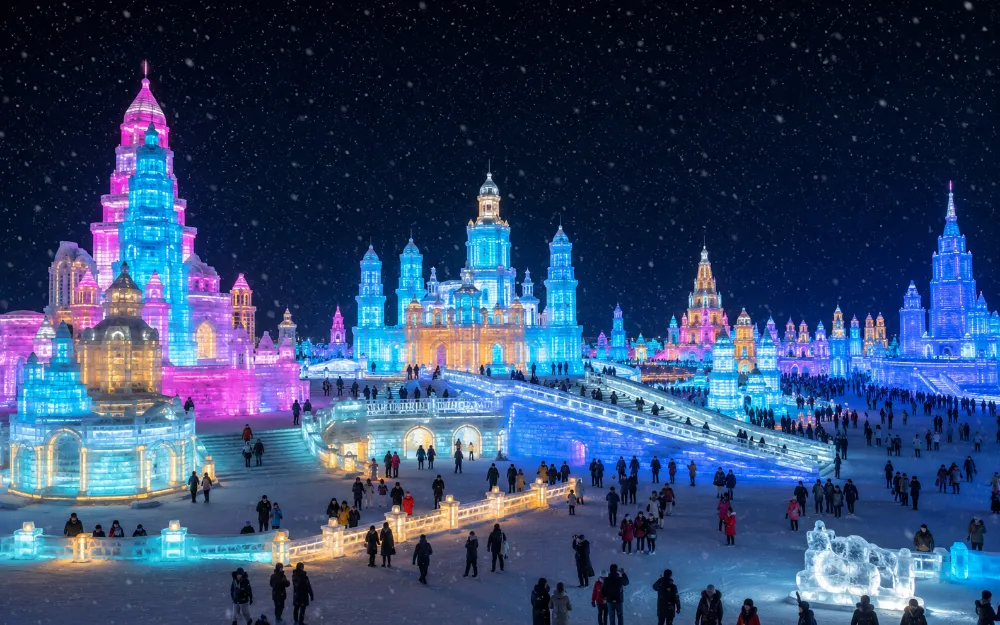
There’s a moment that catches almost every first-time visitor off guard at the Harbin Snow Festival China is famous for: standing at the entrance gate as dusk settles in, watching an entire skyline of ice, towers, palaces, bridges, all of it glowing from within as the lights switch on. It doesn’t look quite real. Photos of the event circulate constantly online, but they tend to flatten the scale of the thing, and scale is really the point here. This isn’t a handful of ice sculptures in a park. It’s closer to an entire city built from frozen river water, rebuilt from scratch every single winter, then left to melt away by spring.
This guide covers what the Harbin Snow Festival China hosts every winter actually is, how it got started, what to expect at each major venue, and how to plan a visit that doesn’t leave you frozen and miserable instead of amazed.
What Exactly Is the Harbin Snow Festival
The event most people mean when they say “Harbin Snow Festival” is officially known as the Harbin International Ice and Snow Sculpture Festival, and it’s widely recognized as the largest ice and snow festival on the planet. It takes place annually in Harbin, the capital of Heilongjiang province in China’s far northeast, a city that sits close enough to Siberia that winter cold fronts roll in with very little to slow them down. Average winter temperatures hover around -16.8°C, and lows of -25°C aren’t unusual, which sounds brutal on paper but turns out to be exactly the kind of cold that makes a festival built entirely from ice and snow actually possible.
The festival itself runs across roughly two and a half months, generally opening in mid-to-late December and continuing through late February, with an official opening ceremony usually held around January 5th. That ceremony date isn’t arbitrary. It traces back to January 5, 1985, when the modern festival was formally established at Zhaolin Park, and the date has stuck as the symbolic kickoff ever since, even though the main venues typically open to visitors weeks earlier.
How a City Started Carving Ice Lanterns and Ended Up With the World’s Biggest Winter Festival
The roots of this whole spectacle go back further than most visitors realize. Harbin’s relationship with ice art started in 1963, with a modest tradition of ice lantern displays and winter garden parties, essentially neighborhood-scale decorations rather than anything resembling today’s towering ice skyscrapers. Like a lot of cultural activities in China during that period, the tradition was interrupted for years during the Cultural Revolution before being formally revived and announced as an annual event at Zhaolin Park on that January 5, 1985 date.
The festival kept growing from there, and in 2001 it merged with Heilongjiang’s International Ski Festival, taking on its current full name: the Harbin International Ice and Snow Sculpture Festival. That merger mattered, because it folded winter sports and skiing culture into what had previously been mostly a sculpture-viewing event, broadening the whole thing into the multi-venue, multi-activity festival it is today.
Along the way, the festival has racked up some genuinely impressive records. In 2007, it featured a sculpture honoring Canadian doctor Norman Bethune and earned a Guinness World Record for the largest snow sculpture ever built: 250 meters long, 8.5 meters high, using over 13,000 cubic meters of packed snow. By 2019, at the 35th edition, the flagship Ice and Snow World venue had expanded to cover more than 600,000 square meters and included over 100 separate landmark structures, built from a combined 110,000 cubic meters of ice and 120,000 cubic meters of snow. The most recent edition pushed that scale even further, with the venue expanding to roughly 1.2 million square meters, its largest footprint yet, and a central ice tower reportedly reaching the equivalent height of more than fourteen stories.
The numbers on visitor turnout are just as striking. The festival drew an estimated 3.56 million visitors in a recent season, generating tens of billions of yuan in tourism revenue, figures that have turned what started as a neighborhood ice lantern display into one of the most economically significant tourism events in northern China.
The Main Venues: Where to Actually Go
Ice sculptures show up scattered all across Harbin during festival season, dotting public squares and boulevards throughout the city, but three venues do the real heavy lifting in terms of scale and spectacle. Understanding what each one offers, and roughly when to visit each, makes a real difference in how smoothly the trip goes.
Harbin Ice and Snow World: The Main Event
When people picture the Harbin Snow Festival, what they’re usually picturing is Harbin Ice and Snow World, located on the north bank of the Songhua River in the Songbei District. This is the festival’s flagship venue, often nicknamed the “Disneyland of Ice and Snow,” and for good reason. The park is built almost entirely from blocks of ice harvested directly from the frozen Songhua River, carved into towers, castles, bridges, and elaborate structures, many of them several stories tall, all wired internally with multicolored LED lighting that transforms the entire landscape after sunset.
The park typically operates from around 10:00 AM to 10:00 PM, though the experience genuinely shifts depending on when you arrive. Visiting in daylight lets you appreciate the clarity and craftsmanship of the ice itself, since deionized water is often used to produce blocks as transparent as glass rather than the cloudier ice you’d get otherwise. But the real transformation happens at dusk, when the internal lighting kicks in and the entire park shifts from a daytime ice sculpture garden into something closer to a glowing, otherworldly cityscape. Most seasoned visitors recommend timing arrival for around 3:00 PM, giving enough daylight to appreciate the architecture before sticking around for the lighting transition.
Because temperatures drop sharply after sunset, and this is already a place where daytime highs rarely climb much above freezing, most guides recommend capping your visit inside the park at around four hours. Beyond that, the cold tends to outlast the novelty for most visitors, however magical the surroundings.
Sun Island: Where the Snow Sculptures Live
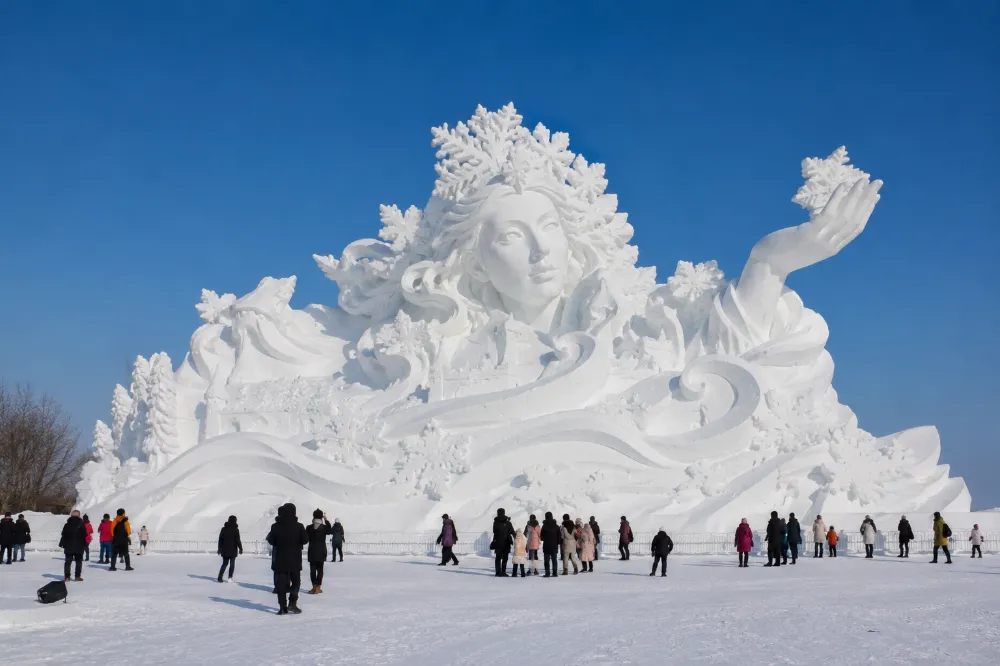
Across the river from the city center, Sun Island hosts the International Snow Sculpture Art Expo, the festival’s other major venue and a meaningfully different experience from Ice and Snow World. Where the main park is built from carved ice blocks and depends heavily on internal lighting for its visual impact, Sun Island works with packed snow, and the results are judged largely in natural daylight rather than after dark.
Artists from around the world travel here to compete and create monumental snow sculptures, some towering over three stories high, depicting everything from pandas and mythical creatures to recreations of famous global landmarks. The park typically operates from 8:00 AM to 4:00 PM, and a full visit usually takes two to three hours. Since the sculptures aren’t illuminated at night, the conventional wisdom among repeat visitors is to tour Sun Island in the morning while the light is good, then head over to Ice and Snow World in the afternoon to catch both the daylight detail and the evening light show in a single, well-paced day.
Zhaolin Park: The Original, More Intimate Venue
For a quieter, smaller-scale taste of the tradition that started all of this, Zhaolin Park, located centrally within the city and an easy walk from the Central Pedestrian Street, offers a more child-friendly and intimate experience. This is where the festival’s roots actually live, and the ice lantern displays here tend to be smaller and more delicately detailed than the skyscraper-scale builds at the main venues, many of them created by students and emerging young artists rather than professional sculpture teams. The park typically runs from around 9:00 AM to 9:00 PM and often hosts live ice-carving competitions, giving visitors a chance to watch sculptors actually at work rather than only viewing finished pieces.
Beyond the Sculptures: What Else Happens During the Festival
Treating the Harbin Snow Festival as purely a sculpture-viewing event undersells what’s actually on offer. The festival has, over the decades, expanded into a sprawling celebration of winter culture generally, with activities stretching well beyond standing around admiring carved ice.
Winter sports feature heavily, including skiing, ice skating, snow tubing, and ice biking, alongside more traditional regional pastimes like ice fishing on the frozen Songhua River. The flagship venue includes a snow ferris wheel, ice acrobatics performances, dance carnivals, and stretches of food vendors serving regional specialties, lamb skewers and other warming street food being particularly popular among visitors trying to fend off the cold from the inside. Recent editions have organized the experience around multiple themed tourist routes and have packed the festival calendar with well over a hundred separate cultural, sporting, and economic events spread across the festival’s full run, along with opening ceremonies built around fireworks, drone light shows, and theatrical performances.
The festival has also developed a genuine international dimension over the years. Sculpture teams travel in from around the world to compete, and past editions have featured sculptures honoring international figures and themes, a notable example being the Canadian-themed sculpture commemorating Dr. Norman Bethune. Ice sculpture and snow sculpture competitions run throughout the festival’s duration, drawing professional carving teams competing for recognition in front of the millions of visitors passing through each season.
How the Ice Sculptures Are Actually Made
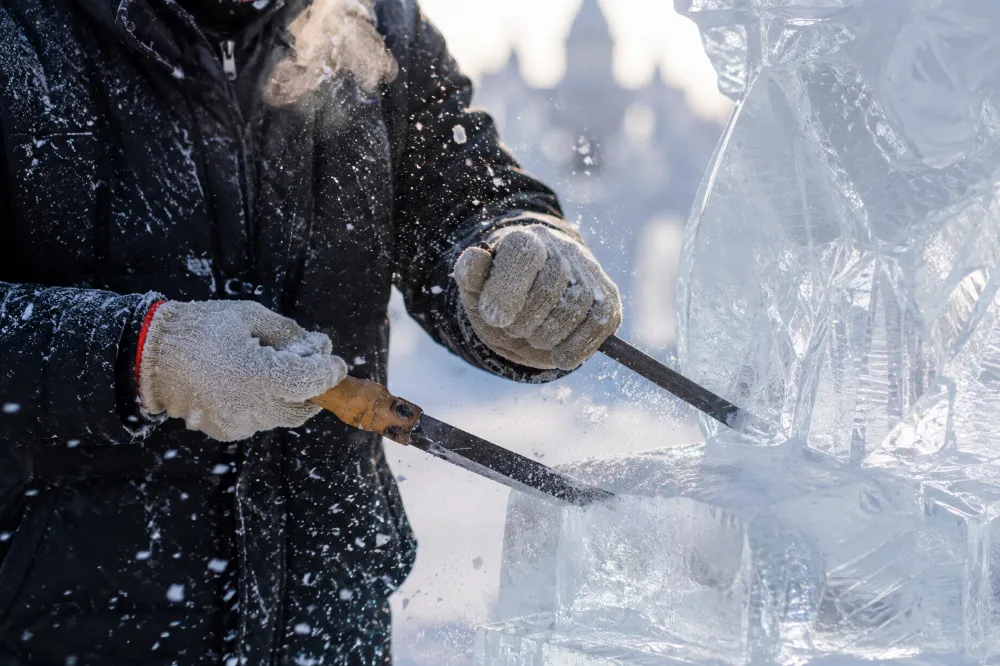
Part of what makes the festival worth seeing in person rather than just scrolling through photos is appreciating the genuine craft involved. Ice blocks are harvested directly from the frozen Songhua River, often using deionized water in controlled freezing for the clearest, most glass-like sculptures, which allows internal lighting to shine through with maximum brilliance and color saturation once installed.
Sculptors work with chisels, ice picks, and an array of specialized saws, carving massive blocks into intricately detailed structures, sometimes working continuously day and night in the lead-up to the festival’s opening to meet the deadline before opening day. The scale of individual pieces varies enormously: some recreate real architectural landmarks at dramatically exaggerated size, others depict animals, mythical creatures, or entirely invented fantasy structures, and a fair number incorporate working ice slides built directly into the design, giving visitors something to actually do rather than just photograph.
When to Go: Picking the Right Window
Timing matters more at this festival than at most travel destinations, partly because the entire spectacle is, quite literally, dependent on the weather holding cold enough to keep the structures intact. The festival generally spans from mid-to-late December through late February, but the experience shifts noticeably depending on which part of that window you choose.
January is generally considered peak season, both in terms of crowd size and sculpture condition. By this point, the structures are freshly built and in pristine condition, the lighting installations are fully operational, and the festival’s full slate of events and competitions is in motion. The trade-off is crowds: millions of visitors pass through during the festival’s busiest stretch, and recent reporting noted over a million visitors arriving in Harbin in a single day during the New Year holiday period alone.
Late December and early February tend to offer a reasonable middle ground, with somewhat thinner crowds while the sculptures remain largely intact and the festival atmosphere is still in full swing. Visiting toward the very end of February carries genuine risk, since the festival depends entirely on sustained sub-freezing temperatures, and unseasonably warm spells in late winter have, in past years, forced an early closure of the main venues when ice and snow structures began melting faster than anticipated. If your travel dates are flexible, building in a buffer rather than cutting it close to the festival’s scheduled end date is the safer bet.
Dressing for Temperatures That Don’t Forgive Mistakes
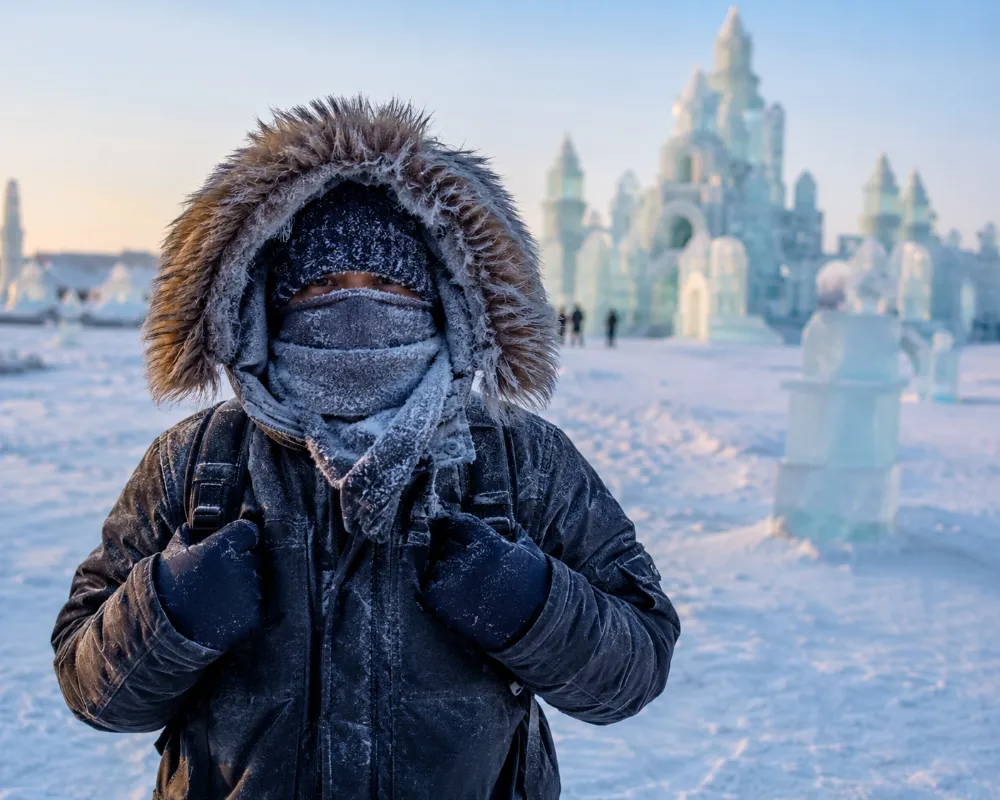
It’s worth being blunt about this: Harbin in January is genuinely, seriously cold, with temperatures regularly dropping below -20°C and occasionally lower. This isn’t the kind of cold a stylish wool coat and a scarf will handle. Layering properly here isn’t optional, and most visitors who underestimate it end up cutting their visit short, shivering through what should have been a magical experience.
A functional system generally starts with thermal base layers, moves through an insulating mid-layer, and finishes with a genuinely windproof, insulated outer shell, ideally rated for extreme cold rather than ordinary winter weather. Insulated, waterproof boots matter just as much as the coat, since standing on packed ice and snow for hours will chill your feet faster than almost anything else. Thick gloves or mittens, a hat that actually covers your ears, and a face covering or scarf for wind protection round out the essentials. Many visitors also pack disposable hand and foot warmers, the kind sold in convenience stores, as a simple, cheap backup when the cold starts winning.
It’s also worth pacing your visit deliberately rather than trying to power through. Most experienced visitors plan in deliberate warm-up breaks, ducking into a heated rest area, a café, or even just a covered structure within the venue, rather than attempting to tour for hours straight in sub-zero conditions.
Getting Around and Where to Stay
Public transportation to the festival venues is generally not recommended, somewhat counterintuitively given how walkable parts of central Harbin otherwise are. With millions of visitors converging on a handful of venues during peak season, buses fill up fast and taxis become difficult to flag down, and standing on a freezing street corner waiting for transportation that may not show up is exactly the kind of situation the layering advice above is meant to prevent. Most visitors rely on private transfers, hotel shuttle arrangements, or ride-hailing apps, with the subway also offering a reasonably reliable option for reaching Ice and Snow World specifically.
For accommodation, the area around Central Street (Zhongyang Pedestrian Street) offers more budget-friendly hotel options, with the added benefit of being within walking distance of landmarks like St. Sophia Cathedral and Zhaolin Park, plus easy access to shopping, dining, and nightlife. The drive from this area out to Ice and Snow World typically takes 20 to 30 minutes. For a more upscale stay, or for travelers prioritizing proximity to the main festival venue, the Songbei District, where Ice and Snow World itself is located, has a growing cluster of higher-end and family-friendly hotels.
Tickets and Practical Costs
Pricing varies by venue, with the main Ice and Snow World park requiring a paid ticket, typically priced somewhere in the range of 320 to 330 yuan for a standard adult entry, while venues like the Harbin International Ice and Snow Sculpture Festival’s broader city displays and Zhaolin Park are largely free or carry only a nominal fee. Combo tickets covering multiple venues are often available and can offer meaningful savings if you’re planning to see more than just the flagship park.
Because exact dates and prices can shift slightly year to year depending on weather conditions and event planning, it’s worth checking official sources or a reputable local tour operator roughly a month ahead of any planned trip, rather than relying on a fixed date carried over from a previous season.
Why This Festival Keeps Getting Bigger Every Year
It’s worth pausing on why a single winter event in a regional Chinese city has managed to keep scaling up decade after decade rather than plateauing the way a lot of tourism festivals eventually do. Part of the answer is straightforward civic investment: Harbin’s local government has treated the festival as a flagship economic driver for years now, channeling resources into expanding venue footprints, recruiting international sculpting talent, and building out the surrounding infrastructure, hotels, transport links, themed attractions, needed to absorb millions of visitors over a roughly ten-week window.
There’s also a simple supply-and-demand logic at play. Few places on earth combine the climate, the river access for harvesting ice, and the accumulated decades of carving expertise that Harbin has built up since 1963. That combination is genuinely difficult to replicate elsewhere, which has let the festival keep claiming the title of the world’s largest ice and snow festival even as competing winter destinations have tried to build their own versions. Social media has clearly amplified the effect too: a festival built almost entirely around dramatic, photogenic visuals was always going to benefit disproportionately once smartphone photography and platforms built for sharing images became the default way people plan travel, and recent editions have leaned into that reality with drone light shows and increasingly elaborate evening illumination designed as much for photographs as for in-person viewing.
A Few Things First-Timers Tend to Get Wrong
Talk to enough repeat visitors and a handful of recurring mistakes come up again and again. The first is underestimating how much ground there actually is to cover. Ice and Snow World alone spans well over a million square meters in its current form, and trying to see everything without a rough plan often means running out of daylight, or worse, running out of cold tolerance, before reaching the parts of the park you actually wanted to see most.
The second common mistake is assuming evening photography will go smoothly without any preparation. Phone batteries drain dramatically faster in extreme cold, sometimes shutting down entirely within minutes of sustained exposure, so experienced visitors keep their phone in an inside jacket pocket between shots rather than holding it exposed to the air, and many bring a portable battery pack kept warm inside a layer of clothing.
The third is treating the festival as an all-day, single-stretch outing. Given how punishing the cold becomes after a few hours, the visitors who tend to enjoy themselves most are the ones who break the day into distinct chunks, Sun Island in the morning, a long lunch and warm-up indoors, then Ice and Snow World from mid-afternoon into the evening, rather than treating it as one continuous marathon against the cold.
Combining the Festival With the Rest of Harbin
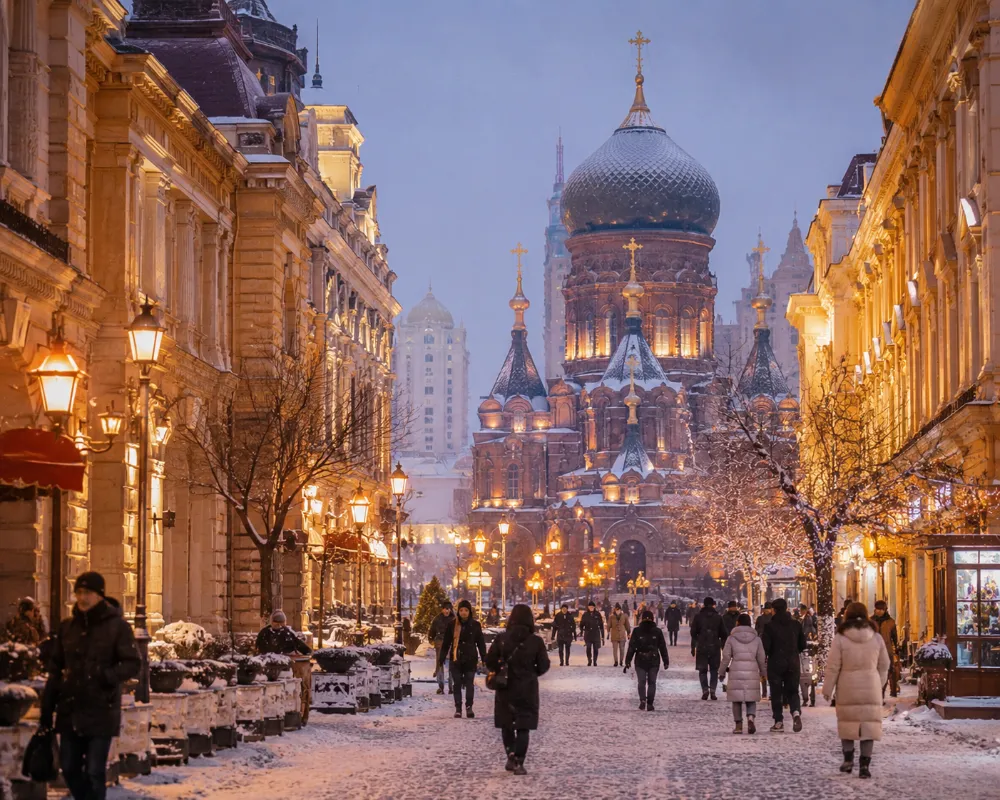
Given how much of the festival experience is concentrated into focused, multi-hour visits at specific venues, most travelers find it worthwhile to build out a fuller Harbin itinerary around the festival dates rather than treating the trip as a single-purpose visit. The city’s Russian colonial-era architecture, particularly around St. Sophia Cathedral and the broader Central Street area, reflects Harbin’s unusual history as a major stop along the historic China-Russia railway, and offers a genuinely different, more architectural counterpoint to the ice spectacle. Year-round, Harbin’s indoor ice and snow attractions also mean that even travelers visiting outside the main festival window can get a taste of the city’s icy identity, though nothing quite replicates the scale of the full winter festival in its prime season.
Frequently Asked Questions
What is the Harbin Snow Festival China is known for?
The Harbin Snow Festival China hosts each winter, formally known as the Harbin International Ice and Snow Sculpture Festival, is an annual winter event held in Harbin, recognized as the largest ice and snow festival in the world. It features massive illuminated ice sculptures, giant snow carvings, winter sports, and cultural performances spread across multiple venues throughout the city.
When does the Harbin Snow Festival take place?
The festival generally runs from mid-to-late December through late February, with an official opening ceremony typically held around January 5th. January is considered peak season, offering the freshest sculptures and the fullest slate of festival activities, though it also brings the largest crowds.
What are the main venues at the Harbin Snow Festival?
The three primary venues are Harbin Ice and Snow World, the flagship park built from illuminated ice sculptures; Sun Island, home to the International Snow Sculpture Art Expo featuring massive snow carvings; and Zhaolin Park, a smaller, more intimate venue known for delicate ice lantern displays and student-created works.
How cold does it get during the Harbin Snow Festival?
Temperatures regularly drop below -20°C during the festival, with occasional lows reaching -25°C or colder. Proper layered, windproof, insulated clothing along with insulated waterproof boots is essential for a comfortable visit.
How did the Harbin Snow Festival start?
The tradition traces back to 1963, beginning as a modest local ice lantern display and winter garden party. After being interrupted for years during the Cultural Revolution, it was formally revived as an annual event at Zhaolin Park on January 5, 1985, and merged with Heilongjiang’s International Ski Festival in 2001 to become the festival known today.
Can Americans Travel to China in 2026? Complete Visa, Entry Requirements & Travel Guide