If you’re trying to get a handle on dunhuang history and culture, most people who’ve heard of the place know it for one thing: a cliff face riddled with painted caves out in the Gobi Desert. That’s not wrong, exactly, but it sells the place short. Dunhuang’s history and culture run far deeper than a single archaeological site, however extraordinary that site happens to be. For roughly a thousand years, this small oasis town sat at one of the most consequential crossroads on the planet, where camel caravans, Buddhist monks, Persian merchants, and Chinese imperial officials all passed through the same narrow strip of green wedged between two deserts and a mountain range. Understanding Dunhuang means understanding why a dot on the map in northwestern Gansu province became, for a few centuries, one of the most cosmopolitan places on earth.
This guide walks through how Dunhuang earned that status, what’s left to see today, and how to actually plan a visit that does justice to a place this layered.
Why Dunhuang Existed in the First Place
Dunhuang’s entire reason for being comes down to geography. The town sits in a natural oasis at the western edge of the Hexi Corridor, the narrow passage of habitable land squeezed between the Qilian Mountains to the south and the deserts of the Gobi and Taklamakan to the north. For anyone trying to move goods or people between China and Central Asia, there simply weren’t many other options. You either passed through this strip of land, or you didn’t make the journey at all.
The Han dynasty understood this strategic value early. Emperor Wu established Dunhuang as a frontier garrison outpost in 111 BC, primarily to defend against incursions by the Xiongnu, a nomadic confederation that had been a persistent threat to Han territory. The name itself, often translated as “blazing beacon,” refers to the beacon towers used along this frontier to warn of approaching raids. What started as a military outpost, though, quickly became something far more significant: the last major Chinese settlement before travelers headed west into Central Asia, and the first one reached by anyone arriving from that direction.
That positioning turned Dunhuang into an essential waystation along the network of trade routes now collectively known as the Silk Road. Merchants stopped here to resupply, rest their animals, and trade goods before continuing into the punishing terrain of the Taklamakan Desert. Pilgrims and monks did much the same, pausing to pray for safe passage or give thanks for having survived it. Over centuries, this constant flow of travelers turned Dunhuang into something genuinely unusual for its time: a small desert town where Chinese, Tibetan, Sogdian, Khotanese, Uighur, Indian, and even occasional European and Hebrew influences all mixed together in daily life.
The Mogao Caves: A Thousand Years of Buddhist Art Carved Into a Cliff
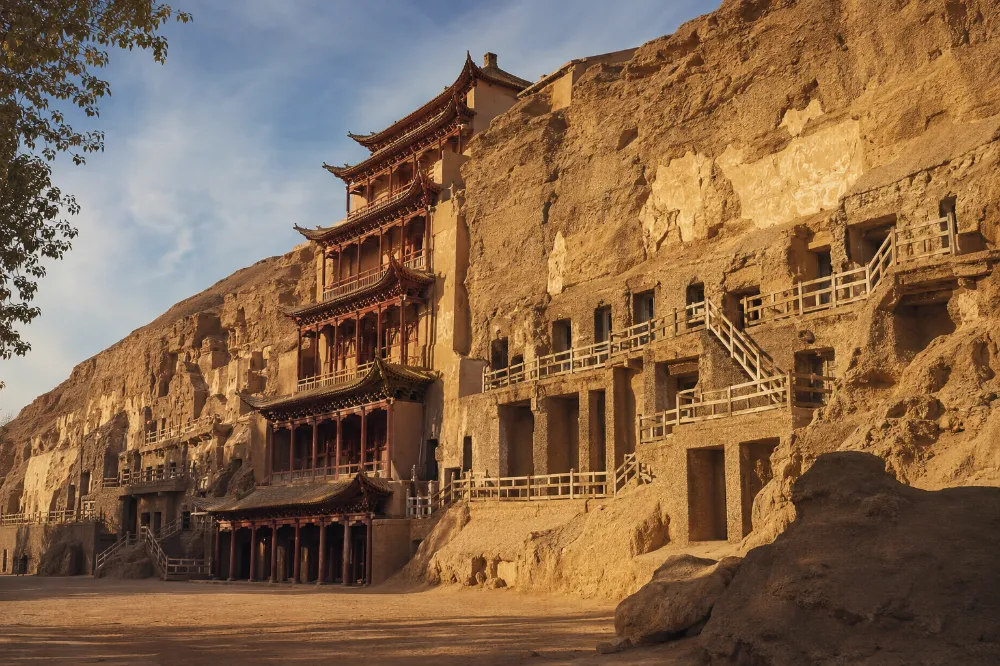
Everything that makes Dunhuang historically significant converges at the Mogao Caves, located about 25 kilometers southeast of the modern city. According to tradition, the story begins in 366 CE with a wandering monk named Yuezun, who is said to have seen a vision of a thousand golden Buddhas radiating from the cliff face above the Daquan River. Inspired by what he’d witnessed, he carved a small meditation cell into the rock. Others soon followed his example, and what began as a single hermit’s shrine grew, over the following ten centuries, into a sprawling complex of nearly 500 caves stretching across roughly a mile of cliff face.
The scale of what survives is genuinely difficult to grasp without seeing it. Today, 492 caves are preserved, containing approximately 45,000 square meters of murals and more than 2,000 painted sculptures, some towering over 30 meters tall. The caves span construction from the Northern Dynasties period all the way through the Yuan dynasty, meaning a single visit can move you through roughly a thousand years of continuous artistic development, dynasty by dynasty, all within the same cliff face.
How the Art Itself Evolved
What makes Mogao so valuable to historians isn’t just its age or scale, but the way the art inside genuinely shifts in style as you move from cave to cave, decade by decade. Early caves from the Northern Dynasties period show heavier influence from Indian and Central Asian Buddhist art, with figures that feel somewhat formal and otherworldly. By the time you reach the Sui and Tang dynasties, generally considered the artistic high point of the entire site, the style had transformed into something distinctly more Chinese: figures grew more naturalistic, compositions became more confident and crowded with detail, and the murals began depicting not just religious scenes but also everyday life along the Silk Road.
Cave 302, dating to the Sui dynasty, contains one of the earliest and most vivid depictions of Silk Road trade, showing a camel pulling a cart in a scene typical of the merchant caravans that passed through Dunhuang. Tang dynasty caves like 23 and 156 show workers tending fields and processions of warriors respectively, offering a kind of visual documentary of frontier life that text alone could never fully capture. By the Song dynasty, Cave 61 features a sweeping landscape of Mount Wutai rendered with remarkable cartographic precision, mapping out mountains, rivers, temples, roads, and travelers in a single composition.
The largest Buddha sculptures at the site, some constructed during the Tang dynasty, rise dramatically inside multi-story cave temples built specifically to house them, including the famous nine-story temple structure enclosing Cave 96, which has become one of the most recognizable architectural features at Mogao when viewed from a distance.
The Library Cave and Its Astonishing Discovery
If the murals and sculptures represent Mogao’s artistic legacy, the discovery of the so-called Library Cave represents its most extraordinary contribution to historical scholarship. At some point in the early eleventh century, for reasons that remain genuinely unclear, an enormous archive of documents and artifacts was sealed inside a small chamber adjacent to one of the main caves, known today as Cave 17.
This hidden chamber remained undisturbed for roughly nine centuries. Then, in 1900, a Daoist monk named Wang Yuanlu, who had taken it upon himself to act as a self-appointed caretaker of the largely abandoned site, discovered the sealed room. Inside, he found nearly 50,000 manuscripts, along with paintings, textiles, and other artifacts, dating from periods well before the cave’s eleventh-century sealing. The documents themselves spanned an extraordinary range of languages and subjects: Buddhist sutras alongside Confucian and Daoist texts, administrative records, contracts, and personal letters, written in Chinese, Tibetan, Sanskrit, Sogdian, Old Turkish, and other languages, even including occasional Hebrew manuscripts that hint at the breadth of cultural contact passing through this single desert town.
The discovery has been described by scholars as one of the greatest archaeological finds in the history of East Asian studies, offering an unprecedented window into the religious, economic, and social life of the medieval Silk Road. Unfortunately, the story of the Library Cave also has a more complicated chapter. In the years following its discovery, foreign explorers and archaeologists, most notably the Hungarian-British scholar Aurel Stein and French sinologist Paul Pelliot, acquired large portions of the collection, which subsequently dispersed to institutions including the British Museum, the Bibliothèque nationale de France, and others around the world. Today, scholars and conservators continue working to digitize and reunite this scattered archive, at least virtually, so that researchers anywhere can study manuscripts that are now physically held on different continents.
Decline, Abandonment, and Rediscovery
Mogao’s fortunes rose and fell with the Silk Road itself. The site reached its creative and religious peak during the Tang dynasty, when Dunhuang functioned as a major hub of both commerce and Buddhist worship, attracting patronage from clergy, local elites, merchants, military officers, and occasionally the imperial court itself. After the Tang dynasty’s decline, however, new cave construction slowed considerably, and ceased entirely after the Yuan dynasty.
The underlying cause was a broader shift in global trade patterns. As maritime routes increasingly took over the movement of goods between China and the rest of the world, the overland Silk Road gradually lost its commercial importance. By the Ming dynasty, the route had been officially abandoned, and Dunhuang itself slowly depopulated, fading from a bustling crossroads into a forgotten desert outpost. Most of the caves were sealed off or simply left untended, though the site never entirely lost its role as a place of local pilgrimage.
It would take the chance rediscovery of the Library Cave in 1900 to pull Dunhuang back into global awareness, setting off a wave of scholarly and, later, conservation interest that continues to this day. In 1961, the site was designated a State Priority Protected Site by the Chinese government, and in 1987, the Mogao Caves were inscribed as a UNESCO World Heritage Site, cementing their status as one of the great cultural treasures not just of China, but of human civilization broadly.
Visiting the Mogao Caves Today
Modern conservation concerns shape almost everything about how the caves are experienced today. Given that hundreds of thousands of visitors pass through annually, and that human breath alone introduces damaging levels of humidity and carbon dioxide into these enclosed spaces, site managers have had to balance public access against long-term preservation in increasingly careful ways.
In practice, this means visits today are highly structured rather than freely wandered. Tickets are sold through a visitor center located some distance from the caves themselves, where guests typically watch a pair of short films before being shuttled to the site: one covering the broader history of the region and the Silk Road, and another offering immersive, large-format views of cave interiors that aren’t physically accessible to the public, allowing visitors to experience details and chambers that would otherwise be off-limits. From there, a guide leads small groups through a rotating selection of open caves, with strict limits on time spent inside each one and a firm no-photography policy to protect the murals from light exposure.
It’s worth knowing this structure ahead of time, mainly so you don’t show up expecting the kind of self-paced wandering you might get at a typical archaeological site. The trade-off is reasonable, though: without these restrictions, the murals that have survived a thousand years of desert climate likely wouldn’t survive another century of unrestricted tourism. The visitor center itself, along with the adjacent Mogaoku Museum, is worth allotting extra time for, since it houses artifacts recovered from the site, detailed exhibits on the conservation work undertaken in partnership with international institutions, and full-scale replica caves that let visitors examine details up close in a way the dim lighting of the originals doesn’t always allow.
Beyond Mogao: The Rest of Dunhuang’s Cultural Landscape
While the Mogao Caves understandably dominate any conversation about Dunhuang’s historical significance, treating them as the only worthwhile destination in the area would mean missing a surprising amount of what makes this oasis town distinctive, both historically and scenically.
Mingsha Mountain and Crescent Lake
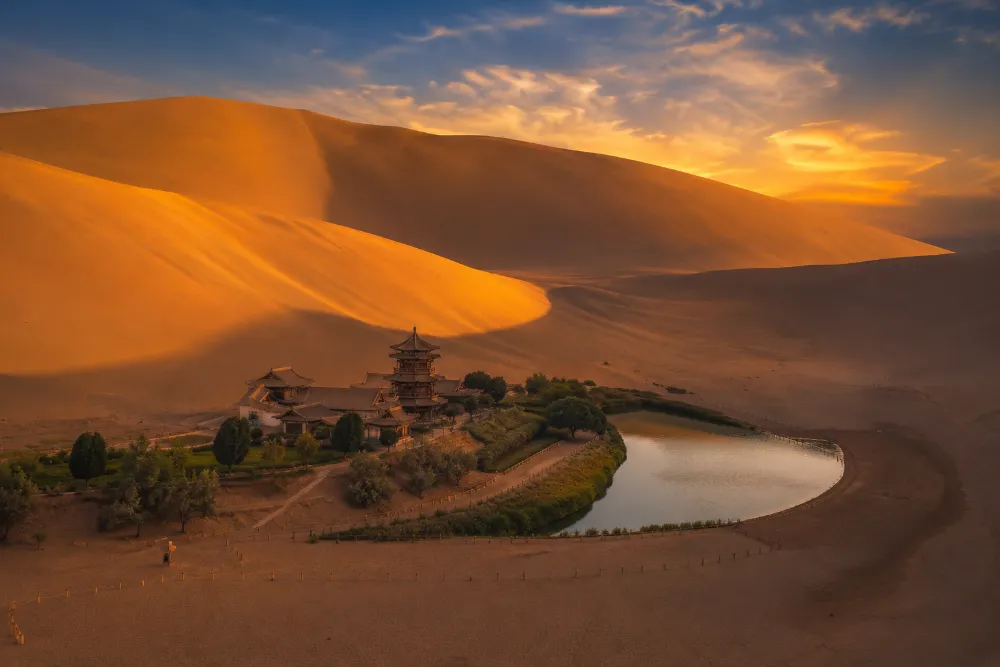
Just south of Dunhuang city sits one of the more visually striking pairings in Chinese geography: Mingsha Mountain, a range of towering sand dunes that seem to rise directly out of the desert floor, and Crescent Lake, a small, crescent-shaped spring-fed pool tucked improbably into a hollow among the dunes. The name Mingsha translates roughly to “singing sands,” a reference to the distinctive sound the dunes are said to produce when wind moves across them or when sand shifts underfoot, a phenomenon documented at a handful of dune fields around the world but rarely as dramatically as here.
Crescent Lake itself has functioned as something of a desert oasis legend for centuries, a small body of water that, against all logical expectation, has persisted in essentially the same spot surrounded by shifting sand for well over a thousand years without being buried. Historical pavilions and small temple structures line its edges today, giving the whole scene a slightly otherworldly quality, particularly around sunset when the dunes take on deep gold and amber tones and the crowds of daytime visitors begin to thin out.
For travelers interested in a more active experience, this is also where most visitors arrange camel rides, sand-sledding, or simply the considerable effort of climbing one of the larger dunes for a panoramic view back across the oasis toward the city. It’s worth noting that the sand here is genuinely steep and exhausting to climb directly, so many visitors use the rope ladders provided at popular routes rather than attempting it without assistance.
Yumen Pass and Yangguan Pass
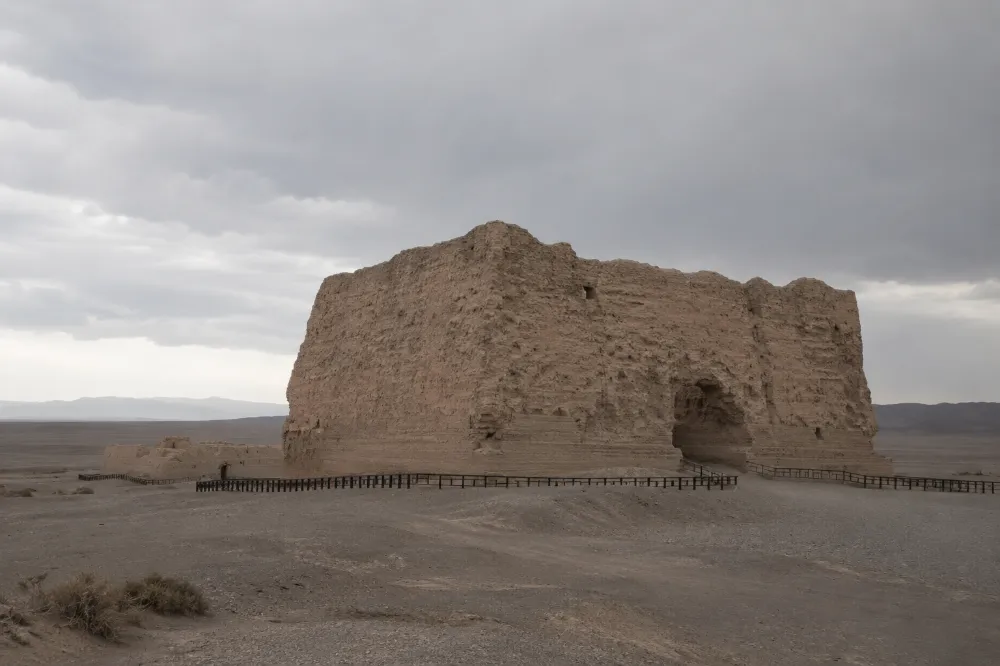
For visitors with a deeper interest in the military and administrative history of the Silk Road, the ruins of Yumen Pass and Yangguan Pass, both west and southwest of Dunhuang respectively, offer a more austere but historically rich counterpoint to Mogao’s artistic splendor. These were among the key checkpoints controlling movement along the Han dynasty’s western frontier, marking the literal edge of Chinese imperial authority for centuries.
Yumen Pass, whose name translates to “Jade Gate,” takes its name from its historical role as a key point along the routes through which jade and other goods moved between China and Central Asia. What remains today is largely a weathered earthen ruin standing alone in flat desert terrain, but its sparse, windswept setting does more to convey the genuine remoteness and hardship of frontier life along the ancient Silk Road than almost any restored monument could. Yangguan Pass similarly marked a frontier checkpoint and has long carried symbolic weight in Chinese literature and poetry as a place associated with departure, exile, and the melancholy of leaving the cultural heartland behind for unknown lands further west.
Yardang Geological Park
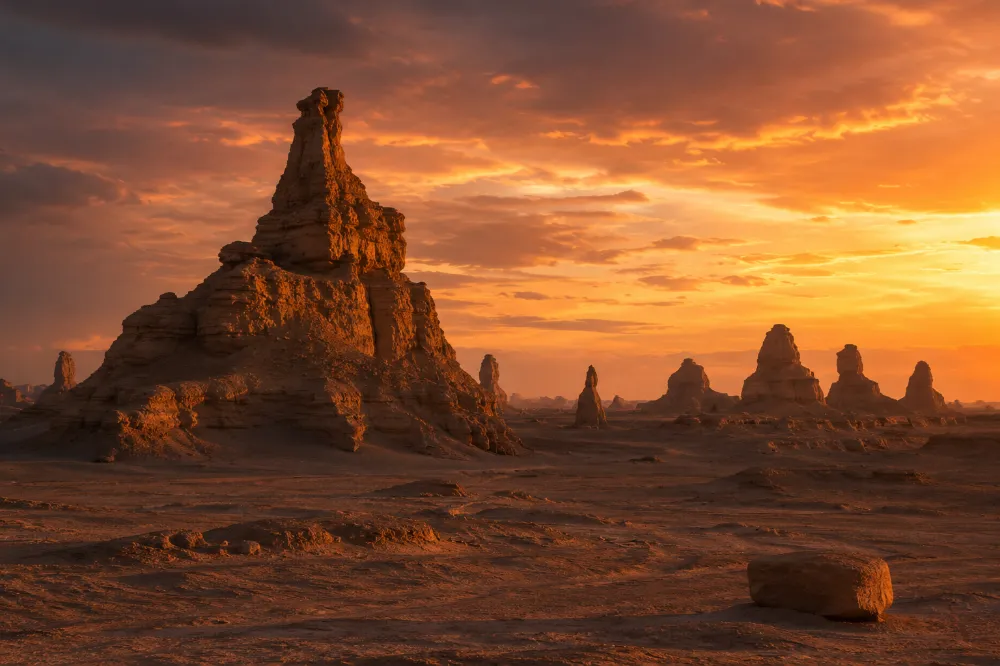
Roughly two hours outside the city, the Yardang Geological Park, sometimes referred to locally by its more evocative nickname, the “Ghost City,” showcases a different kind of natural spectacle entirely. Centuries of wind erosion have carved the area’s soft sedimentary rock into clusters of towering, irregular formations, some resembling castles, animals, or human silhouettes depending on the angle and time of day. The site is particularly striking near sunset, when long shadows and shifting light dramatically alter the apparent shape of the formations, and when the wind itself often produces eerie sounds as it moves through the narrow channels between rock towers, which likely contributed to the area’s ghostly reputation among travelers over the centuries.
Dunhuang City and Its Night Market
The city of Dunhuang itself, though modest in size compared to major Chinese metropolitan centers, retains a genuinely pleasant small-oasis-town character that’s worth experiencing beyond simply using it as a base for day trips. The Dunhuang Night Market, located centrally, draws both locals and travelers each evening with stalls selling regional specialties, handicrafts inspired by Silk Road and Buddhist motifs, and a wide range of Gansu and Xinjiang-influenced street food, reflecting the same cultural crossroads character that shaped the city’s deeper history.
How Dunhuang’s History Shaped Its Distinct Cultural Identity
What ultimately sets Dunhuang apart from many other historical sites in China is the sheer diversity of influences that shaped it, a direct consequence of its function as a meeting point rather than a center of any single empire or tradition. Dunhuang art is frequently described by scholars as a genuine amalgamation: it blends Han Chinese artistic conventions with stylistic elements absorbed from ancient Indian and Gandharan Buddhist traditions, while also incorporating visual and cultural input from Turkic peoples, Tibetans, and other ethnic groups who passed through or settled in the region at various points.
This blending wasn’t merely artistic. At various points in its history, Dunhuang fell under Tibetan political control, administered through a hybrid system that merged Tibetan governance structures with existing Han Chinese administrative practices, with both Tibetan officials and local Han elites participating in local rule. The result, reflected vividly in the cave art commissioned across different periods, is a cultural record that resists easy categorization as purely Chinese, purely Buddhist, or purely anything else. It’s a genuine record of cultural synthesis, built up patiently over centuries by an enormous range of patrons, from emperors and foreign dignitaries down to local merchants, soldiers, and women’s devotional groups who pooled resources to sponsor smaller caves.
Planning a Visit to Dunhuang
Dunhuang is reachable by air, with flights connecting to major Chinese hubs including Beijing, Shanghai, Xi’an, and Chengdu, landing at an airport situated a short distance from the city center. Train service also connects Dunhuang to the broader Gansu and northwestern China rail network, though depending on your starting point, this can be a considerably longer journey than flying. Most travelers choose to base themselves in Dunhuang city itself, where accommodation and dining options are more developed, using it as a hub for day trips out to Mogao, Mingsha Mountain, and the more remote sites further afield like Yardang Geological Park.
Given Dunhuang’s desert climate, timing matters considerably more here than in many other Chinese destinations. Summers bring intense heat and strong sun exposure, particularly out among the dunes where there’s no shade whatsoever, while winters can be bitterly cold with biting wind, especially around exposed sites like the pass ruins. Spring and autumn tend to offer the most comfortable conditions for the kind of extensive outdoor exploration that a proper Dunhuang visit demands, though sandstorms remain a possibility at various points throughout the year given the surrounding desert terrain.
Because the Mogao Caves limit daily visitor numbers and structure access through scheduled tours, it’s worth allocating a full day for that site alone rather than trying to combine it with other major attractions, and arranging tickets in advance where possible rather than assuming same-day availability. Mingsha Mountain and Crescent Lake, being closer to the city and less restricted in terms of access, pair well together for a single afternoon or evening visit, particularly timed around sunset when both the lighting and the temperature are at their most forgiving.
Why Dunhuang Still Matters
It’s easy to treat Dunhuang as a remote curiosity, a desert outpost worth a detour mainly because of one spectacular cave complex. But getting a fuller picture of dunhuang history and culture reframes the place considerably. For roughly a thousand years, this small oasis functioned as a genuine meeting point of civilizations, where Buddhist monks debated philosophy alongside Sogdian traders haggling over silk, where Chinese administrators governed in tandem with Tibetan officials, and where artistic traditions from India, Persia, Central Asia, and China itself blended into something that existed nowhere else in quite the same form.
The Mogao Caves preserve that history in extraordinary physical detail, but the broader landscape around Dunhuang, from the singing dunes of Mingsha Mountain to the lonely ruins of Yumen Pass, tells the same story from different angles: of a frontier town that, against considerable odds, became one of the most culturally rich crossroads the ancient world ever produced.
Frequently Asked Questions
What makes the Mogao Caves historically significant?
The Mogao Caves preserve nearly a thousand years of continuous Buddhist art, from the 4th to the 14th century, making them one of the largest and most artistically diverse collections of Buddhist cave art in the world. The 1900 discovery of the Library Cave, containing tens of thousands of ancient manuscripts in multiple languages, also makes the site one of the most important archaeological finds related to medieval Silk Road history.
Why was Dunhuang important along the Silk Road?
Dunhuang’s location at the western edge of the Hexi Corridor made it the last major Chinese settlement before travelers crossed into Central Asia, and the first one reached from the other direction. This positioning turned it into an essential waystation for merchants, pilgrims, and officials, fostering centuries of cultural exchange between Chinese, Tibetan, Central Asian, and Indian civilizations.
What other attractions are there in Dunhuang besides the Mogao Caves?
Beyond Mogao, Dunhuang’s main attractions include Mingsha Mountain and Crescent Lake, known for their towering sand dunes and a small spring-fed lake; the historical ruins of Yumen Pass and Yangguan Pass, which marked the ancient frontier; and Yardang Geological Park, where wind-eroded rock formations have earned the site the nickname “Ghost City.”
Can visitors take photographs inside the Mogao Caves?
No. Photography is prohibited inside the caves themselves to protect the delicate murals from light exposure. Visitors can, however, view detailed digital reproductions and large-format films at the visitor center, which allow close inspection of cave interiors not normally open to in-person viewing.
What is the best time of year to visit Dunhuang?
Spring and autumn generally offer the most comfortable conditions for exploring Dunhuang’s outdoor sites, given the desert climate’s intense summer heat and cold, windy winters. Visitors should be prepared for strong sun exposure at sites like Mingsha Mountain regardless of season, since shade is minimal across the dune fields.