When Is2027 Chinese New Year?
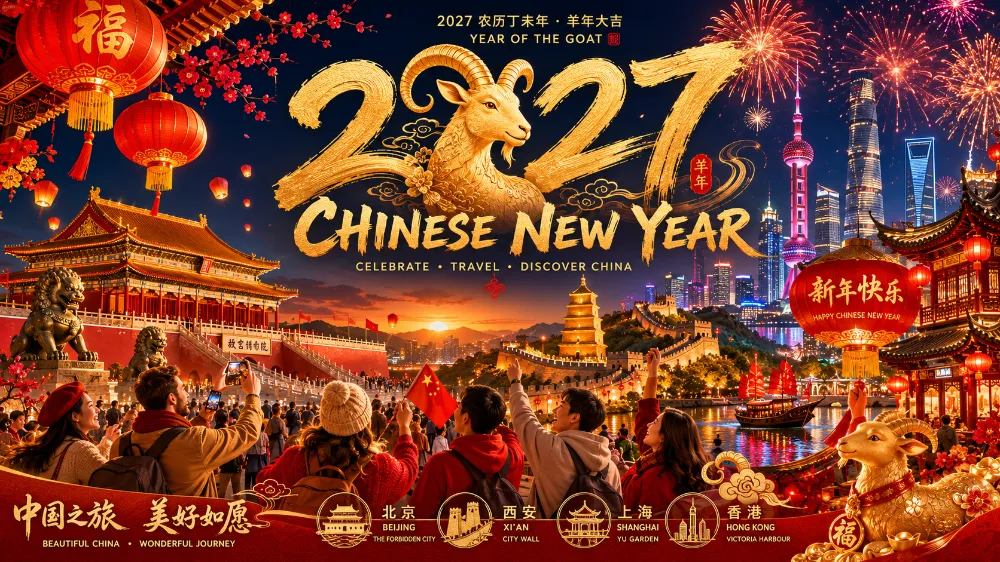
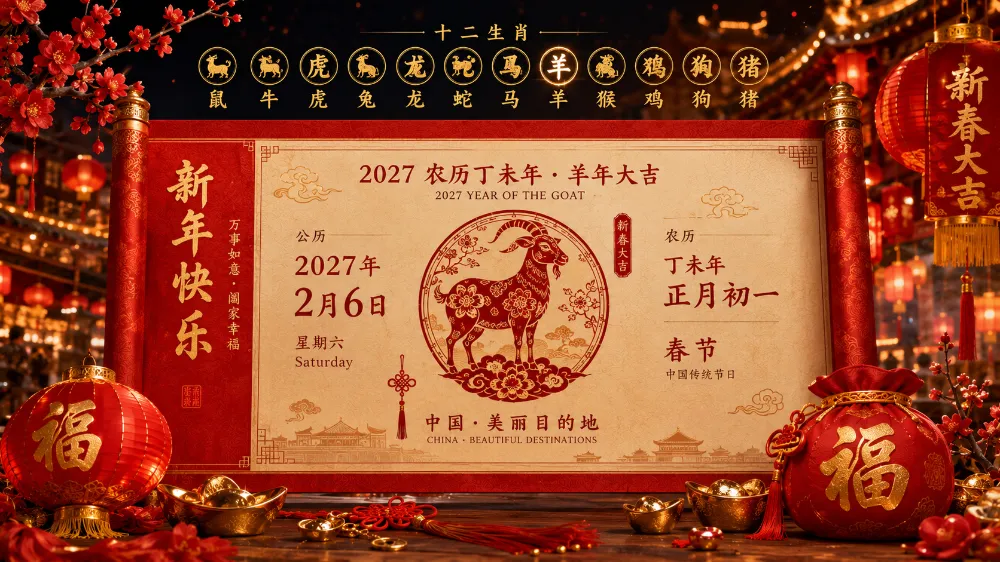
2027 Chinese New Year falls on Saturday, February6,2027. It marks the start of the Year of the Fire Goat (丁未年, Ding Wei Nian) in the Chinese zodiac. The official public holiday in China typically runs for seven days, from February6 (Chinese New Year’s Eve preparation day in some years) through February12,2027, though exact dates depend on the State Council’s annual announcement.
2027 Chinese New Year: A Straight Answer Up Front
If you’re wondering when2027 Chinese New Year falls — it’s Saturday, February6,2027. The Year of the Goat (sometimes translated as Sheep or Ram) begins that day, and it carries the Fire element in the traditional Chinese sexagenary cycle, making it specifically the Year of the Fire Goat (丁未年).
The seven-day public holiday in mainland China typically runs February6 through February12,2027, although the State Council usually publishes the exact dates in late December of the preceding year. The15-day celebration period, from Lunar New Year’s Eve (除夕 Chúxì) through the Lantern Festival (元宵节 Yuánxiāo jié), extends to February20,2027.
This guide covers everything: the exact dates, the cultural meaning of the Year of the Goat, the customs, the foods, and — most importantly — where to actually go in China if you want to experience Spring Festival the right way. Because honestly? Celebrating Chinese New Year in Beijing or Xi’an is one of those trips you’ll talk about for the rest of your life.
The Exact Dates: Lunar Calendar vs. Solar Calendar
Chinese New Year is a lunar event, so it falls on a different date every year on the Gregorian calendar. Here’s how2027 lines up.
The Key Dates for2027
- January24,2027 (Sunday) — Start of the Little Year (小年 Xiǎonián) in northern China. The kitchen god ceremony happens this day in many households.
- February5,2027 (Friday) — Lunar New Year’s Eve (除夕 Chúxì). Reunion dinner, family gatherings, the CCTV Spring Festival Gala.
- February6,2027 (Saturday) — Lunar New Year’s Day (春节 Chūnjié). The Year of the Goat begins.
- February7,2027 (Sunday) — Day2. Sons-in-law traditionally visit wives’ parents.
- February8,2027 (Monday) — Day3. Called “赤口” (Red Mouth), traditionally avoided for social visits.
- February12,2027 (Friday) — Day7. Renri (人日), the “Day of Humankind.”
- February20,2027 (Saturday) — Lantern Festival (元宵节). The grand finale.
How the Date Is Determined
The Chinese lunar calendar follows the cycles of the moon. The new moon closest to the beginning of spring (立春 Lìchūn, around February4 in the solar calendar) determines the date. For2027, that new moon falls on February6.
This means2027’s Chinese New Year is “early” by the standard of recent years —2028 will push it to late January, while2026’s CNY was on February17. The earliest possible CNY in the Gregorian calendar is January21; the latest is February20.
Public Holidays in China
China officially designates seven consecutive days as the Spring Festival holiday. For2027, expect the official window to be approximately February6 to February12, with adjustments for weekend shifting. During this week, most businesses close, transportation peaks, and the country essentially shifts into holiday mode.
In practice, the holiday extends well beyond the official week. Workers typically take an extra3–5 days off before or after to make a10–14 day break. This is the world’s largest annual human migration — known as Chunyun (春运) — and it involves roughly9 billion passenger trips over a40-day window.
The Year of the Fire Goat: What It Means
2027 is the Year of the Goat, also called Year of the Sheep or Year of the Ram. The Chinese character羊 (yáng) covers all of them. In the sexagenary cycle, the year is specifically 丁未 (Dīng Wèi) — Fire Goat.
The Chinese Zodiac Basics
Twelve animals rotate through the calendar: Rat, Ox, Tiger, Rabbit, Dragon, Snake, Horse, Goat, Monkey, Rooster, Dog, Pig.2027 is the eighth animal in the cycle, the Goat. Each animal also pairs with one of five elements (Wood, Fire, Earth, Metal, Water), creating a60-year cycle.
For2027, the element is Fire (丁 Dīng), making this the Fire Goat year. The last Fire Goat year was1967, the next will be2087. So if your family has stories about1967, that’s your reference point.
Symbolism of the Goat
The Goat (or Sheep) symbolizes:
- Gentleness and kindness — goats are considered docile, peaceful animals.
- Artistic sensibility — Goat years are associated with creative people and aesthetic pursuits.
- Family orientation — goats are herd animals, valuing group harmony.
- Compassion — in Buddhist and folk tradition, goats are seen as merciful creatures.
It’s not considered the luckiest zodiac year for career or money matters (the Dragon and Horse get more hype), but it’s traditionally seen as favorable for relationships, family life, and creative work.
Who Is “In” the Goat Year?
People born in Goat years include those born in1919,1931,1943,1955,1967,1979,1991,2003, and2015. In2027, those born in those years “offend Tai Sui” (犯太岁) — meaning they clash with the year’s energy and traditionally need to wear red, be cautious with major decisions, and perhaps visit a temple to pray for protection.
If you’re not Asian and you’re reading this, you might find the Tai Sui concept amusing. But ask any Chinese person born in a Goat year about2027, and they’ll likely have a plan — even if it’s just “wear more red underwear.”
The Origins: Why Does This Festival Even Exist?
Chinese New Year has roots going back roughly3,500 years. Different origin stories float around, and most are half-legend, half-history. Here are the main ones.
The Beast Named Nian
The most popular folk legend: a mythical beast called Nian (年) would come out of hiding on the first day of the lunar year to devour livestock, crops, and even people. People learned that Nian feared three things — fire, loud noise, and the color red. So they lit fires, set off firecrackers, hung red lanterns, and put up red paper decorations. All the iconic CNY traditions trace back to this.
This explains why red dominates everything, why firecrackers are central, and why the festival is so loud. The “beast” is essentially a metaphor for winter’s harshness and the dangers of the season.
The Shang Dynasty Origins
The earliest historical records of New Year celebrations come from the Shang Dynasty (c.1600–1046 BCE), where people performed year-end ceremonies to worship ancestors and natural gods. The festival evolved over centuries, absorbing elements from Buddhism, Daoism, and folk religion.
The Han Dynasty Calendar
The Han Dynasty (202 BCE –220 CE) standardized the lunar calendar and formalized the date. The festival as we know it today took shape during the Han and Tang dynasties.
The Legend of the Monster “Sui”
There’s also a related legend about a demon named Sui (祟) that would touch children’s heads while they slept, causing fever and illness. Parents would stay up all night to protect their children — and that’s the origin of Shousui (守岁), staying up late on New Year’s Eve.
The15 Days: What Happens When
Chinese New Year isn’t just one day. It’s a15-day festival arc, and each day has its own traditions.
Days1–4: Family Time
- Day1 (February6,2027) — Welcome the ancestors and the gods of heaven and earth. Wear red. No sweeping (don’t sweep away good luck). Vegetarian meals are traditional in many regions.
- Day2 (February7,2027) — Daughters’ Day (迎婿日). Married women visit their birth parents with their husbands.
- Day3 (February8,2027) — Red Mouth Day (赤口). Traditionally avoided for social visits because arguments are thought to be more likely.
- Day4 (February9,2027) — Welcome the Kitchen God back. The灶王爷 returns from heaven to report on the family.
Days5–7: Return to Public Life
- Day5 (February10,2027) — Welcoming财神 (God of Wealth). Businesses often reopen this day, with dragon dances and firecrackers.
- Day6 (February11,2027) — “马日” (Horse Day). Send away poverty (送穷).
- Day7 (February12,2027) — Renri (人日), the Day of Humankind. Traditionally everyone’s birthday, celebrated with a special soup called “七菜羹” (seven-vegetable broth) in some regions.
Days8–15: Public Celebrations
- Day8 (February13,2027) — Family gatherings continue. Pre-Lantern Festival activities ramp up.
- Days9–14 (February14–19,2027) — Preparations for the Lantern Festival. Lantern markets open. Temple fairs go into full swing.
- Day15 (February20,2027) — Lantern Festival (元宵节). The grand finale, marked by lanterns, tangyuan (sweet rice balls), lion dances, and the first full moon of the lunar year.
The Customs You Should Know
Here’s the rundown of the major customs — and how to actually do them if you’re visiting.
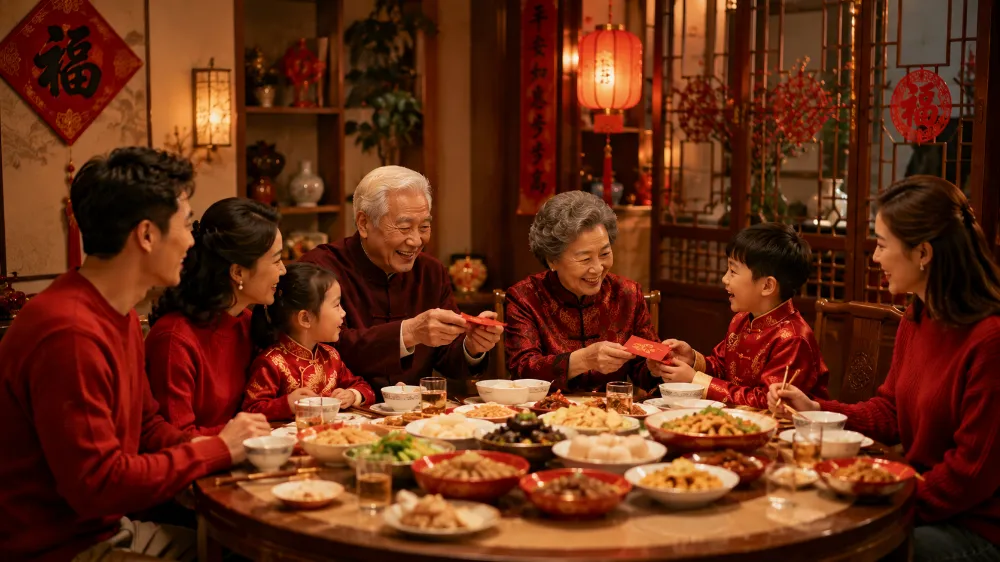
Reunion Dinner (年夜饭 Nián yè fàn)
The most important meal of the year, eaten on Lunar New Year’s Eve (February5,2027). Family members travel from wherever they are in the world to be at the family table. The dishes are symbolic — fish (鱼 yú, “surplus”), dumplings (交子 jiǎozi, “wealth”), rice cakes (年糕 niángāo, “rising higher”), spring rolls (春卷 chūnjuǎn, “gold bars”), and more.
For visitors: book a restaurant early if you want to experience this. Many top-tier restaurants in Beijing, Shanghai, and Hong Kong offer CNY reunion dinner packages that include traditional dishes and sometimes lion dance performances. Expect to pay USD60–300 per person for a quality experience.
Red Envelopes (红包 Hóngbāo)
Red envelopes containing money are given by elders to children and unmarried younger relatives. In2026, the standard amounts via digital payment apps ranged from RMB100 to RMB1,000 per envelope. WeChat has a feature where you can send digital red envelopes to groups, which has become a major part of modern CNY.
For visitors: if you’re invited to a Chinese home or event, you’ll likely receive a red envelope. Accept it graciously with both hands and don’t open it in front of the giver.
Firecrackers and Fireworks
Traditional fireworks are a huge part of CNY. Most cities restrict them to specific hours and zones, but rural areas and many cities still have official displays. The midnight countdown on Lunar New Year’s Eve is the loudest moment of the year in China.
For visitors: don’t set off fireworks yourself unless you’re in an authorized area. Many cities have public displays you can watch. Beijing typically has fireworks-free zones in the city center; Xi’an and smaller cities often have more relaxed rules.
New Year Clothes (新衣 Xīn yī)
Wearing new clothes — often red or other bright colors — for the new year is a long-standing tradition. The color red symbolizes luck and wards off the Nian beast. Wearing black or white is generally avoided because those colors are associated with mourning.
Visiting Temples and Praying (拜庙 Bài miào)
Temples are crowded in the first few days of CNY. People burn incense, light candles, pray for the new year, and sometimes draw fortune sticks (签 qiān) to predict the coming year. Major temples in Beijing (Lama Temple), Shanghai (City God Temple), and Guangzhou (Temple of the Six Banyan Trees) are especially popular.
Dragon and Lion Dances
You’ll see these everywhere — in shopping malls, on streets, in front of businesses. The lion dance (舞狮) involves two performers in a lion costume mimicking the animal’s movements, often to drumbeats. The dragon dance (舞龙) uses a long fabric dragon carried by a team of dancers on poles. Both are believed to bring good luck and chase away evil spirits.
For visitors: drop a red envelope into the lion’s mouth if one comes to your hotel or business — it’s traditional and considered polite. The lion will “bless” you in return.
The Foods You Need to Eat
Chinese New Year food is essentially a meal-as-symbol system. Every dish means something.
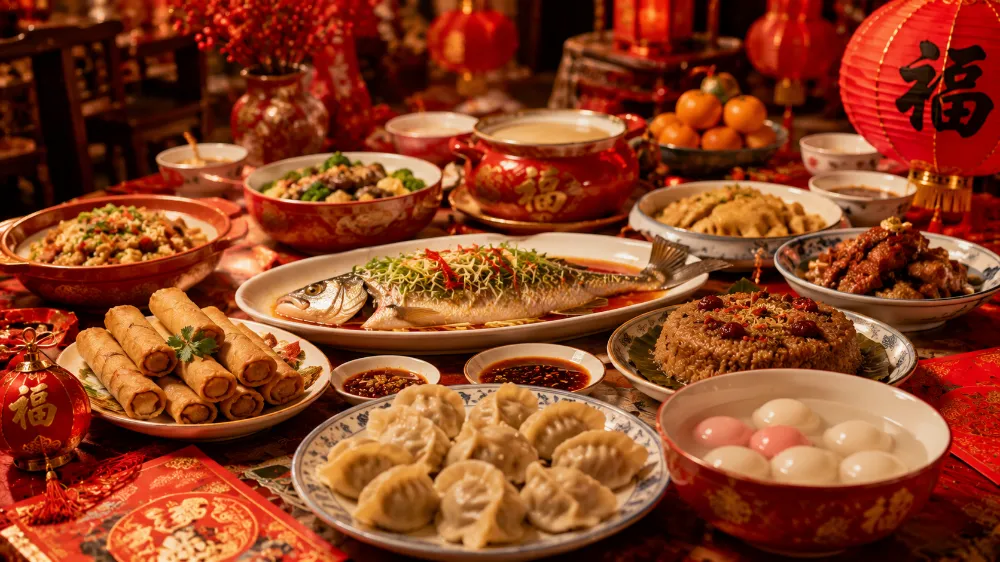
The Big Four
- 鱼 (yú) — Fish: Pronounced like “surplus” (余 yú). Must be served whole, head and tail intact. In some regions, the fish is left partially uneaten to symbolize surplus carrying over.
- 饺子 (jiǎozi) — Dumplings: Shaped like ancient gold ingots (元宝). Eating dumplings is thought to bring wealth. In northern China, families gather to fold dumplings together on New Year’s Eve.
- 年糕 (niángāo) — Rice Cake: Pronounced like “higher year” (年高 niángāo). Eating it symbolizes rising higher in life — career, status, education. Common in southern China.
- 春卷 (chūnjuǎn) — Spring Rolls: Resemble gold bars. Common in eastern China, especially Jiangsu, Zhejiang, and Shanghai.
Regional Specialties
- Tangyuan (汤圆): Sweet glutinous rice balls, served at the Lantern Festival. Symbolize family togetherness (圆 = round, complete).
- Hot Pot (火锅): Increasingly popular for reunion dinners, especially in Sichuan and Chongqing. The communal nature fits the family-bonding theme.
- Whole Chicken (全鸡): Served in many regions, symbolizing prosperity and family unity (鸡 jī puns with 吉 jí, “auspicious”).
- Long Noodles (长寿面): Long noodles symbolize longevity. Eaten especially on Day7 (Renri).
- Eight Treasures Rice (八宝饭): A sweet sticky rice dessert with eight different fillings, served in many regions.
Foods to Avoid
- Porridge (粥): Considered poor people’s food, eaten in hard times. Avoided at CNY.
- Meat in odd numbers: Even numbers symbolize good things in pairs (双 shuāng). Odd is avoided for major dishes.
- Sharp objects (knives, scissors): Not eaten with on certain days because cutting is thought to “cut” luck.
Where to Celebrate in China: A Regional Travel Guide
Now the fun part. If you’re thinking about coming to China for Chinese New Year2027, here’s a regional breakdown of where to go and what to expect. I’ll be honest — different cities offer wildly different experiences.
Beijing (北京): The Classic Imperial Capital Experience
Beijing in Spring Festival is magical. The Forbidden City gets dressed up in red lanterns and traditional decorations. Temple fairs (庙会 miàohuì) take over public parks — the most famous ones are at Ditan Park (Temple of Earth Park), Longtan Park, and the Beijing Temple Fair at the Grand View Garden.
What’s unique to Beijing CNY:
- Temple fairs: A mix of folk performances, traditional snacks, handcrafts, opera performances, and games. The atmosphere is genuinely fun.
- Ditan Park: One of the largest and most authentic temple fairs. Expect crowds of100,000+ per day.
- Hutong neighborhoods: Smaller, more intimate celebrations in the old alleyways. Watch a family fold dumplings, listen to firecrackers echoing between courtyard walls.
- Lama Temple (雍和宫): One of the most popular places to pray on the first day. Long lines, intense incense smoke, and a deeply atmospheric experience.
- Forbidden City: Often has special CNY exhibitions and night openings. Check the Palace Museum website for2027 announcements.
Recommended stay:4–5 days. Combine with a day trip to the Great Wall (Mutianyu section, less crowded in winter).
Xi’an (西安): Ancient Tang Dynasty Vibes
Xi’an was the imperial capital for over a thousand years, and CNY here has a weight to it that Beijing’s modern buzz doesn’t quite match. The city wall becomes a giant lantern-lit walkway at night. The Muslim Quarter erupts in food stalls.
What’s unique to Xi’an CNY:
- City Wall Lantern Festival: The Ming-dynasty city wall (the best preserved in China) gets fully wrapped in red lanterns for CNY. Walking or cycling the wall at night is unforgettable.
- Muslim Quarter (回民街): Even more crowded than usual. Try biangbiang noodles, roujiamo (Chinese “hamburger”), and persimmon cakes.
- Tang Dynasty shows: The Tang Paradise (大唐芙蓉园) and Shaanxi History Museum host traditional performances.
- The Big Wild Goose Pagoda: One of the most iconic CNY photo spots, especially at night with the lights.
Recommended stay:3–4 days. Pair with a visit to the Terracotta Warriors, which is much less crowded during CNY than usual (since most tourists are Chinese and most Chinese go home for the holiday).
Shanghai (上海): Cosmopolitan Energy
Shanghai’s CNY is more modern and commercial than Beijing’s or Xi’an’s, but no less impressive. The Yu Garden Lantern Festival is legendary. The Bund gets dressed up. Nanjing Road is packed.
What’s unique to Shanghai CNY:
- Yu Garden Lantern Festival (豫园灯会): One of the most famous lantern displays in China, dating back to the Ming dynasty. The2027 theme will likely be related to the Year of the Goat. Expect massive crowds but genuinely beautiful displays.
- City God Temple (城隍庙): Adjacent to Yu Garden, this is a major incense-burning spot.
- The Bund (外滩): Walk along at night for the illuminated skyline view. Huangpu river cruises often run during CNY.
- Longhua Temple (龙华寺): One of Shanghai’s oldest Buddhist temples, packed on New Year’s Day.
Recommended stay:4–5 days. Add a side trip to Suzhou or Hangzhou if time allows — both have lovely traditional CNY celebrations.
Chengdu (成都): Sichuan Food and Panda Country
Chengdu offers a more laid-back, food-focused CNY experience. The Sichuan food is legendary. The pandas are always worth visiting. And the city’s vibe is famously chill — even during the busiest holiday.
What’s unique to Chengdu CNY:
- Wide and Narrow Alley (宽窄巷子): Restored historical streets with teahouses, restaurants, and craft shops. CNY decorations and performances here are excellent.
- Jinsha Site Museum: Site of the ancient Shu kingdom, often hosts special CNY exhibitions.
- Panda Base: The Chengdu Research Base of Giant Panda Breeding. Less crowded during CNY since most international visitors travel in spring. The pandas are particularly active in winter.
- Hot pot, hot pot, hot pot: Sichuan hot pot is one of the great food experiences. Just be ready for the spice.
Recommended stay:3–4 days. Pair with a visit to Leshan to see the Giant Buddha, or a side trip to the more traditional Tibetan-influenced areas of western Sichuan.
Hong Kong: The Best Fireworks in Asia
Hong Kong’s Chinese New Year is arguably the most photogenic in Asia. Victoria Harbour lights up with one of the world’s great fireworks displays. Flower markets bloom. The city mixes traditional Cantonese customs with international energy.
What’s unique to Hong Kong CNY:
- CNY Fireworks Display: Over Victoria Harbour on the second day of CNY (February7,2027). One of the most spectacular fireworks shows on Earth. Get a spot at the Tsim Sha Tsui waterfront early.
- Victoria Park Flower Market (花市): Open in the days leading up to CNY. Sells peach blossoms (桃花), kumquat trees (年桔), and other auspicious plants.
- Night Parade: Floats, lion dances, and performers through the streets of Tsim Sha Tsui and Wan Chai.
- Lam Tsuen Wishing Trees: A more traditional experience — write a wish on a paper, tie it to an orange, throw it at the tree. The Hong Kong version in Yuen Long is one of the most famous.
- Lo Pan (魯班) Festival: Honoring the patron saint of builders, with celebrations in various construction trade areas.
Recommended stay:3–4 days. Hong Kong is small enough to cover in a long weekend.
Other Destinations Worth Considering
- Harbin (哈尔滨): If you time it right, you can catch the tail end of the Ice and Snow Festival (which runs from late December through February). Combine ice sculptures with Chinese New Year celebrations.
- Guangzhou (广州): Cantonese New Year traditions are distinct — flower fairs, traditional lion dances, and the famous Guangdong reunion dinner foods.
- Fuzhou (福州): Less touristy, more authentic. Strong Min culture traditions and ancient architecture.
- Dunhuang (敦煌): For a truly offbeat experience, pair CNY with a Silk Road adventure. The desert in winter is hauntingly beautiful.
- Zhangjiajie or Huangshan: Mountain landscapes covered in snow during winter. CNY celebrations in mountain villages are more intimate and traditional.
Travel Logistics: Practical Stuff for2027
Now the practical questions. If you’re seriously considering coming to China for CNY2027, here’s what you need to know.
Visas and Entry
China has dramatically expanded its visa-free entry policies through2025 and2026. As of mid-2026, citizens of over60 countries can enter China visa-free for periods ranging from7 to30 days. This includes most EU countries, Australia, New Zealand, South Korea, Japan, Malaysia, Thailand, and many others.
For2027, expect these policies to continue or expand. The visa-free transit policy also allows240-hour (10-day) transit through China for many nationalities — useful if you’re combining China with another Asian destination.
If your country isn’t on the visa-free list, you’ll need to apply for a tourist visa (L visa) at a Chinese consulate. Standard processing takes4–7 business days.
Booking Flights and Hotels
Book early. This is not optional. The CNY travel window is the peak of the peak season. International flights to Beijing, Shanghai, and Hong Kong typically need to be booked2–3 months ahead for the best prices and availability.
Domestic flights within China also spike. If you’re planning multiple cities, consider high-speed rail (高铁) — China’s rail network is extraordinary, and the trains are clean, fast, and on time. Beijing to Shanghai is about4.5 hours; Beijing to Xi’an is about4.5 hours; Shanghai to Hangzhou is about1 hour.
Hotels in major cities book up1–2 months ahead for CNY. Expect prices to be30–60% higher than off-season.
Budget Planning
A reasonable CNY trip budget for one person (international visitor,10 days, mid-range comfort):
- International flight: USD800–1,800
- Domestic flights or rail: USD200–400
- Hotels (mid-range): USD80–150 per night
- Food: USD25–50 per day
- Attractions and shows: USD10–30 per day
- Transport within cities: USD5–15 per day
Total estimated: USD2,500–4,500 per person for10 days, excluding international flights. You can do it cheaper (USD1,200–1,800) if you stay in hostels and eat street food. You can also do it much more luxuriously (USD8,000+) at five-star hotels and Michelin restaurants.
Mobile Payments
China runs on WeChat Pay and Alipay. Cash still works in some places, but mobile payment is the default. As of2025–2026, both apps have improved international credit card linking — you can now link Visa, Mastercard, and some other international cards to WeChat Pay, though Alipay is generally easier for foreigners.
Download both apps before you arrive and link your foreign credit card in advance. Also download a VPN if you need Google, Instagram, WhatsApp, etc. — these are blocked in mainland China. Hong Kong and Macau don’t have this restriction.
Language
Mandarin Chinese is the official language. English is spoken in major hotels, tourist attractions, and airports, but not widely on the street. Translation apps like Google Translate or Pleco are essential. Learn a few basics: 你好 (nǐ hǎo – hello),谢谢 (xiè xiè – thank you),多少钱 (duō shǎo qián – how much), and不用了 (bù yòng le – no thanks).
What to Do (and Not Do) at Chinese New Year
A quick etiquette guide so you don’t accidentally offend anyone.
The Dos
- Wear red or bright colors: Especially on Day1. Red is auspicious.
- Accept red envelopes with both hands: And don’t open them in front of the giver.
- Say “新年好” (Xīn nián hǎo): “Happy New Year” — the standard greeting.
- Bring fruit or a small gift when visiting: Apples (苹果 píngguǒ = peace, 平 píng) are particularly auspicious.
- Eat the fish head and tail: If you’re the guest of honor at a dinner. Or at least don’t leave the whole fish untouched.
- Give and receive items with both hands: It’s respectful.
- Treat temple visits as solemn: Even if you’re not religious, follow the local etiquette.
The Don’ts
- Don’t wear black or white: These are mourning colors.
- Don’t sweep or take out the trash on Day1: You might sweep away good luck. (Some households wait until Day5.)
- Don’t break anything: Especially mirrors or bowls. The word “碎” (suì, broken) sounds like “岁” (suì, year), so “岁岁平安” (suì suì píng’ān) is the recovery phrase.
- Don’t lend or borrow money on Day1: Thought to set the tone for the year’s finances.
- Don’t wash your hair on Day1: In Cantonese tradition, “发” (fà, hair) sounds like “发财” (fā cái, get rich), so washing hair is avoided.
- Don’t give clocks, sharp objects, or umbrellas as gifts: All have unlucky associations (clock = counting down time, sharp = cutting relationships, umbrella =伞 sǎn sounds like散 sàn, separation).
- Don’t argue or be negative: The first few days set the tone for the year.
Number Etiquette
The number8 is lucky (sounds like 发 fā, prosperity). The number4 is unlucky (sounds like死 sǐ, death — many buildings skip the4th floor). Red envelope amounts typically avoid the number4 and prefer8,6, or9. Even numbers are generally preferred over odd for gift-giving amounts.
The Decorations and Symbolism
If you’ve seen photos of Chinese New Year, you know the streets look like someone exploded a fireworks factory of red paper. There’s meaning behind all of it.
Spring Couplets (春联 Chūnlián)
Red paper strips with black or gold calligraphy, posted on either side of doorways. The phrases are usually four characters on each side, expressing wishes for the new year. Common themes: prosperity, longevity, family harmony, success.
Paper Cuttings (剪纸 Jiǎnzhǐ)
Red paper cut into intricate patterns — often characters, animals, or flowers — and pasted on windows. Goat imagery will be especially popular in2027.
New Year Paintings (年画 Niánhuà)
Woodblock prints traditionally pasted on walls. Common subjects include door gods (门神), children, plump babies, and mythological figures. Each region has its own style — Tianjin, Suzhou, and Sichuan are particularly famous.
Knots and Ornaments
The Chinese knot (中国结) is a traditional decorative handicraft art. Red knots are hung in homes for luck.
Lanterns (灯笼 Hōngdēng)
Red lanterns are everywhere during CNY. The Lantern Festival on Day15 is when elaborate lantern displays reach their peak.
The Character 福 (Fú)
The character 福 (fú, “fortune” or “good luck”) is displayed prominently — often upside down. Why upside down? Because倒 (dào, “upside down”) sounds like 到 (dào, “to arrive”). So 福倒了 (fú dào le) means “fortune has arrived.” A small but charming bit of wordplay.
Modern Chinese New Year: How It’s Changing
Chinese New Year isn’t frozen in tradition. It’s a living festival. Here’s how it’s evolved.
The Spring Festival Gala (春晚 Chūn Wǎn)
Aired on CCTV every New Year’s Eve since1983, this4–5 hour variety show is the most-watched television program in the world — peak viewership in2024 was over700 million. It features歌舞、相声、小品、魔术 (songs, dances, comedy sketches, magic acts). Many families watch it while folding dumplings.
Foreign visitors sometimes find the gala baffling or dated. But watching a few minutes is genuinely a cultural experience. The comedy sketches often poke fun at bureaucracy, marriage pressure, and family dynamics — so it’s not just propaganda.
Digital Red Envelopes
WeChat’s red envelope feature, launched in2014, has transformed the tradition. People send digital envelopes to groups, with randomized amounts — sometimes totaling in the thousands. It’s now a major form of workplace and social bonding during CNY.
Travel and Tourism Boom
The2024–2026 period saw a massive rebound in CNY travel. International arrivals to China during CNY jumped over200% in2024 vs.2023. By2027, expect the trend to continue — Spring Festival is increasingly marketed internationally, and China’s visa-free policies have made it easier than ever for foreign visitors.
The Evolving Family Dynamic
Younger generations increasingly push back on some CNY pressures — marriage questions from relatives (the dreaded “are you dating anyone yet?” interrogation), red envelope “etiquette” gone competitive, and the expectation to spend the holiday with family rather than friends. There’s a generational conversation happening about which traditions to keep and which to adapt.
For visitors, this is actually good news. Younger Chinese people tend to be more relaxed about etiquette, more welcoming to foreigners, and more likely to invite you into their celebrations. Don’t be shy — most young people are genuinely happy to share their culture with curious travelers.
The Common Misconceptions
A few things people get wrong about Chinese New Year.
Myth1: “Chinese New Year” and “Lunar New Year” Are Different Things
They’re not really different festivals — they’re the same festival with different names. “Lunar New Year” is the broader term that also includes Korean (Seollal), Vietnamese (Tết), and other East/Southeast Asian traditions. “Chinese New Year” specifically refers to the Chinese version. In2027, both terms refer to February6.
Myth2: All of China Celebrates the Same Way
Nope. Northern and southern China have different foods (dumplings in the north, rice cakes in the south), different customs (eating niangao is more southern), and different festival lengths. Cantonese CNY (in Guangdong, Hong Kong) has its own distinct traditions.
Myth3: It’s a7-Day Holiday
The official public holiday is7 days, but the broader festival period is15 days (until the Lantern Festival). Many workers take additional leave. Some businesses close for the entire15-day period.
Myth4: The Whole Country Shuts Down
Major cities stay open. Tourist attractions generally operate (some have reduced hours). Restaurants, hotels, and tourist infrastructure function normally. The “shutdown” is most felt in smaller cities and rural areas.
Myth5: The Year of the Goat Is Bad Luck
Not really. Goat years are considered gentler, more peace-oriented. They’re not the luckiest year for wealth accumulation, but they’re not “bad luck.” It depends on the individual’s zodiac sign and the specific element of the year.
Frequently Asked Questions
When exactly is2027 Chinese New Year?
Saturday, February6,2027. The seven-day public holiday in China typically runs February6 through February12, with the Lantern Festival closing the celebration on February20,2027.
What animal is2027 in the Chinese zodiac?
The Goat (羊 yáng), also translated as Sheep or Ram. With the Fire element, it’s specifically the Year of the Fire Goat (丁未年).
Is2027 a good year?
Astrologically, Goat years are associated with gentleness, family harmony, and artistic pursuits. Whether it’s a “good year” depends on individual zodiac signs and life circumstances. Chinese astrology has much more nuance than the broad strokes Westerners usually hear about.
How long is the Chinese New Year holiday?
Officially7 days in mainland China. The festival celebration extends15 days total, ending on the Lantern Festival (February20,2027). Many people take additional days off, making it a10–14 day break.
What should I wear for Chinese New Year?
Red or other bright colors. Avoid black and white. New clothes are traditional. Red symbolizes luck and wards off evil.
What is the most popular Chinese New Year food?
Fish (鱼) and dumplings (饺子) are the two most iconic dishes, present in most reunion dinners. Fish symbolizes surplus; dumplings symbolize wealth. The specific dishes vary by region.
Can tourists experience Chinese New Year in China?
Absolutely, and you should. Temple fairs, lantern displays, fireworks, traditional performances — all of these are public and welcoming to visitors. Beijing, Shanghai, Xi’an, Chengdu, Hong Kong, and Harbin are especially recommended.
Do I need a visa to visit China during Chinese New Year?
It depends on your nationality. Citizens of over60 countries can enter China visa-free as of2025–2026, including most EU, Australia, NZ, Japan, South Korea, and ASEAN countries. Check the latest regulations before you book.
What is the Lantern Festival?
The Lantern Festival (元宵节 Yuánxiāo jié) on February20,2027 marks the end of CNY celebrations. It’s marked by lantern displays, eating tangyuan (sweet rice balls), and lion/dragon dances.
Is it safe to travel to China during Chinese New Year?
Yes. China is generally very safe for tourists. CNY can be crowded, but violent crime is rare. The main concerns are: crowded transportation (book early), potential scams in tourist areas, and the need to respect local customs.
What is the Year of the Goat personality?
People born in Goat years are traditionally described as gentle, kind, artistic, and family-oriented. They’re said to be more introverted and compassionate than some other zodiac signs.
Which zodiac signs clash with the Goat in2027?
People born in Ox (牛) years are said to clash with the Goat (the Goat and Ox are opposite in the zodiac wheel). People born in Goat years themselves “offend Tai Sui” and should take extra precautions. This is traditional Chinese astrology — take it with appropriate grains of salt.
How do I say “Happy New Year” in Chinese?
The standard Mandarin greeting is 新年好 (Xīn nián hǎo) or, more commonly during CNY, 新年快乐 (Xīn nián kuài lè). The Cantonese version is 新年快樂 (San1 nin4 faai3 lok6). In formal writing, you’ll also see恭贺新禧 (Gōng hè xīn xǐ).
Why is Chinese New Year so loud?
Firecrackers are believed to scare away the mythical beast Nian, who feared loud sounds. Modern fireworks displays serve the same symbolic purpose. Also, the noise is fun. Don’t underestimate that part.
An Invitation: Come to China for2027 Chinese New Year
Here’s my honest pitch.
Chinese New Year is the single most important holiday for roughly one-fifth of humanity. It’s also one of the most photogenic, sensory-rich, and culturally profound festivals on Earth. If you have even a passing interest in culture, food, or photography, you should seriously consider coming to China for Spring Festival2027.
It’s not as hard as it sounds. China’s visa-free entry program has expanded dramatically. The high-speed rail network is excellent. The food is extraordinary. The people are welcoming — particularly in major cities and at tourist-friendly sites, where English is increasingly spoken. And the experience of being in Beijing as the city lights up red, or standing on the Xi’an city wall as fireworks echo off the Ming-dynasty battlements, is something you genuinely cannot replicate anywhere else.
The window is roughly February5 (Lunar New Year’s Eve) through February20,2027 (Lantern Festival). Two weeks is a good amount of time to see two cities. Three weeks lets you add a third.
My honest recommendation for a first-time visitor:
- Days1–4: Beijing — Temple fairs, Forbidden City, hutongs, Peking duck.
- Days5–7: High-speed rail to Xi’an — City wall lanterns, Muslim Quarter food, Terracotta Warriors.
- Days8–11: Fly to Shanghai — Yu Garden lanterns, Bund night views, Suzhou side trip.
- Days12–14: Fly to Hong Kong — Victoria Harbour fireworks, flower markets, dim sum.
That’s two solid weeks, covers the cultural highlights of north, central, and south China, hits the major CNY festivities in each region, and gives you time to actually absorb it all without rushing.
Or, if you only have a week, just do Beijing plus a Great Wall day trip. You’ll still come home with stories.
Final Thoughts
Chinese New Year2027 is going to be a special year. The Year of the Fire Goat carries a particular energy — gentler than the Horse year before it, more family-oriented, more reflective. If you come to China for it, you’ll experience that energy directly, in the food, the decorations, the rituals, and the warmth of the people celebrating.
The dates are set: February6,2027, through the Lantern Festival on February20. The venues are ready: Beijing, Shanghai, Xi’an, Chengdu, Hong Kong, and a dozen smaller cities you’ve probably never heard of but will remember forever. The festival is waiting. The food is going to be extraordinary.
So consider it. Start saving. Look up visa requirements for your country. And maybe — just maybe — start practicing 你好 and谢谢. Because China’s doors are open, and Chinese New Year2027 is going to be one for the books.
新年好。See you in February2027.
Sources and Further Reading
This article draws on information from the China National Tourism Administration, the State Council of the People’s Republic of China, the Hong Kong Tourism Board, the Shanghai Municipal Tourism Bureau, and standard references on Chinese cultural traditions including the Book of Rites, Comprehensive Mirror to Aid in Government, and contemporary scholarly work on the Spring Festival. Festival dates and public holiday schedules are subject to official government announcement — verify before booking international travel.