Erhai Lake Dali China: 20 Best Things to Do in 2027
Erhai Lake Dali China is a 250 square km high-altitude lake in Yunnan, 1,972 m above sea level, with a 120 km bike loop, white Bai minority villages, the Cangshan mountain backdrop, and the Three Pagodas nearby. The most popular activities are the lakeside bike ride, the morning market in Xizhou, an overnight stay in Shuanglang, and the sunset from Longkan Wharf. The best time to come is March to May or September to November. Two to three full days is the right amount of time for most travelers.
I have spent about a year across multiple trips to Dali over the last decade, including two springs biking the lake and one winter watching the Siberian gulls come in. The version of Dali that shows up in most English travel content is the “Dali Old Town plus a quick look at the lake” version. The version worth traveling for is the one that takes two or three days and does the full lake loop, including the Bai villages on both shores, the Cangshan cable car, and at least one overnight in a lakeside guesthouse. This guide is the long version. It is built around the 20 things I would book a trip to Dali for if I had three full days, plus the practical detail — bike rental, where to stay, what to eat, what to skip — that I wish someone had told me the first time.

The short answer: the 5 must-do activities at Erhai Lake
The fastest possible version of this article for someone in a hurry.
- Bike the Haixi (west) ecological corridor from Caicun to Xizhou, about 13 km one way. The single most beautiful short ride in Dali. Mostly car-free, mostly flat, with the lake on your left and Bai villages along the way. Three to four hours including photo stops.
- Watch sunset at Longkan Wharf or Caicun. The west shore catches the light directly. Arrive by 5:30 PM in summer, 5:00 PM in winter. The sky turns from yellow to pink to purple across about 40 minutes.
- Stay overnight in Shuanglang or Wase village. A lakeview guesthouse is the single most memorable accommodation in the entire Dali area. The east-shore villages are quieter and more photogenic than Dali Old Town, and at 200-500 RMB per night they are within most budgets.
- Eat a Xizhou baba and drink three-course tea (san dao cha). The Xizhou baba is a stuffed wheat flour pancake, and the three-course tea is a bitter-then-sweet-then-aftertaste Bai ceremony. Both are unique to this region.
- Visit the Three Pagodas of Chongsheng Temple. The single most historic site in Dali, 1,000 years old, in the foothills just north of Dali Old Town. Allow 2 hours; tickets are 75 RMB.
That covers the must-dos. The full 20-things list is below, plus detailed bike routes, hotel picks, and the Bai food I have eaten on six different trips.
What is Erhai Lake, and where exactly is it
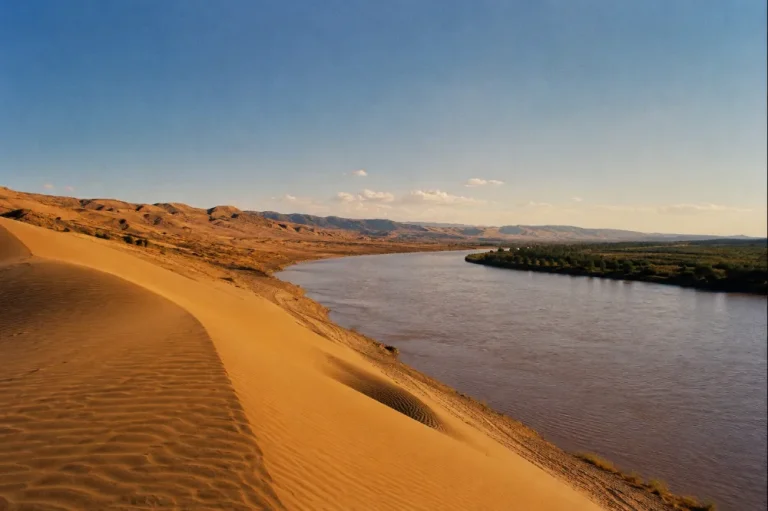
Erhai Lake (洱海, ěr hǎi, literally “Ear Sea”) is a high-altitude freshwater lake in Dali Bai Autonomous Prefecture, Yunnan Province, southwestern China. The name comes from the lake’s shape: long, narrow, and slightly curved, like a human ear. The lake is about 41 km (25 miles) long north to south and between 3 and 9 km (2-6 miles) wide east to west, with a surface area of about 250 square km (97 square miles). The average depth is 10 m, and the deepest point is 21 m. The lake sits at 1,972 m (6,470 ft) above sea level, which is why the air is thinner and the sun harsher than most travelers expect.
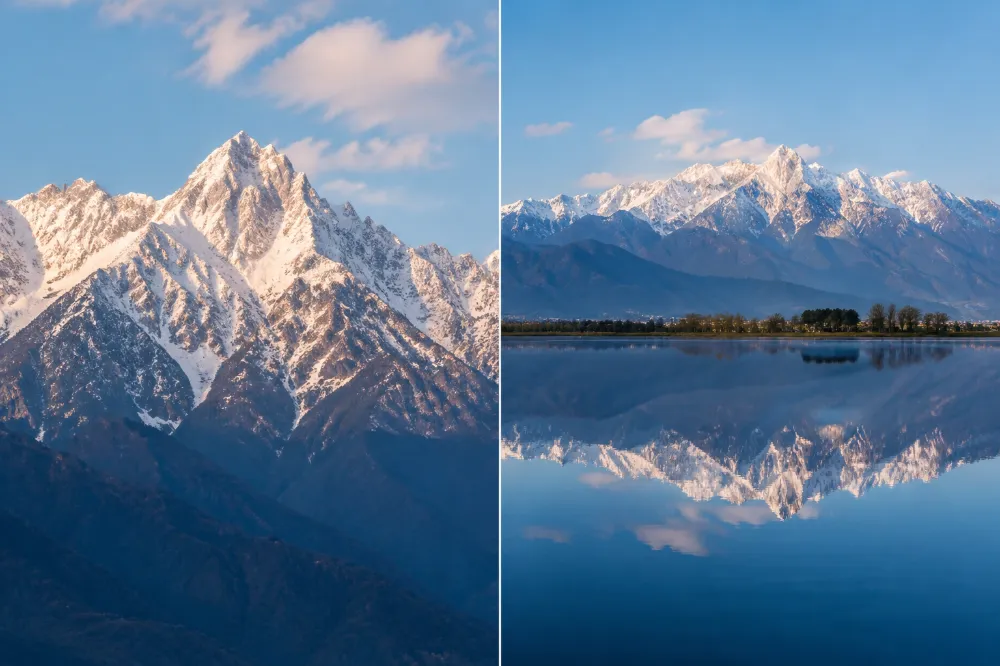
Erhai is the second-largest freshwater lake in Yunnan after Dianchi (which is right next to Kunming) and the seventh-largest in China. By global comparison it is much smaller than Lake Geneva or Lake Como, but it has two things those lakes do not: a 4,000-meter mountain range (Cangshan) running along its entire western shore, and a working agricultural civilization (the Bai minority) that has been living around the lake for at least 1,300 years. The result is a landscape where farms, villages, monasteries, and rice paddies sit inside what could otherwise be a Swiss or Italian alpine lake view.
For most travelers, Dali is reached as a stop between Kunming and Lijiang, or as a 3-5 day side trip from either city. The lake itself is a 30-40 minute drive from the Dali Old Town depending on traffic, and most visitors spend at least 2 full days exploring it.
When to come: the best seasons for Erhai Lake
The right time to visit Erhai Lake depends on what you want. The lake is at its best in the shoulder seasons, but each season has a specific reason to come.
| Season | Months | Temperature | What to expect |
|---|---|---|---|
| Spring (best overall) | March to May | 10-22°C (50-72°F) | Wildflowers along the lake, clear visibility, fewer crowds than autumn. Cangshan mountain still has some snow on the peaks. |
| Summer (rainy season) | June to August | 18-25°C (64-77°F) | Frequent afternoon rain, the lake can turn gray. The plus is the countryside is at its greenest, and there are some local festivals. |
| Autumn (best photo season) | September to November | 8-22°C (46-72°F) | Golden rice paddies around the villages, clear skies, comfortable temperatures. The most popular season, so book hotels 2-3 weeks ahead. |
| Winter (best for gulls) | December to February | 3-15°C (37-59°F) | Black-headed gulls from Siberia arrive around November and stay until March. Cangshan may have snow on the higher peaks. Mornings are cold, especially on the bike. |
My honest recommendation: come in late October or early November. The rice paddies around Xizhou turn golden, the weather is in the comfortable 15-20°C range, the gulls are arriving, and the air is at its clearest. Spring is the second-best, with the bonus of plum and cherry blossoms but without the gulls. Avoid Chinese New Year week (late January or early February depending on the year) unless you specifically want the festival atmosphere, because the prices triple and the villages get crowded. Our 2027 Lunar New Year date guide has the exact festival dates if you are trying to plan around or around the holiday.
Day to day, the lake is most photogenic in the early morning (5:30-7:30 AM) and late afternoon (5:00-7:00 PM). The midday hours are the harshest for photography: flat light, hazy air, and the sun almost directly overhead. If you are biking the lake, leaving at 6:30 AM and finishing by 11 AM is the cleanest plan.
What 2026 looked like, and what 2027 changes
Three things from 2026 at Erhai that I think are worth carrying into your 2027 planning.
1. 2026 was the year Dali overtook Lijiang on the international backpacker map. For most of the last decade, Lijiang got 4-5x the international visitors Dali did. The 2026 numbers flipped that. The high-speed rail from Kunming cut the Lijiang-Dali corridor to 2 hours, and the direct flights from Singapore, Bangkok, and Kuala Lumpur to Dali Fengyi (which I mentioned above) started taking real volume. The international traveler I met in Shuanglang in October 2026 was a French photographer on his second trip in three years; in 2019 the people I met in Dali were 80% mainland Chinese. The 2027 Dali will continue to skew more international, and prices at the mid-range hotels have moved up about 15-20% in response.
2. The bike-rental infrastructure professionalized in 2026. When I first biked the Haixi corridor in 2019, the rental shops were mostly family-run and the bikes were old. By 2026, the shops in Caicun and Dali Old Town had standardized on Trek and Giant mountain bikes, real repair kits, and proper insurance. The 2027 shops are still the same family operations at the same addresses; the bikes are now better. Expect 80-150 RMB per day for a quality mountain bike, and ask for a helmet (most shops have them, but you have to ask).
3. The 2026 winter gull season was the best in five years. The black-headed gull population on Erhai has been declining since 2020; the 2026 winter saw an estimated 18,000-20,000 birds, the highest count since 2019. The Siberian migration is sensitive to climate conditions at the breeding grounds, so this number could be lower or higher in 2027. The standard advice still holds: come in late November or early December to maximize the chance of seeing them at peak numbers.
Getting to Dali: flights, trains, and the last 30 km
Dali is well-connected to the rest of China and to several Southeast Asian cities. The two airports that work are Dali Fengyi and Kunming Changshui, and the high-speed train from Kunming has changed the route in a major way since 2018.
By air: Dali Fengyi Airport (DLU)
The closest airport, 13 km east of Dali Old Town. Dali Fengyi has direct flights to Beijing (3 hours), Shanghai (3.5 hours), Guangzhou (2.5 hours), Chengdu (2 hours), Kunming (1 hour), and a growing list of Southeast Asian cities. Bangkok, Singapore, and Kuala Lumpur have direct flights in 2027, mostly on China Eastern, Air China, and a few budget carriers. From the airport to Dali Old Town, taxis run 50-80 RMB and take 30-40 minutes depending on traffic. The airport bus is 25 RMB per person and runs every 40-60 minutes from 7 AM to the last flight.
By air: Kunming Changshui Airport (KMG)
The alternative if you cannot find a direct flight, or if you are combining Dali with Kunming, Lijiang, or Shangri-La. Kunming is the main Yunnan hub with hundreds of international and domestic connections. From the airport, you can either take a 1-hour shuttle to Kunming Railway Station and then the high-speed train, or you can take a direct coach. Most travelers use the train.
By high-speed train: Kunming to Dali
This is now the most common route in. The Kunming-Dali high-speed rail line opened in 2018 and cuts the journey from 6-7 hours by older trains to about 2 hours by G-series high-speed. Trains leave Kunming Railway Station roughly every 20-30 minutes from 6:30 AM to 8:00 PM. Second-class seats are 145-180 RMB; first-class 230-300 RMB. Dali Railway Station (not Dali North) is the right stop; it is 12 km south of Dali Old Town, and taxis from there to the old town run 40-60 RMB.
By road
Dali is on the G56 Hangzhou-Ruili Expressway, but driving in from another province is rarely the best option. The high-speed train is faster, more comfortable, and significantly safer than long-distance driving in Yunnan. If you are driving from Lijiang, the G5611 Dali-Lijiang Expressway cuts the trip to 2 hours from the previous 4-5 hours.
The last 30 km
Whatever way you arrive, the last leg is from Dali Old Town or Xiaguan (the modern downtown) to your first lakeside village. This is straightforward: taxis, ride-hailing (Didi works well in Dali), or a pre-arranged transfer from your hotel. Most boutique hotels in Xizhou, Shuanglang, or Wase offer free pickup from Dali Old Town if you book direct; ask when you reserve.
The 20 best things to do in 2027
Here is the master list of what I think is worth doing at Erhai Lake, ordered loosely by priority. I have done all 20 across multiple trips; some are worth 2 hours of your time, others are worth a full day.
1. Bike the Erhai Lake loop
The single most popular activity. Full detail in the bike section below. Half-day version: bike the Haixi (west) ecological corridor from Caicun to Xizhou and back, 26 km round trip, 3-4 hours. Full-day version: bike the entire 120 km loop, 2 days with one overnight in a lakeside village. Both are detailed later.
2. Watch the sunset at Longkan Wharf or Caicun
Longkan Wharf (龙龛码头) is the most accessible sunset point from Dali Old Town, about 2.5 km south, and a 10-minute e-scooter ride or 30-minute walk. It gets crowded at peak times but the sky is wide open to the west. Caicun (才村) is one village further north along the Haixi corridor, slightly less crowded, with more village atmosphere. Both are good. Bring a light jacket; the temperature drops 5-8°C between 5 and 7 PM.
3. Visit Xizhou old town and morning market
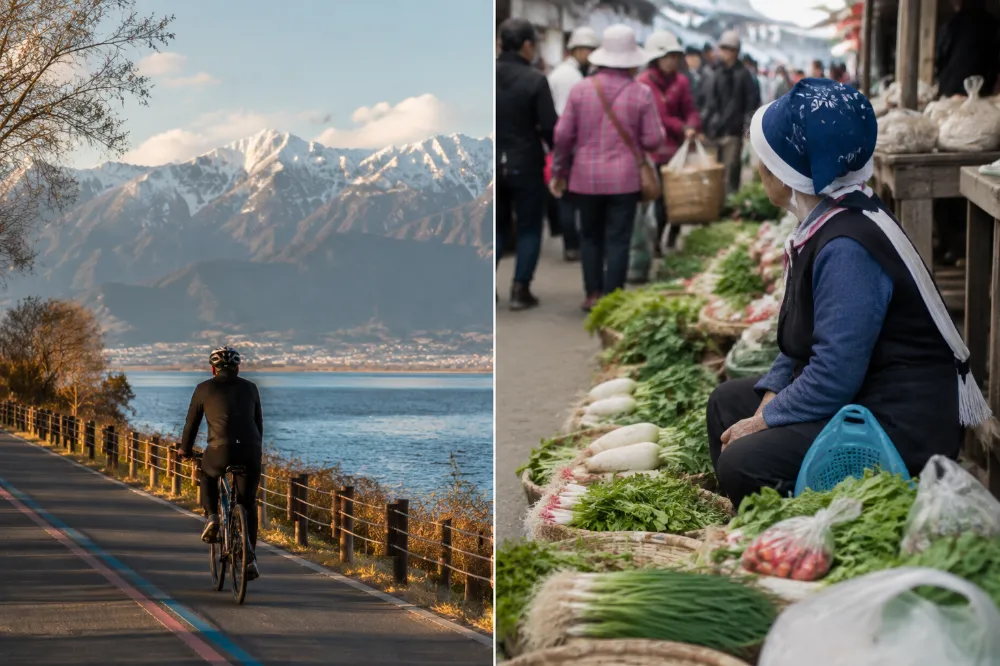
Xizhou (喜洲) is a Bai minority town 17 km north of Dali Old Town, on the west shore of the lake. The town has over 100 well-preserved Bai courtyard houses (si he yuan), most of them 100-200 years old, and a morning market that runs from 6:30 AM to noon every day. The market is the real draw: locals selling fresh mushrooms, dried yak cheese, baba pancakes cooking on cast iron, baskets of fresh vegetables from the lakeside fields, and Bai grandmothers in indigo headscarves. Go before 9 AM to see it at its busiest. Allow 2-3 hours including a Bai courtyard house visit; the Yan Family Compound (严家大院) is the most famous, 50 RMB entry.
4. Try a Xizhou baba pancake
The Xizhou baba (喜洲粑粑) is a stuffed wheat flour pancake, the signature food of the town. Two versions: sweet (rose sugar, sesame) and savory (salted pork, scallion). A small street stall will charge 6-10 RMB. The most famous old baba shop is Yang’s, near the central square; expect a 10-15 minute line on weekends. Eat it standing up, with chili oil on the savory version.
5. Stay overnight in Shuanglang
Shuanglang (双廊) is on the northeast shore of the lake, about 50 km from Dali Old Town. The town sits on a small peninsula, with guesthouses and cafes lining the waterfront. Most of the guesthouses have lake-facing balconies or roof terraces. A lakeview room with breakfast runs 400-800 RMB in 2027; a high-end boutique property with a pool runs 1,500-3,000 RMB. Stay at least one night; the sunset and the morning calm are the point. Yuji Island (玉几岛) is a 10-minute walk from the main pier, and Nanzhao Folk Island is a small island opposite the town with a paid cultural park (entry 50 RMB).
6. Explore Zhoucheng tie-dye village
Zhoucheng (周城) is a Bai village 2 km north of Xizhou, famous for traditional Bai tie-dye (zha ran, 扎染) — the indigo blue-and-white textile technique that has been practiced here for at least 300 years. The village has over 20 family workshops where you can watch the process, take a class (50-150 RMB for 1-2 hours), or buy a piece. The standard pattern is the Bai butterfly or the sun-and-moon-and-mountain motif. Allow 2-3 hours.
7. Take a boat to Small Putuo Island
Small Putuo Island (小普陀) is a tiny island in the northeast corner of the lake, 200 m from the shore, with a small Guanyin Pavilion. Boats run from the Wase pier to the island every 20-30 minutes; the ride is 5 minutes and costs 15-20 RMB. The boat itself is more memorable than the island, which is essentially a single building on a rock. The real reason to come: in November through February, the black-headed gulls that winter on the lake swarm around the boats and the pier, and you can hand-feed them with shrimp-flavored crackers sold by vendors on the dock. 1-2 hours including the boat ride.
8. Climb the Three Pagodas of Chongsheng
The Three Pagodas of Chongsheng Temple (崇圣寺三塔) are 1.5 km north of Dali Old Town, in the foothills of Cangshan mountain. The main pagoda (Qianxun) was built in 839 AD during the Nanzhao Kingdom, making it one of the oldest standing structures in Yunnan. The two smaller flanking pagodas are 100 years younger. The complex includes the rebuilt Chongsheng Temple (the original was destroyed in the 19th century) and a lake reflection pool that is the most photographed spot. Tickets: 75 RMB, allow 2-3 hours. The temple grounds are large; the highlight is the reflection of the three pagodas in the pool, best in the early morning or late afternoon. Detailed section below.
9. Take the Cangshan cable car
The Cangshan Cableway (苍山索道) goes from the foot of Cangshan mountain, behind the Three Pagodas, up to the Ximatan (洗马潭) station at 3,966 m. The full ride takes about 30 minutes. Tickets 280 RMB round-trip. At the top, there is a high-altitude lake (Ximatan, 洗马潭) that is frozen in winter and brilliant blue in summer, plus a 4 km boardwalk. The high altitude (3,966 m) can cause mild altitude sickness; the cable car is smooth but the temperature at the top is 10-15°C colder than at the base. Detailed section below.
10. Walk the Hai Xi ecological corridor
The Hai Xi (海西) ecological corridor is a 13 km dedicated bike and pedestrian path between Caicun village and the north end of Xizhou, mostly along the western shore of the lake. It is flat, paved, separated from the main road, and lined with poplar and cypress trees. No motor vehicles allowed. This is the section most foreign tourists bike, and the section you can walk if you want a more relaxed half-day. Allow 3-4 hours walking one way, 2-3 hours biking.
11. Drink three-course tea (san dao cha)
Three-course tea (三道茶) is a Bai minority tea ceremony unique to the Dali area. The three courses are: bitter (a roasted, slightly burned green tea), sweet (a tea with brown sugar, walnut, and sesame), and aftertaste (a spicy honey-and-chili tea). The symbolism is that life has the same three phases: bitterness comes first, sweetness follows, and what remains is the warm aftertaste. Most Bai restaurants in Xizhou and Dali Old Town offer it; expect 30-50 RMB per person for the full ceremony with snacks. Allow 30-45 minutes.
12. Photograph Wenbi village sunrise
Wenbi village (文笔村) is on the eastern shore, between Wase and Shuanglang, perched on a small peninsula. It is the most photogenic sunrise spot on the east shore, with the Cangshan mountain range across the lake in the background. The road in is narrow and partly unpaved; the most reliable way to get there is by car or e-scooter. Arrive by 5:30 AM in summer, 6:30 AM in winter. The sky does the color change across 30-40 minutes. No admission fee.
13. Explore Wase fishing village
Wase (挖色) is a small fishing village on the east shore, 30 km north of Dali Old Town, with Bai ancient gate towers from the late Qing and early Republic eras. The village is more authentic than Shuanglang — fewer guesthouses, more working fishing boats, more elderly residents. The old gate towers are the most photogenic element, with three to four well-preserved structures in the village center. Allow 1-2 hours, or stay overnight in one of the small guesthouses for the most peaceful option in the lake area.
14. Visit Jinsuo Island
Jinsuo Island (金梭岛) is the largest island in Erhai Lake, about 1.5 km long, located in the northern part of the lake near the Luoquan Peninsula. A 20-minute boat ride from the Jinsuo pier; round-trip boat 80-120 RMB, plus the island entry 30 RMB. The island is a small Bai fishing community with a Bai culture performance, several small temples, and a few seafood restaurants. The view of Cangshan from the south end of the island is the highlight. Allow 3-4 hours including the boat ride.
15. Walk the ancient Dali Old Town walls
Dali Old Town (大理古城) was the capital of both the Nanzhao Kingdom (738-902 AD) and the Dali Kingdom (937-1253 AD). The current town walls are mostly rebuilt from the Ming dynasty, but the street layout inside the walls still follows the original grid. Walking the walls (the south and west sections are the best preserved) takes about 90 minutes. The town itself is the most touristy part of the area — heavy on souvenir shops, Bai clothing, and Yunnan coffee — but the Renmin Lu and Fuxing Lu street sections have a few genuinely good local food spots. The town is free to enter; 2 RMB to climb the city tower.
16. Try Bai cuisine at a local restaurant
The Bai minority has a distinctive cuisine that is hard to find outside Dali. The must-try dishes: raw pork (sheng pi, 生皮) served with chili and herbs, sour-spicy fish (suan la yu, 酸辣鱼) cooked with Erhai lake fish, rushan cheese (乳扇) either grilled or pan-fried, fried cheese and roses (ru shan juan, 乳扇卷), and baba pancakes. The most authentic Bai restaurant experience is in Xizhou, where family-run places have been doing the same recipes for generations. Detailed food section below.
17. See black-headed gulls in winter
From late November to early March, around 10,000-15,000 black-headed gulls (红嘴鸥) migrate from Siberia to Erhai Lake. They are most concentrated at Small Putuo Island, Longkan Wharf, and the Wase pier. Feeding them is a popular local activity: vendors on the docks sell packets of shrimp-flavored crackers for 5-10 RMB. The gulls will take food from your hand once you get used to it. The best time to see them is 1-2 hours before sunset, when the flocks are most active.
18. Hike the Cangshan mountain trails
Cangshan has 19 peaks, the highest at 4,122 m. The full summit trek (Cangshan Grand Traverse, 苍山大穿越) is 19 km with 1,300 m of vertical gain, takes 8-12 hours, and requires a guide (600-1,200 RMB per person, group of 4-6). For most travelers, the half-day Yudai Yunyou (玉带云游) trail at 2,600 m is the right level: a 12 km flat path on a ridge between Cangshan and the lake, with views in both directions, 4-5 hours round trip. Entry 30 RMB, cable car up 200 RMB. Bring layers; the temperature at 2,600 m is significantly cooler than at the base.
19. Day trip to Shaxi Old Town
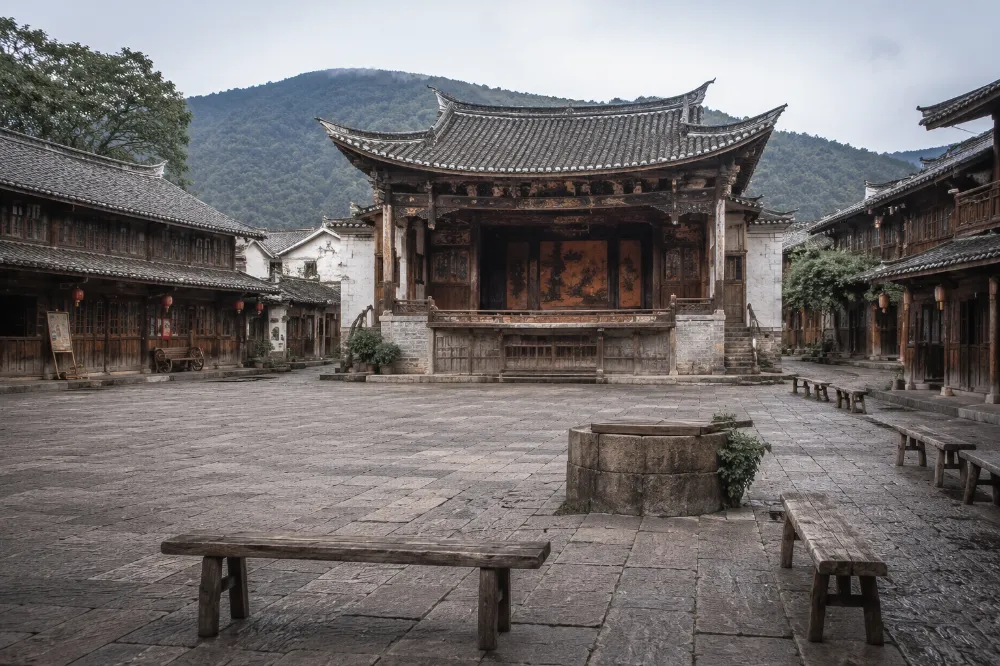
Shaxi (沙溪) is a 14th-century market town in a valley 130 km north of Dali, on the road to Shangri-La. It is one of the few surviving tea-horse-road market towns in Yunnan, with a stone-paved central square (Sideng, 四登) and a 600-year-old wooden theater. Most travelers skip it; the ones who go say it is the most memorable day trip in Yunnan. The drive takes 3-4 hours each way on a winding mountain road, so this is an early start. Allow a full day. No direct public transport; the options are a private car (1,000-1,500 RMB round-trip with driver), a shared mini-bus, or a tour through a travel agency like slitours.com (1,200 RMB per person for a group day trip from Dali).
20. Take a Bai cooking class
Cooking classes in Dali and Xizhou have become genuinely good over the last five years. The best ones are the small in-home classes in Xizhou Bai villages, where the grandmother teaches you three to four dishes over 3 hours: usually the savory baba, the sour-spicy fish, a stir-fried mushroom dish, and rushan cheese. Classes run 200-300 RMB per person, including the meal you cook. The Dali-based ones are more polished but more commercial; the Xizhou ones are more authentic but smaller. Book through your hotel in Xizhou or directly with the homestay.
The Erhai Lake bike loop: full guide
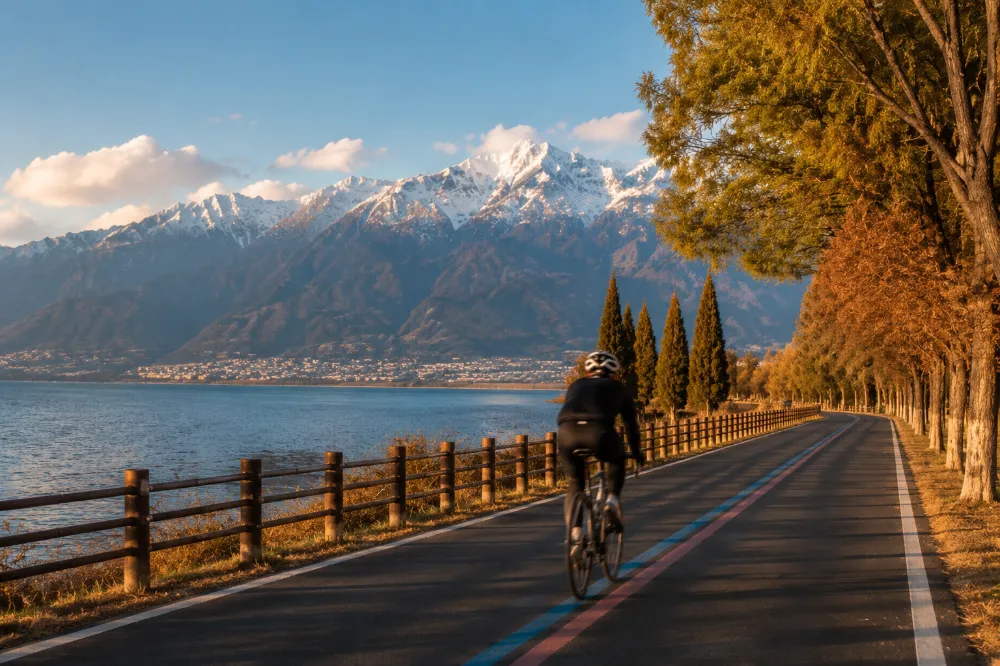
The Erhai Lake bike loop is the single activity I would tell any visitor to prioritize. It is the reason Dali is a cycling destination; it is why most people in the bike shops are from overseas; and it is the activity where the lake reveals its scale in a way that a single viewpoint cannot.
Distance, time, and difficulty
The full loop is about 120 km (75 miles), with roughly 800 m of total elevation gain, almost all of it in short climbs at the north and south ends of the lake. The route is 70% flat, 20% rolling hills, 10% short climbs. Most casual riders can do the loop in 2 days; faster riders and locals do it in 1 long day. The standard split: Day 1 from Dali Old Town or Caicun to Shuanglang (about 55 km on the west shore, then a short ferry or south-to-north trip across the lake), Day 2 from Shuanglang back to Dali via the east shore (about 65 km). Allow 5-7 hours of riding per day, plus stops.
Route options: west (Haixi), east (Haidong), or full loop
Three options, depending on time and ambition.
Option 1: West shore (Haixi) only — 13 km one way, 3-4 hours. From Caicun village (the bike-rental cluster) north to the end of the ecological corridor near Xizhou. Mostly car-free, mostly flat, with the lake on the left and Bai villages along the way. The best option if you have half a day and want the iconic view without committing to the full loop. The official ecological corridor is well-paved, well-signed, and has a clear separation from the road. After Xizhou, the route gets more rural and less busy. Most bike rental shops in Caicun will give you a map and recommend a turnaround point.
Option 2: East shore (Haidong) only — 13 km one way, 3-4 hours. From Wase village south to Wenbi village, on a quieter road along the eastern shore. The Cangshan mountain range is across the lake the whole way, and the views are the best of any short ride in the area. The downside: the road is shared with motor vehicles in some sections, and there are fewer places to stop for snacks or coffee. Ride in the morning before the road gets busier.
Option 3: Full lake loop — 120 km, 2 days. West shore from Dali to Xizhou and on to the north end of the lake (50 km, including the climb past Shuanglang on the west side), short ferry crossing near the north end to the east shore, then east shore south back to Dali (65 km). Most bike rental shops will help you arrange the ferry and recommend an overnight stop in Shuanglang, Wase, or one of the smaller villages. Total cost for a guided 2-day tour with bike, guide, vehicle support, and 1 night of guesthouse: 800-1,500 RMB per person.
Bike rental in Dali
Bike rental shops are clustered in three areas: Caicun village (best for Haixi), Dali Old Town (decent for half-day rides, less convenient for serious routes), and the north end of the lake in Shuanglang and Wase (best for Haidong). In 2027, mountain bike rental runs 60-100 RMB per day, road bike 100-200 RMB per day, e-bike 80-150 RMB per day. Most shops include a helmet, a basic repair kit, and a paper map; some will deliver the bike to your hotel in Dali Old Town for an extra 30-50 RMB. The shops I have used and would book again: Hello Bike in Caicun, Dali Bike Adventures in Xiaguan, and the family-run shop behind Yuji Island in Shuanglang.
What to bring on the bike
Five things I would not ride without: a refillable water bottle (the eco-corridor has refill stations every 5 km), high-SPF sunscreen (Dali UV is stronger than most of China), a light rain jacket (afternoon rain in summer is common), a power bank (no charging along the corridor), and a small bag for snacks. Most bike shops will give you a handlebar bag; bring your own if you have one.
The 7 villages that make Erhai Lake worth it
The villages are the point. Anyone can find a lake; the reason Erhai stands out is that the lakeshore has retained working Bai villages, with a 1,300-year-old agricultural civilization still visible in the courtyard houses, the morning markets, the tie-dye workshops, and the small harbors. Below are the seven most worth your time.
1. Caicun (才村)
1.5 km north of Dali Old Town, the closest lake access from the old town. Mostly a bike-rental and small-guesthouse cluster rather than a working village. The pier here is one of three that run ferries to Small Putuo and Jinsuo Island. Come for the bike shops and the photo stop, not for the village itself. Allow 1 hour.
2. Xizhou (喜洲)
17 km north of Dali Old Town, the cultural and architectural heart of the Erhai area. Over 100 Bai courtyard houses from the late Qing and Republic periods, most with white walls, gray-tile roofs, and decorated gate towers. The morning market is the standout. The town is also where the Xizhou baba pancake originated. Allow 3-4 hours; the morning market is best before 9 AM.
3. Zhoucheng (周城)
2 km north of Xizhou, smaller and less famous but the center of the Bai tie-dye craft. Over 20 family workshops, several of which welcome visitors. The Peng family workshop is the most well-known; the Xinhua workshop is the most professional. A 2-hour tie-dye class is 80-150 RMB and you leave with a finished piece. Combine with Xizhou for a half-day trip.
4. Shaping (沙坪)
10 km north of Xizhou, a small Bai village on the western shore. Less touristed than Xizhou and worth the detour if you want a quieter look at Bai village life. The main draw is the local Bai festival if you happen to be there in late spring (the date moves each year based on the lunar calendar). Allow 1-2 hours.
5. Wase (挖色)
On the east shore, 35 km from Dali Old Town. A working fishing village with Bai ancient gate towers from the late Qing dynasty, three of which are well-preserved and walkable. Wase has a small pier with boats to Small Putuo Island. It is the most authentic feeling of all the lakeside villages, with the fewest guesthouses and the most local life. Combine with a Wenbi sunrise for a half-day trip.
6. Wenbi (文笔)
5 km south of Wase, a tiny village on a small peninsula. The most photogenic sunrise spot on the east shore, with the Cangshan range directly across the lake. The road in is partly unpaved; an SUV or e-scooter works. No major attractions beyond the view. 1-2 hours for sunrise, more if you walk the peninsula.
7. Shuanglang (双廊)
The most famous and the most touristed of the lakeside villages. On a small peninsula on the northeast shore, 50 km from Dali Old Town. The town has a 2-km waterfront lined with cafes, restaurants, and guesthouses, most with lake views. Yuji Island is a 10-minute walk from the main pier, with a few small museums and a famous tea house. Nanzhao Folk Island is opposite the town, accessible by a 5-minute boat. The town has a few mid-range and high-end boutique hotels, the most photogenic in the Erhai area. The downside: it is much busier than Wase, and the guesthouses are correspondingly more expensive. Allow at least one overnight.
Cangshan Mountain: cable car and trails
Cangshan (苍山) is the 4,000-meter mountain range that runs along the entire western shore of Erhai Lake, with 19 named peaks, the highest at 4,122 m (Malong Peak). For most travelers, there are three ways to experience it: the Ximatan cable car, the Yudai Yunyou trail, and the Cangshan Grand Traverse.
Ximatan cable car
The Ximatan Cableway (洗马潭索道) goes from the foot of Cangshan behind the Three Pagodas to the Ximatan station at 3,966 m, the highest cable car in Yunnan. The ride takes about 30 minutes, with views of Erhai Lake, the Three Pagodas, and on a clear day the entire Dali basin. Tickets: 280 RMB round-trip. At the top: a high-altitude lake (Ximatan, 洗马潭) that is frozen from November to March and brilliant blue in summer, a 4 km boardwalk with views in all directions, and a small visitor center. The temperature at the top is 10-15°C colder than at the base; bring a jacket even in summer. Allow 3-4 hours round trip from Dali Old Town. The cable car is the easiest Cangshan experience; it is suitable for anyone in reasonable shape and any age.
Yudai Yunyou trail
The Yudai Yunyou (玉带云游) is a 12 km flat ridge trail at 2,600 m, between the Cangshan range and Erhai Lake. The trail is named after the cloud band that often forms along this ridge in the early morning. The walk is one of the most scenic in Yunnan: lake on one side, mountain peaks on the other, with the trail passing through forest and meadows. Allow 4-5 hours round trip; entry 30 RMB, one-way cable car to the start 200 RMB. Bring water, food, and a jacket. The trail is well-maintained and not technical, but it is at altitude, so take it easy if you are not used to 2,600 m.
Cangshan Grand Traverse
The full summit trek across all 19 peaks, 19 km, 1,300 m of vertical gain, 8-12 hours. This is a serious day, and most of the trail is on exposed ridges at 3,500-4,000 m. A licensed guide is required (the Yulong Snow Mountain-style rules do not yet apply, but local regulations require a guide for safety). 600-1,200 RMB per person for a guide plus transport, for a group of 4-6. I have not done this one; the people I know who have say it is one of the best day treks in southwest China.
The Three Pagodas of Chongsheng Temple
The Three Pagodas of Chongsheng Temple (崇圣寺三塔) are 1.5 km north of Dali Old Town, at the foot of Cangshan. The main pagoda (Qianxun, 千寻塔) was built in 839 AD during the Nanzhao Kingdom, making it one of the oldest structures in Yunnan that is still standing in its original form. The two smaller flanking pagodas were built about 100 years later. The complex includes the rebuilt Chongsheng Temple (the original was destroyed in the 19th century Qing campaigns against the Muslim revolt) and a 200-meter reflection pool that frames the three pagodas in their reflection.
What to actually see: the three pagodas themselves (the highlight, especially the main one, which is 69 m tall and has survived multiple major earthquakes over 1,000 years), the rebuilt temple complex (less essential, but the scale is impressive), the bronze mirror of Qianxun (a flat bronze disc that supposedly reflects the sun’s rays back to the viewer, located inside the main pagoda), and the reflection pool. Allow 2-3 hours. Tickets 75 RMB; the temple complex inside the walls is included.
Two practical notes. First, the reflection pool is best in the early morning (before 10 AM) when the wind is low and the reflection is clean. By mid-afternoon, the wind picks up and the reflection gets blurry. Second, the main pagoda is not open to climb (the 1,000-year-old stairs are too fragile), so do not expect a view from the top. The view from the base, looking up, is the experience.
The 6 best sunset and sunrise spots
Erhai Lake is famous for its sunset and sunrise light; the western shore catches the sunset directly, the eastern shore gets the sunrise. The most reliable spots, with how to get there and when to arrive.
| Spot | Shore | Best for | How to get there | Arrive by |
|---|---|---|---|---|
| Longkan Wharf | West | Closest sunset from Dali Old Town | 10-min e-scooter or 30-min walk from south gate | 5:30 PM summer, 5:00 PM winter |
| Caicun Pier | West | Sunset with village atmosphere, less crowded than Longkan | 20-min walk or 5-min taxi from old town | 5:30 PM summer, 5:00 PM winter |
| Wenbi Village | East | Best sunrise in the area, Cangshan across the lake | 1.5-hour drive or arrange a taxi through hotel | 5:30 AM summer, 6:30 AM winter |
| Small Putuo Pier | East | Sunrise plus gulls in winter, boat activity | Wase village, 30-min drive from old town | 6:00 AM summer, 7:00 AM winter |
| Shuanglang Waterfront | East | Sunset across the lake with Cangshan lit up | Drive or e-scooter; 1.5 hr from old town | 5:30 PM summer, 5:00 PM winter |
| Haixi Corridor mid-point | West | Sunset over a quieter section, no crowds | Bike from Caicun, 5 km north | 5:30 PM summer, 5:00 PM winter |
Two practical details. The temperature drops 5-8°C between 5 and 7 PM, so a light jacket is necessary even in summer. And the colors in the sky usually last 30-40 minutes; do not leave after the first 5 minutes.
Where to stay: hotels and homestays by budget
Where to stay in the Erhai area depends on what you want. Most first-time visitors stay in Dali Old Town for convenience; most repeat visitors move out to a lakeside village. Below are my picks across three budgets, with approximate 2027 prices.
| Budget | Where to stay | Price range (2027) | What to expect |
|---|---|---|---|
| Budget (under 200 RMB) | Dali Old Town or Caicun guesthouses | 80-200 RMB per night | Basic double room, shared or private bathroom, no lake view. Best for short stays and bike-trip travelers. |
| Mid-range (200-800 RMB) | Xizhou, Shaping, Wase guesthouses | 400-800 RMB per night | Bai-style courtyard house, often with a garden, sometimes a lake view. Includes breakfast. The right balance for most travelers. |
| High-end (800+ RMB) | Shuanglang boutique hotels, top Wase guesthouses | 1,500-3,500+ RMB per night | Lakeview room, infinity pool, designer interior, full breakfast. For a special trip or a romantic escape. |
Specific recommendations
These are properties I have stayed at or visited personally, with the year of my last visit.
Dali Old Town (convenient but crowded): Dali Old Town has 300+ small guesthouses, mostly in renovated Bai courtyard houses. The ones on the south side (closer to the lake) are quieter than the ones near the central bar street. The Linden Centre is the best-known heritage option, with a 200-year-old courtyard and a small museum, 600-900 RMB per night. The Dali Old Town Hostel is a backpacker standby at 60-80 RMB per bed.
Xizhou (cultural, walkable, the right balance for most): The Linden Xizhou and the Xizhou No. 1 Courtyard are the two best mid-range options, 500-800 RMB per night with breakfast. Both are in restored Bai courtyard houses, within walking distance of the morning market. The Landscape Hotel is the high-end option in town, 1,500-2,500 RMB per night.
Shuanglang (lakeview, romantic, the postcard option): The peninsula has the highest concentration of lakeview boutique hotels. The Three Houses of Shuanglang (三家院) is the most famous high-end, with a private pool and individual design, 2,500-4,000 RMB per night. The Sunyata Hotel Dali (无舍) and the Dali Shuanglang Indigo Hotel are both mid-range with reliable lake views, 800-1,500 RMB per night.
Wase (quiet, authentic, the right choice for repeat visitors): The Bai-style guesthouses in Wase are smaller and more authentic than Shuanglang. The Wase Lakeview Inn (挖色海景客栈) is the most reliable mid-range option, 350-500 RMB per night with breakfast and a small lake-facing balcony. The Mei You Inn (没有) is the standout, 600-900 RMB per night, with a small infinity pool overlooking the lake.
Bai cuisine: what to eat and where
The Bai minority has a distinctive cuisine that is hard to find outside Dali. The flavors are sour, spicy, and fresh, with strong emphasis on local lake fish, mushrooms, and cheese. The signature dishes, what they taste like, and where to find them in 2027.
Rushan cheese (乳扇)
The signature Bai food, a milk-based cheese that is stretched into thin sheets and either grilled, pan-fried, or rolled around rose petals. The grilled version, served with rose sugar, is sweet and slightly chewy. The pan-fried version, served with chili, is savory. A small portion is 15-30 RMB. The best place to try it: the family-run shops along the main street of Xizhou. The next best place: any of the Bai restaurants in Dali Old Town that claim to specialize in rushan.
Xizhou baba (喜洲粑粑)
The stuffed wheat flour pancake I mentioned earlier. A staple of the Xizhou morning market. The savory version (with pork and scallion) is the more substantial option; the sweet version (with rose sugar) is the snack version. 6-10 RMB per pancake. Yang’s, near the Xizhou central square, is the most famous old shop, with a 10-15 minute line on weekend mornings.
Sour-spicy fish (酸辣鱼)
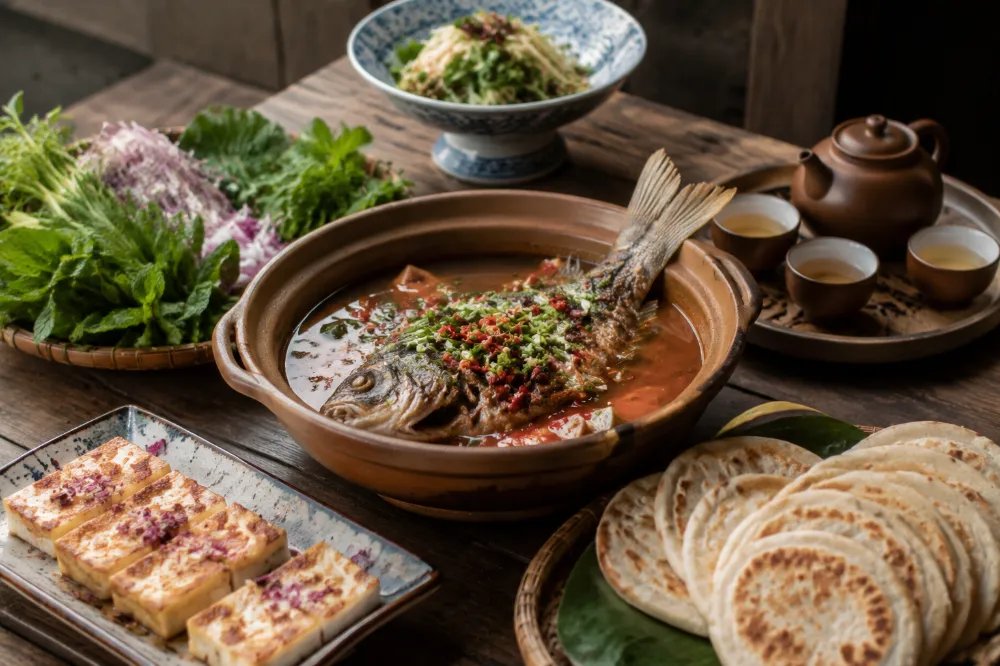
A whole Erhai lake fish (usually carp) cooked in a sour and spicy broth with tomatoes, chilies, pickled vegetables, and herbs. The flavor is sharp and bright. A small fish for one person runs 60-100 RMB; a large fish for two is 100-160 RMB. Most Bai restaurants in Dali and Xizhou serve it; the version in Xizhou, where the fish is closer to the source, is generally better.
Raw pork (生皮)
A Bai specialty that is exactly what it sounds like: thin slices of just-cooked pork, served raw-looking (it is briefly seared but the inside stays pink) with a dipping sauce of chili oil, herbs, and salt. The texture is silky, the flavor is rich. Not for everyone, but a signature Bai experience. Most Xizhou restaurants serve it; 30-60 RMB per portion.
Three-course tea (三道茶)
The Bai tea ceremony covered in section 11 above. 30-50 RMB per person for the full ceremony with snacks.
Cold chicken (凉鸡)
A Yunnan classic that the Bai do particularly well. A poached chicken, cooled, sliced, and dressed with chili oil, Sichuan pepper, ginger, and cilantro. Served cold or at room temperature. 30-50 RMB per portion.
Where to eat in Xizhou
Xizhou is the most authentic Bai food area. The two best family-run restaurants in 2027 are Yang Ji (杨记), near the central square, which has been doing the same recipes for three generations, and the unnamed place opposite the Yan Family Compound, which is harder to find but has the best raw pork in the area. Both are 50-100 RMB per person for a full meal including fish. Avoid the tour-bus restaurants on the main road; they are reliably worse than the side-street options.
Where to eat in Dali Old Town
The Old Town has a mix of Bai restaurants, Yunnan general restaurants, and Western food aimed at the tourist crowd. The Bai restaurants on the west side of the old town (away from Renmin Lu) are better than the ones on the main street. Dali Kitchen (大理厨房) is a reliable mid-range option for a Bai meal at 80-150 RMB per person. The Xihouyuan (喜后园) is a higher-end Bai restaurant at 150-300 RMB per person with a more refined setting.
Practical: money, language, getting around
Money
Yunnan is a 100% cashless society in 2027. WeChat Pay and Alipay work everywhere, including small village shops. Foreign credit cards work in the larger hotels and chain restaurants in Dali Old Town, but do not expect them to work in Xizhou or Shuanglang. The few ATMs in Dali Old Town (Bank of China, ICBC) accept Visa and Mastercard. Bring 1,000-2,000 RMB in cash as backup, especially if you are biking the lake and stopping at small village stalls.
Language
Mandarin is universally spoken in Dali. The local Bai dialect (Baipho) is still spoken in the villages but is rarely used in commercial settings. English is widely spoken in the larger hotels, the bike shops in Caicun and Shuanglang, and a few of the high-end restaurants. Outside these specific places, very little English. A translation app on your phone is genuinely useful. The Bai family-run restaurants usually have a small English menu or photo menu; the Xizhou morning market vendors usually do not.
Getting around
Four options, in order of usefulness for most travelers.
Bike or e-bike. The single best way to explore the lake. Rental shops in Caicun, Dali Old Town, and Shuanglang; 60-150 RMB per day. The eco-corridor is flat and protected from cars. E-bikes are now widely available (Meituan, Hellobike apps) for 30-50 RMB per day plus per-minute charges; the speed limit is 25 km/h.
Didi (Chinese ride-hailing). Works well in Dali. From Dali Old Town to Xizhou is about 30-50 RMB; from Dali Old Town to Shuanglang is 150-200 RMB. Didi drivers are reliable and most speak a little English.
Public bus. Available but slow and infrequent. The No. 4 bus from Dali Old Town to Xizhou runs roughly every 30 minutes and costs 5 RMB. For Shuanglang, the bus is not worth the time; use Didi or a private car.
Private car with driver. The right option for day trips to Shaxi, Jianshui, or even the Cangshan summit trek. 800-1,500 RMB per day for a sedan, including driver and fuel. Book through your hotel or through a travel agency like slitours.com.
When to book what
For October and April (peak season): high-end hotels 2-3 weeks ahead, mid-range hotels 1-2 weeks ahead, Xizhou cooking classes 1 week ahead. For other months: a few days ahead is usually fine. Bike rental: walk in the same day, no booking needed. The Three Pagodas: tickets are sold at the gate, no booking needed except for groups. The Ximatan cable car: tickets are sold at the gate, but in peak season arrive by 9 AM to avoid the line.
Safety and scams
Dali is a low-crime area; the main scams are the standard tourist-shoulder ones: taxis that don’t run the meter (always insist on Didi or a metered taxi), and souvenir shops that sell “antique Bai textiles” that are made in Guangzhou. The lake access is generally safe, but the Cangshan trail is not for inexperienced hikers; a guide is the right call for the summit trek. The single biggest practical risk is the afternoon sun; the UV at 2,000 m is significantly stronger than at sea level, and most travelers underestimate it on day 1.
The 6 mistakes first-timers make at Erhai Lake
I have made at least three of these myself on different trips. The other three are from conversations with other travelers.
Mistake 1: Spending all the time in Dali Old Town and not on the lake
The Old Town is the easy base, with all the hotels, restaurants, and the famous bar street. But the lake is the point. The Old Town can be done in half a day. The lake needs at least 2 full days. If you only have 24 hours, skip the Old Town and stay in Xizhou or Shuanglang.
Mistake 2: Trying to bike the full loop in one day
The 120 km full loop in one day is doable for experienced cyclists, but most casual riders do not enjoy the second half. The two-day version with an overnight in Shuanglang or Wase is the right way to do it; the lake reveals itself at the slower pace. If you are not a regular cyclist, the half-day Haixi section from Caicun to Xizhou is the most rewarding 3 hours on the lake.
Mistake 3: Going in July or August
Rainy season. The lake turns gray, the visibility drops, the bike paths get muddy, and the rice paddies lose their color. October or April are objectively better. If you can only travel in July or August, go anyway; the lake is still worth it, just expect some gray days and bring a rain jacket.
Mistake 4: Not bringing enough layers for the bike
The temperature on the lake at sunrise is often 5-8°C colder than in Dali Old Town. In winter, the early morning bike temperature can be close to freezing. A windproof jacket, gloves, and a hat are necessary for any winter ride. In summer, a light long-sleeve is enough for the first 2 hours of the day. Layering is the single most useful piece of advice for the bike.
Mistake 5: Eating only at the Dali Old Town restaurants
The Old Town restaurants are reliable but a bit touristy. The Bai restaurants in Xizhou are better and cheaper. The roadside stalls at the Xizhou morning market (the baba, the rushan, the freshly cooked mushrooms) are some of the best meals you will have in Yunnan. Allow at least one breakfast and one dinner in Xizhou.
Mistake 6: Skipping the east shore
Most first-time visitors do the west shore (Haixi) only, because it is closer to Dali Old Town and the bike corridor is more developed. The east shore (Haidong) is the more dramatic landscape, with the Cangshan range across the lake and the more authentic villages. If you have time for only one of the two, the east shore is more memorable; if you have time for both, do both.
Day trips: Shaxi, Jianshui, and Lijiang
Erhai Lake is well-positioned for several day trips that are worth the extra time. Below are the three most common ones, with the practical details.
Shaxi Old Town (沙溪古镇)
The most worthwhile day trip from Dali. Shaxi is a 14th-century tea-horse-road market town in a valley 130 km north of Dali, on the road to Shangri-La. The town has a stone-paved central square (Sideng, 四登), a 600-year-old wooden theater (Xingjiao, 兴教寺), and an active Bai farming community. The drive is 3-4 hours each way on a winding mountain road, so this is a long day; leave Dali by 7 AM, return by 8 PM. Private car with driver 1,200-1,500 RMB; group day trip from a travel agency 1,200-1,500 RMB per person. Our family Yunnan tour can be customized to include Shaxi.
Jianshui (建水)
A 1,000-year-old Han Chinese town 400 km southeast of Dali, famous for the 1,300-year-old Chaoyang Gate tower, the ancient train to the Tuanshan village, and the Jianshui tofu (a local specialty grilled over coals). The drive is 4-5 hours each way, so this is an overnight rather than a day trip from Dali. Most travelers combine Jianshui with a stop in Yuanyang (the famous rice terraces), which is a further 2 hours south. If you have 3-4 days to spare in Yunnan beyond Dali, Jianshui is the right add-on. The Hani and Yi minority culture in Yuanyang is as rewarding as the Bai culture in Dali.
Lijiang (丽江)
200 km north of Dali, a 2-hour drive on the new G5611 expressway, or a 2.5-hour high-speed train from Dali Railway Station. Lijiang is the more famous old town in Yunnan, and a useful comparison: Lijiang is larger, more touristed, and at 2,400 m altitude (slightly more altitude-sick risk), while Dali is smaller, more relaxed, and lower. Most travelers do Dali first, then Lijiang. Our Tianmen Mountain travel guide covers a similar high-altitude Chinese destination; the comparison is useful if you are trying to decide which one to prioritize.
Erhai Lake Dali China FAQ
Where is Erhai Lake in China?
Erhai Lake is in Dali Bai Autonomous Prefecture, Yunnan Province, southwestern China. The lake sits at the foot of the Cangshan mountain range, about 330 km west of Kunming, the provincial capital. It is the second-largest freshwater lake in Yunnan and the seventh-largest in China. The lake is at 1,972 m (6,470 ft) above sea level, and the lake surface covers about 250 square km.
How long does it take to bike around Erhai Lake?
The full loop around Erhai Lake is about 120 km. Most cyclists split it into 2 days: roughly 50-60 km on day 1 and the rest on day 2, with one overnight in a lakeside village like Xizhou or Shuanglang. In a single day, the loop takes 7-9 hours including photo stops and lunch. For most travelers, the half-day west-shore (Haixi) section from Caicun to Xizhou, about 13 km one way, captures the best of the lake in 3-4 hours.
What is the best time to visit Erhai Lake?
The best time to visit Erhai Lake is March to May (spring) and September to November (autumn). Spring brings wildflowers, mild weather (15-25 degrees C), and clear lake views. Autumn is similar with the bonus of golden rice paddies in the lakeside villages. November to February is also nice, especially if you want to see the black-headed gulls from Siberia that winter on the lake. Avoid June to August, which is the rainy season.
Can you swim in Erhai Lake?
Swimming in Erhai Lake is officially restricted. The Yunnan provincial government has regulated lake access since 2017 to protect water quality; swimming, boating, and washing are not allowed in most of the lake. There are no public beaches. You can wade in the shallow edges near some villages, but for swimming, hotels with pools are the practical alternative.
Is Erhai Lake worth visiting?
Yes, Erhai Lake is one of the most worthwhile destinations in Yunnan and one of the most beautiful high-altitude lakes in China. The combination of the Cangshan mountain backdrop, traditional Bai villages like Xizhou and Shuanglang, the Three Pagodas nearby, and the bike loop is hard to match anywhere else in the country. It is a much more relaxed alternative to Lijiang, which sits 200 km north and gets four times the visitors. Two to three full days is the right amount of time for most travelers.
How do I get from Dali Old Town to Erhai Lake?
Dali Old Town is 1-2 km from the lake’s southern shore. The closest access points are Erhai Park (a 10-minute walk from the south gate of the old town) and Caicun Village (a 20-minute walk or 5-minute taxi from the old town). Bike rental shops are clustered in both areas. By e-scooter, the lake is reachable in 10 minutes from almost anywhere in the old town.
What is the closest airport to Erhai Lake?
Dali Fengyi Airport (DLU) is the closest, about 13 km east of Dali Old Town. Direct flights connect Dali to Beijing, Shanghai, Guangzhou, Chengdu, Kunming, and several Southeast Asian cities. Kunming Changshui International Airport (KMG) is the alternative, 330 km east; high-speed trains from Kunming to Dali take about 2 hours.
How many days do I need in Dali?
Two to three full days is the right amount of time for most travelers. Day 1: Dali Old Town and the Three Pagodas. Day 2: Xizhou, Haixi bike ride, Zhoucheng tie-dye village. Day 3: Shuanglang, Wenbi village, Haidong. Add an extra day if you plan to climb Cangshan or do a side trip to Shaxi.
What is Erhai Lake famous for?
Erhai Lake is famous for three things. First, the 120-km bike loop around the lake, considered one of the best casual cycling routes in China. Second, the Bai minority villages on the lakeshore, especially Xizhou with its 200-year-old Bai courtyard houses and Shuanglang with its waterfront guesthouses. Third, the combination of Cangshan mountain (with 19 peaks) and the lake, which together create one of the most photographed mountain-and-water views in southwest China.
How much does it cost to visit Erhai Lake?
Budget travelers can cover Erhai Lake for about 350-500 RMB per day: 100-150 RMB for a guesthouse, 50-80 RMB for bike rental, 80-120 RMB for food, and the rest on entry tickets and small expenses. Mid-range travelers should budget 800-1,500 RMB per day: 400-800 RMB for a boutique guesthouse, 150-300 RMB for activities, 150-250 RMB for meals. High-end travelers, 2,000+ RMB per day gets you lakeview boutique hotels at 1,500+ RMB.