I’ll be honest with you — the first time I heard someone say “Fujian Tulou China,” I thought it was the name of some obscure new craft beer. Then a friend dragged me off to see one in person, and I spent the next three hours just standing there with my mouth slightly open, trying to work out how on earth people built a five-story fortress out of dirt in the 1700s and still had it standing strong enough to house 400 of their relatives.
Welcome to Fujian Tulou China — the Hakka earthen castles of Fujian Province that, somehow, most travelers to China have never heard of. And I’m including people who’ve already done the Great Wall, the Forbidden City, and the Terracotta Army.
This is the guide I wish someone had handed me before I went. I spent more than a week bouncing between Yongding, Nanjing, and Hua’an counties, talking to elderly Hakka residents, getting lost in bamboo forests, eating way too much niangjiu (Hakka rice wine), and taking roughly 800 photos. This article is the result. It’s long. It’s detailed. It has opinions. I hope it saves you a few mistakes.
By the end of this guide, you’ll know exactly what a Fujian Tulou is, why it made the UNESCO World Heritage list in 2008, which of the 46 inscribed buildings are actually worth your time, how to get there from Xiamen, and a few things the brochures won’t tell you (like the mosquito situation in summer, and which entrance to use at Tianluokeng).
Let’s get into it.
What Exactly Is a Fujian Tulou?
A Fujian Tulou — sometimes written as Fújiàn Tǔlóu in pinyin — is a large, multi-story communal earthen fortress built by the Hakka people in the mountainous southwest of Fujian Province in southeastern China. “Tu” means earth, “lou” means building. So literally: earth building. The name sounds humble, but these things are anything but.
Imagine a circular (sometimes square) wall of rammed earth, sometimes 60 meters in diameter, four or five stories tall, a meter or two thick at the base, with one single entrance and a tiny inner courtyard. Now imagine that single building holding an entire clan — three, four, sometimes seven hundred people, across multiple generations. That’s a tulou.
And here’s the bit that got me: a lot of them are still inhabited. You walk in, and there’s Auntie Wang hanging laundry in the third-floor corridor. There’s a 90-year-old grandfather playing mahjong in the central courtyard. Kids are running up and down the wooden staircases that ring the interior. It’s not a museum. It’s a living, breathing community that happens to be 300 years old.
According to UNESCO’s official inscription document, 46 tulou in Fujian were added to the World Heritage List on July 6, 2008, during the 32nd session of the World Heritage Committee. They are spread across three counties — Yongding (23 buildings), Nanjing (11), and Hua’an (3) — plus a few stragglers in Zhangzhou and Longyan. The heritage zone covers about 152.65 hectares, with a buffer zone of 934.59 hectares. Yes, they protected almost 11 square kilometers of “landscape around the tulou” as well, because the whole setting matters.
But that 46 is just the UNESCO number. There are over 3,500 tulou still standing in Fujian, and somewhere north of 30,000 if you count variations across Fujian, Guangdong, and Jiangxi. The UNESCO ones are just the best of the best — the “must-see” portfolio.
A Quick Bit of History (Because You’ll Want This for Conversations)
Most guidebooks will tell you tulou are 1,000 years old. They’re sort of right and sort of wrong, in that annoying way history sometimes works.
The Hakka people — literally “guest families” in Chinese — began migrating south from the Central Plains (modern Henan, Shanxi, Shaanxi area) sometime around the 4th century CE, pushed by wars, famine, and the general chaos of the Jin Dynasty collapse. They kept moving south for nearly a thousand years, in waves, eventually settling in the mountain valleys of Fujian, Guangdong, and Jiangxi. They were, in modern parlance, an ethnic diaspora that never quite stopped being one.
By the Song (960–1279) and Yuan (1271–1368) dynasties, the Hakka in Fujian were starting to build fortified clan houses out of the only material they had plenty of: the local sub-tropical red earth. The earliest confirmed tulou date from this period, though most of what survives is from later. The form really took off during the Ming (1368–1644) and Qing (1644–1912) dynasties, peaking in the 17th and 18th centuries when prosperity and clan power intersected with regional banditry to create the perfect conditions for “build a giant dirt fortress” energy.
The thing is, in this part of Fujian, the land was — and honestly still is — beautiful but poor. Steep hills, narrow valleys, tiger attacks (historically), and bandit raids were all real problems. So a single building that could house 200 to 800 people, defend them from attack, store grain for sieges, and last for centuries? That wasn’t nostalgic. That was engineering pragmatism at its finest.
The last major tulou were built in the 1960s and 70s, often in simpler square forms, and after that the practice largely died out. Modern concrete and brick had become cheaper, and the social structure that supported raising a tulou — a tight-knit patrilineal clan pooling labor and money across generations — was already eroding.
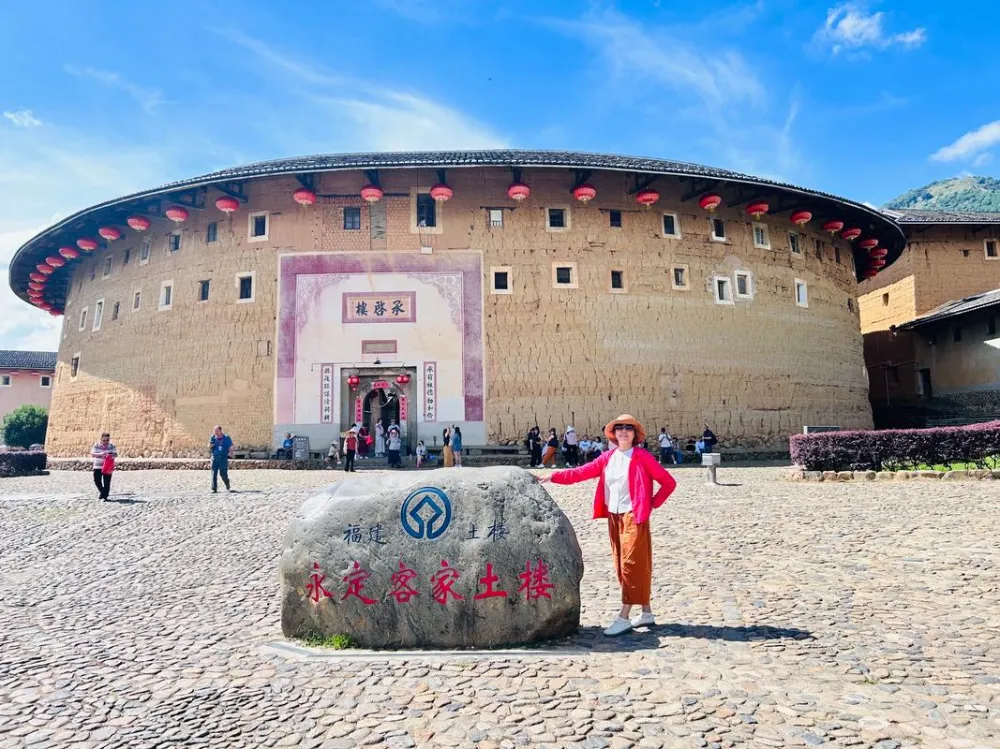
So when you stand in front of Chengqi Lou (承启楼) in Yongding, completed around 1709, you’re looking at the high point of a 700-year-old building tradition. There’s a real sense that you’re seeing the last flower of a whole civilization of earth architecture.
Why Dirt? The Engineering Secret That Shouldn’t Work (But Does)
Okay, this is the part that genuinely baffles engineers, and it puzzled me too until I saw the cross-section of a wall in the small museum at Tianluokeng.
The walls are built from rammed earth — a process where moist subsoil is poured into wooden formwork in layers (typically 15 to 20 cm thick), then compacted by hand or by stone pounders until it’s almost as hard as low-grade concrete. The Hakka version of this recipe adds a few crucial ingredients: sticky rice, brown sugar, egg whites, and sometimes bamboo strips for tensile strength. Yes, they literally built walls with sticky rice. I am not making this up.
Layer by layer, day by day, often over two or three years, the wall rises. Once complete, the outer face is then coated with a lime-and-sand plaster, which protects it from rain. And here’s the thing that surprised me most: the walls are slimmer at the top than at the bottom. A typical tulou wall might be 2 meters thick at the base and 1 meter at the top. Combined with the circular or square plan, this gives the building insane structural stability — they can (and do) withstand earthquakes better than a lot of modern concrete buildings in the region.
One classic story: Wuyun Lou (五云楼) in Gaobei Village, Yongding, has been visibly leaning by about 1.5 meters at the top for over a century. The locals call it the “Won’t-Fall Building.” It’s been that way since before the Qing dynasty ended. Earthquake after earthquake has come through, and it just keeps on leaning. Modern engineers who have studied it say the rammed earth, the ring structure, and the roof load distribution all work together to keep it from collapsing. It’s the world’s slowest slow-motion structural experiment.
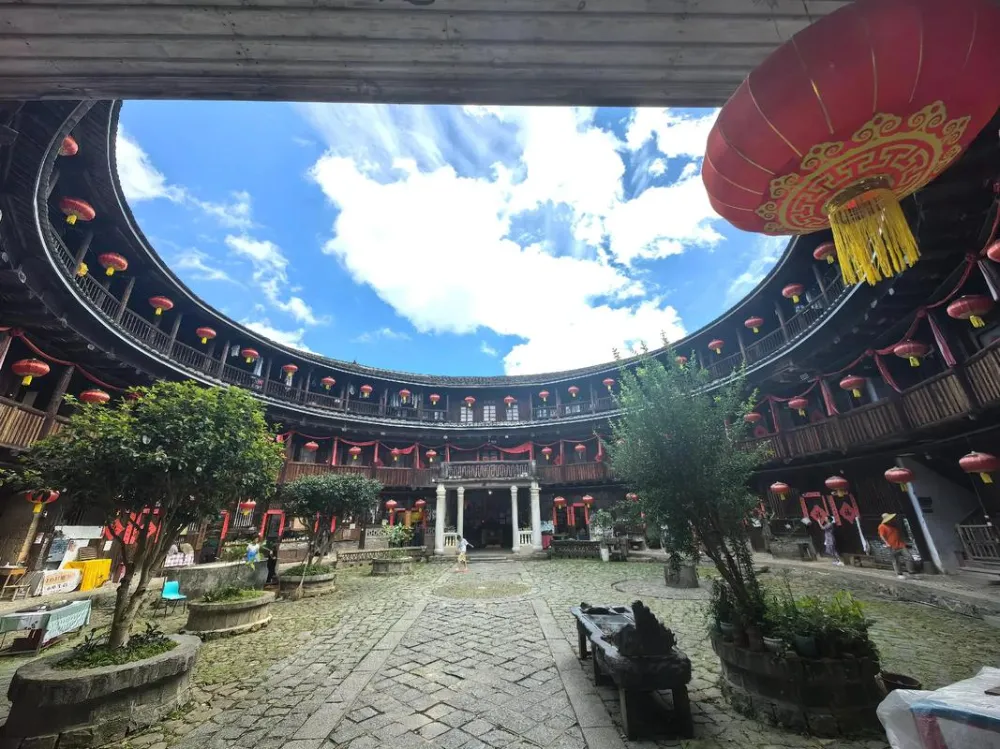
Inside, the building is divided radially: each family gets a vertical slice, typically one room per floor, with kitchens on the ground floor, storage on the second, and bedrooms above. The inner ring of rooms opens onto a wooden corridor that looks down into the central courtyard, which provides light, ventilation, and a place for the clan to gather, hold weddings, perform rituals, and let the chickens wander. There’s a well in the courtyard, a clan ancestral hall at the back, and one single heavy wooden door at the front that, when closed, sealed the whole building.
Oh, and they had a secret water-fire-defense system: a covered ditch on the roof collected rainwater and channeled it to internal cisterns (good for sieges), while slit windows on upper floors could be used as firing positions if bandits got past the door. The whole building was designed, in other words, like a small medieval castle — except made of mud.
Yongding Tulou: Where the King Lives
If you only have time to see one cluster, make it Yongding. Half of the UNESCO-inscribed tulou are here, including the two most famous: Chengqi Lou (承启楼), the “King of Tulou,” and Zhencheng Lou (振成楼), the “Prince of Tulou.”
Yongding is a district of Longyan City, about 160 to 200 km west of Xiamen, depending on which entrance you use. It’s the historical heart of Hakka culture in Fujian, and the Hakka diaspora in Southeast Asia traces much of its ancestry back to this one county. If you’ve ever had a Hokkien friend in Malaysia or Singapore insist their great-great-grandfather was from Fujian, there’s a fair chance it was Yongding specifically.
Chengqi Lou — The King
Chengqi Lou is in Gaobei Village (高北村), in Gaotou Township. Construction started in 1634 (late Ming) and was finished in 1709 (early Qing). It’s a true monster of a building: 4 stories, 4 concentric rings, 402 rooms, and a diameter of about 62.6 meters. At its peak, it housed 600+ people from a single Jiang (江) clan.
Standing in the central courtyard and looking up, the four rings of wooden galleries stack above you like an inverted wedding cake. It’s genuinely disorienting. The roof eaves ring the courtyard in a perfect circle, and you can walk all the way around the inner corridors on each level. The acoustics are weird — a clap in the courtyard echoes back from 400 rooms in a strange, soft, layered way.
Three things to know before you go:
- It’s still a private residence. Some families still live in the outer rings. Be respectful — don’t poke into occupied rooms with your camera. If you see a “no photos” sign, honor it.
- The Disney Mulan connection. In the first trailer for Disney’s Mulan (2020), the exterior shot of Mulan’s home was modeled on Chengqi Lou. There’s a small photo spot with a Mulan cutout at the entrance now. Cheesy, but the kids love it.
- Buy a combo ticket. Chengqi, Shize, Qiaofu, and Wuyun Lou are sold as a group ticket (around ¥90 as of my last visit) and they’re walkable from each other in about 20 minutes. Don’t pay for them separately.
Zhencheng Lou — The Prince
Zhencheng Lou is in Hongkeng Village (洪坑村), about 15 minutes’ drive from Gaobei. Built in 1912 (Republic era), it’s much smaller than Chengqi but — and I admit this is subjective — more elegant. It has a beautiful inner ring of European-influenced ironwork balconies (the Hakka diaspora had money, and they sent some home), a working ancestral hall, and the most photogenic courtyard of any tulou I’ve seen.
Zhencheng was built by a tobacco merchant who came home rich from Southeast Asia and decided the clan deserved something fancy. The result is half fortress, half merchant mansion. The east and west main entrances have stone inscriptions praising the Jiang family for their scholarship — Zhencheng produced an unusually large number of jinshi (the highest imperial exam degree) for one building.
The nearby Tulou Museum (土楼博物馆) is also in Hongkeng. It has good English signage, scale models, and a genuinely fascinating exhibit on the rammed-earth construction process. Spend 45 minutes there — it’s worth it.
Hongkeng vs. Gaobei
Quick side-by-side for planning:
- Gaobei (Chengqi cluster): the “iconic” shot, the King, four buildings close together, more crowded at midday.
- Hongkeng (Zhencheng cluster): a real village, more atmospheric, museum on-site, fewer tour buses.
If you have a full day, do both. If you have half a day, do Chengqi. The “Four Dishes and One Soup” view that everyone photographs is actually at Tianluokeng, which is in Nanjing county, not Yongding. We’ll get to it.
Nanjing Tulou: The “Four Dishes and One Soup” and Cloud Water Yao
After Yongding, Nanjing County (南靖县) in Zhangzhou City is the second must-see. Nanjing is closer to Xiamen than Yongding (about 1.5 to 2 hours by car), and it has a more compact, walkable cluster of UNESCO tulou plus a gorgeous old village.
Tianluokeng Tulou Cluster — “Four Dishes and One Soup”
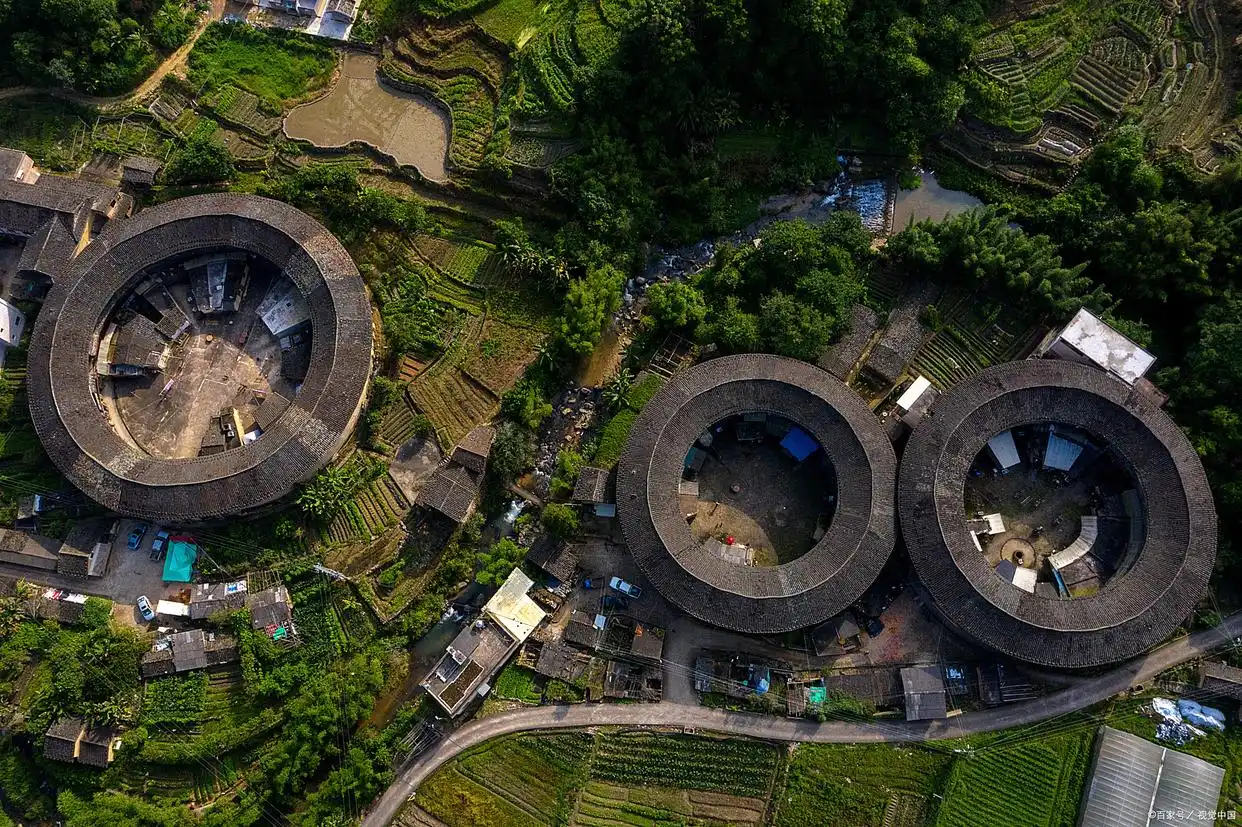
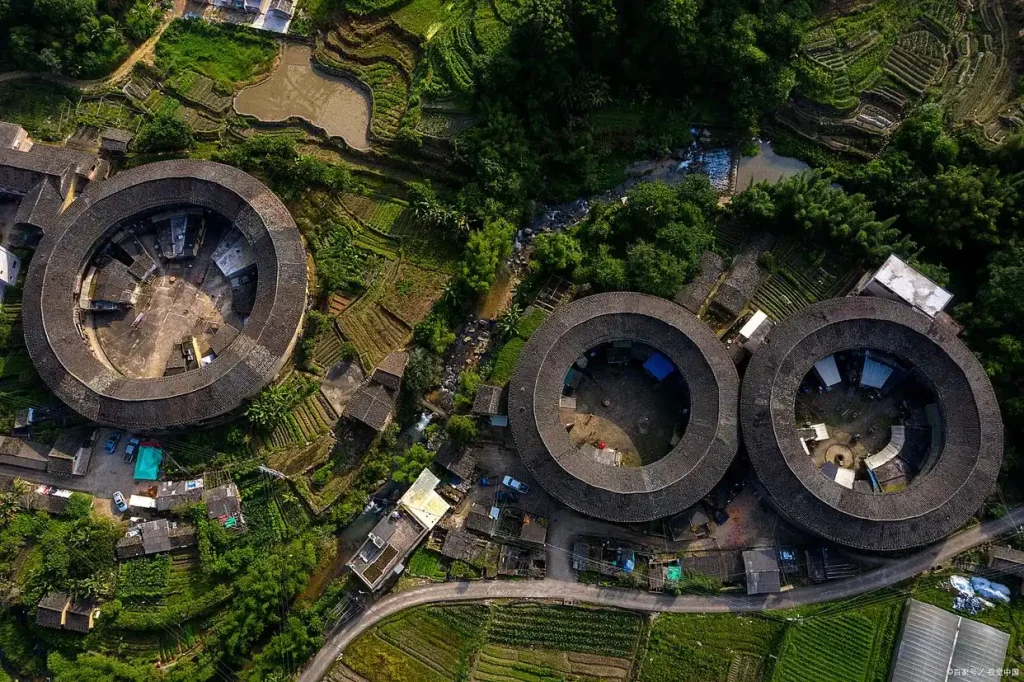
Yes, that’s the actual nickname, and yes, it’s a real food reference. When you look down at Tianluokeng from the official viewing platform on the hillside, the cluster consists of four round tulou arranged around one square tulou, and the whole thing looks, with a bit of imagination, like four bowls of rice and a soup tureen sitting on a plate. The name stuck.
The four round buildings are Buyun Lou, Hechanglou, Zhenchang Lou, and Ruiyun Lou. The square one in the middle is Wenchang Lou. All five date from the 16th to 20th centuries, and they are all still inhabited. Hechanglou in particular is the oldest, built in the Ming dynasty, and you can see the dark, smoke-blackened rafters of its central hall — centuries of cooking fires have left a patina that no amount of restoration could fake.
My honest advice: the viewing platform at the top is the money shot, and you’ll want 10 minutes there. But don’t rush down. Walk through Hechanglou and Buyun Lou, talk to the aunties selling taro buns in the courtyard, and ask them to show you the “sky-well” — a clever square opening in the inner roof that lets rain fall into the courtyard’s cistern.
Tip: the cluster itself is now a paid scenic area (about ¥90), and there’s a shuttle bus that takes you from the visitor center to the viewpoint. The bus is included. You could walk it, but it’s a hot 30-minute uphill climb and not worth it in summer.
Yuchanglou — The Tilted Wonder
About 5 km from Tianluokeng, deeper into the mountains, sits Yuchanglou (裕昌楼), which is even more famous for being wonky than Wuyun Lou. Built in 1308 (Yuan dynasty), its third-floor outer ring of wooden pillars is visibly tilted by about 15 degrees. The locals, with characteristic Hakka dark humor, have called it the “Drunk Building” (醉楼) for 700 years.
Why hasn’t it fallen? Same principle as Wuyun — the ring structure distributes the load. But here’s the Yuchang extra twist: the original builders deliberately offset the pillars to allow for thermal expansion of the wood. They were right, just centuries ahead of their time. There’s a small museum outside with photos and a brief English explanation, and the current residents will happily show you the tilted pillars for a small tip (¥10 is fine).
Taxia Village and Yunshuiyao
This is the romantic part of Nanjing, and frankly the part I liked best.
Taxia Village (塔下村) is a small linear settlement along a creek, with the Deilou Building (德远堂) ancestral hall, several smaller tulou, and a covered stone path. The whole village is laid out according to feng shui principles, and there’s a 30-meter-tall stone wenchang pagoda (文昌塔) at the entrance that was originally a scholar’s beacon. Walking the path in the early morning, with mist still in the valley, is one of those China moments that genuinely stays with you.
Yunshuiyao (云水谣), originally called Changjiao, was renamed after the 2006 movie Yunshuiyao (The Knot) was filmed here. It’s a beautiful old village with two enormous banyan trees, a 13-kilometer cobblestone path along the creek (the “ancient road”), and several iconic tulou including Hegui Lou (和贵楼) — famous for being built on a swamp, with the foundation literally floating on logs. The villagers say you can stand in one specific spot on the second floor and feel the whole building slightly sway. The Yuchang and Yunshuiyao areas are part of the same combined ticket (~¥90, valid for 2 days).
The movie The Knot, by the way, is genuinely worth watching before the trip. It’s a quiet, slow, beautiful love story, and you will recognize every single location.
Hua’an Tulou: Quieter, Older, and Often Skipped
Most Western travelers skip Hua’an County (华安县). That’s both a shame and a reason to go. It has only three of the 46 UNESCO tulou, but they’re unusual, the setting is gorgeous, and the tourist buses don’t really come here.
The standout is Er Yi Lou (二宜楼), built in 1770. It’s the largest single-ring round tulou in the world, with 213 rooms, and has an elaborate internal system of “fire lanes” — narrow hidden corridors connecting the inner and outer rings that can be used to evacuate or, in a siege, to move defenders unseen. The lacquered wooden altar in the central ancestral hall dates from the same period and is considered one of the best surviving examples of Qing-era folk woodcarving in Fujian.
The drive from Nanjing to Hua’an takes about 2 hours through increasingly beautiful mountain scenery. There’s almost no English spoken here, so bring a translation app, or go with a local driver. The food is, in my experience, even better than in Yongding, because you end up eating in family-run restaurants that are just cooking for the village.
The Hakka Culture Behind the Walls
Tulou are not just buildings. They are the physical expression of a specific social philosophy: clan-first, individual-second.
In a tulou, all the families of one patrilineal clan lived under one roof. They shared a courtyard, a well, an ancestral hall, granaries, kitchens (in some cases), and a common defense. Disputes were settled by the clan elders. Resources were pooled. Decisions about marriage, education, and business were made collectively. If you did well, the clan funded your son’s education. If you fell on hard times, the clan kept you fed.
This is the opposite of the Chinese imperial ideal of the small nuclear family that one often associates with Han Chinese culture. The Hakka, as perpetual migrants, had to invent their own social structure to survive in unfamiliar territory, and the tulou was its architecture.
The result is a culture that prizes education, mutual aid, and group harmony above almost everything else. Hakka villages in Fujian have produced a wildly disproportionate number of scholars, merchants, and — once they started emigrating — overseas tycoons. Sun Yat-sen’s close advisors, much of the early leadership of Singapore and Malaysia, and a striking percentage of the early Chinese diaspora in Southeast Asia traced their family roots to the Hakka tulou regions.
When you visit, you’ll notice that many tulou still have an inscription over the main gate — usually four characters in classical Chinese — that captures the clan’s motto. Things like “和气致祥” (harmony brings fortune) or “诗礼传家” (scholarship and ritual pass through the family). They’re not decorative. They are instructions.
The UNESCO Inscription: What It Means (and What It Doesn’t)
The UNESCO inscription in 2008 was a big deal, but worth understanding exactly what was recognized. The three criteria UNESCO cited are:
- Criterion (iii): Tulou bear exceptional testimony to a long-lived defensive communal living tradition.
- Criterion (iv): Tulou are an outstanding example of a building type that illustrates a significant stage in human history — namely, the response of a particular communal society to economic and social change.
- Criterion (v): Tulou, especially the inscribed examples, are an outstanding example of a traditional human settlement that is representative of a culture — and of human interaction with the environment, expressing the principles of feng shui.
What UNESCO was not saying: “These are the only tulou.” “These are the prettiest.” “You must skip the others.” The 46 are the showcase portfolio. There are thousands more.
Since 2008, Fujian has invested heavily in preservation. Most inscribed tulou now have state-of-the-art monitoring (sensors in the walls track moisture, tilt, and stress), the buffer zones have been protected from new construction, and several villagers have been paid to continue traditional maintenance practices like re-plastering the outer walls every 10 years with the original lime-and-sand mix.
What the inscription hasn’t solved: depopulation. Most young Hakka leave for Xiamen, Shenzhen, or the cities. Many tulou have more elderly residents than they did 20 years ago, and the future of the living-community aspect of tulou is genuinely uncertain. This is a real, ongoing tension that you’ll hear about if you talk to local officials, but they will not volunteer it to tourists.
How to Get to Fujian Tulou from Xiamen
Most people base themselves in Xiamen, which is the main gateway. Here’s the practical breakdown.
Option 1: Private Car or Driver (Recommended)
By far the easiest and most flexible. A one-way car from Xiamen to Yongding costs around ¥600–¥800 for a regular sedan, more for a van. A full-day driver (e.g., 8 hours, taking you to two clusters) runs ¥800–¥1,200. You can arrange this through your hotel, through a travel agent on WeChat, or through services like China Discovery or Trip.com. The advantage: the driver will wait, you move at your own pace, and you can stop at viewpoints.
Option 2: High-Speed Train + Local Transfer
Take a high-speed train from Xiamen North Station to Longyan Station (about 1 hour), then a local bus or taxi from Longyan to the Yongding tulou scenic area (about 1 more hour). For Nanjing, take the train to Nanjing Station directly (about 1.5 hours from Xiamen). Trains run frequently and are cheap (¥40–¥60). Once you arrive at the local station, you’ll need a taxi or pre-arranged car to reach the actual tulou villages — they’re 20–40 minutes further into the mountains.
Option 3: Day Tour from Xiamen
Many operators offer one-day group tours from Xiamen to either Yongding or Nanjing, typically ¥300–¥500 per person including transport, guide, and lunch. They are efficient but rushed. You’ll get 2–3 hours at the tulou, group photos in front of the most famous building, and back to Xiamen by 6 pm. Fine if you’re short on time. Not fine if you actually want to experience the place.
Option 4: Multi-Day Hakka Cultural Tour
If you have 2 to 3 days, do this. A typical route: Day 1, Xiamen to Nanjing, see Tianluokeng + Yunshuiyao, overnight in a guesthouse. Day 2, drive to Yongding, see Chengqi + Zhencheng, overnight in a Hakka village guesthouse. Day 3, return to Xiamen via Hua’an or Longyan. Companies like LeadtoChina and WildChina do this well.
Where to Stay
You can stay in Xiamen and do day trips, but staying overnight in or near a tulou cluster is a much better experience. The guesthouses inside and around the tulou villages are almost all family-run, clean, and atmospheric. A few that I’d actually recommend:
- Tulou King Resort (土楼王子大酒店), near Chengqi Lou, Yongding — modern, comfortable, English-speaking front desk, the closest thing to a “real hotel” near the UNESCO site.
- Yunshuiyao Boutique Homestay (multiple options) in Nanjing — restored Hakka houses, some with traditional wooden beds, all within walking distance of the banyan trees.
- Taxia Village Shanzhen Inn (塔下村山珍客栈) — small, family-run, the host makes her own rice wine. Cash only.
Pricing: budget guesthouses ¥150–¥300/night, mid-range ¥400–¥700, top-end “experiential” stays ¥800+. Note: in peak season (national holidays, October) prices double and rooms sell out. Book ahead.
Best Time to Visit
Honestly? October to early December and March to May. These are the comfortable windows.
- Spring (March–May): green hills, mild temperatures (15–25°C), occasional rain. The terraced fields around Tianluokeng flood and reflect the tulou beautifully in April. Bring a light rain jacket.
- Autumn (October–early December): clear skies, harvest season, the rice terraces turn gold, comfortable 15–22°C. This is the peak photography season and also peak tourist season, so expect crowds at Chengqi and Tianluokeng on weekends.
- Summer (June–August): hot (28–35°C), humid, very mosquito-heavy in the bamboo forests, and prone to afternoon thunderstorms. The mountains are also at risk of typhoon-related flooding in July and August. Avoid if you can.
- Winter (late December–February): cold (5–12°C) and damp. Few tourists, atmospheric fog, but many small guesthouses cut services. The big tulou do remain open, though.
Food: Eat Like a Hakka
Hakka cuisine is one of the underrated regional cuisines of China, and the tulou regions are a great place to eat it. A few dishes you should not miss:
- Niurou wan (牛肉丸): Hakka beef meatballs, served in clear broth with radish. Yongding is famous for these — every family has a recipe. Springy, slightly chewy, addictive.
- Yancai (盐菜): preserved mustard greens, used as a flavor base in almost every Hakka dish. Slightly sour, deeply savory, pairs with everything.
- Taro buns (芋子包): steamed dumplings made from taro flour, filled with pork and dried shrimp. Soft, purple, comforting. The ones sold in Tianluokeng courtyard by the old ladies are the best I’ve ever had.
- Braised pork with preserved vegetables (梅菜扣肉): a Hakka classic — thick slices of pork belly steamed with salty-sweet dried mustard greens until the fat melts. Indulgent. Eat it with rice.
- Hakka niangjiu (客家娘酒): a sweet, amber-colored rice wine, traditionally brewed by Hakka mothers for their daughters’ pregnancies. About 10–14% alcohol. Dangerously drinkable, especially the homemade version that the grandmother at the guesthouse will press on you.
- Yongding beef hotpot (永定牛肉火锅): a whole different thing from Sichuan hotpot — a clear, light beef-bone broth with super-fresh sliced beef, locally grown vegetables, and a side of satay sauce. The roadside stalls at the entrance to the tulou scenic area are better than any restaurant in Xiamen.
One warning: if you have a nut allergy, double-check ingredients. Hakka cuisine uses a lot of peanuts and sesame in unexpected places, including in some dumpling fillings and dipping sauces.
Photography Tips (From Someone Who Took 800 Photos)
A few things I wish I’d known earlier:
- The “Four Dishes and One Soup” shot. The official viewpoint at Tianluokeng is the classic. Go in the morning, ideally between 8:30 and 10:00, when the light is from the right angle and the tour buses haven’t arrived yet. The lower viewing platform (a 5-minute walk further down) gives a slightly different angle that’s less crowded.
- Inside Chengqi Lou. The single best shot inside any tulou, in my opinion, is looking straight up from the central courtyard on a clear day — the four concentric ring balconies forming a perfect circular frame around the sky. Bring a wide-angle lens (16–24mm).
- Yunshuiyao at dawn. If you’re staying overnight, get up at 6:00 am and walk the cobblestone path along the creek. The mist, the banyan trees, the early morning light through the tea fields — it’s the closest thing to a Chinese ink painting you’ll see in real life. Bring a tripod.
- Drone use. Technically requires a permit in China. Some travelers ignore this. I won’t tell you to do that, but I will say the aerial shots of Tianluokeng are spectacular. The risk is confiscation and a fine.
- People first. The most moving photos I took were of the elderly residents — a grandfather smoking a long pipe in the courtyard, a woman pounding mochi in the doorway. Always ask permission first. Most will happily say yes if you gesture at your camera and smile.
Common Mistakes Tourists Make (Don’t Be One of Them)
A few things I’d actively warn against, based on what I saw other visitors doing:
- Doing a “Fujian Tulou” day trip from Xiamen with only 2 hours on site. You’ll see the outside, take a selfie, and leave. Pointless. Either commit to a night or two, or skip it and read this article instead.
- Confusing the “Yunshuiyao” the village with the “Yunshuiyao” the scenic area. The latter is a large paid area that includes several smaller tulou and the famous banyan trees. Don’t try to drive into the village proper — park at the visitor center and take the shuttle.
- Touching the wooden pillars inside old tulou. Many of them are original, and the oils from human skin damage the lacquer and accelerate decay. Look, don’t touch.
- Buying “antique” tulou carvings from street vendors. If a vendor is selling what they claim is a 200-year-old tulou wood carving for ¥200, it is not 200 years old. Genuine antiques are regulated and require export permits.
- Underestimating mountain driving time. The roads are winding and slower than Google Maps suggests. Always add 30% to your time estimate.
Preservation Challenges: What’s Really Going On
It’s worth knowing, even as a casual visitor, the real challenges these buildings face. There are three big ones.
1. Depopulation. The single biggest threat. As young Hakka leave for cities, the tulou become physically maintained but socially hollow. Some UNESCO tulou now have only 5 or 6 full-time residents, mostly retirees. There are serious conversations in the local heritage administration about whether “open-air museums” — i.e., subsidized tulou where no one actually lives but everything is preserved for tourism — are the future.
2. Climate. Fujian is getting wetter and warmer, and the rammed earth walls are vulnerable to sustained moisture. Several tulou that weren’t inscribed are already showing serious wall-base erosion. The protective lime-and-sand plaster needs re-application every 8–12 years; missing a cycle can cause irreversible damage to the underlying earth.
3. Unregulated tourism. Before the COVID era, some tulou were seeing 10,000+ visitors a day at peak. Foot traffic wears down the wooden stairs. Cooking smoke from new tourist teahouses inside tulou blackens the walls. Some operators have added Wi-Fi routers, electric kettles, and other modern infrastructure that, in some cases, required drilling into the original rammed earth walls.
None of this means don’t go. Quite the opposite: go, and your entry fee directly funds preservation. But go respectfully, and treat it like the place of living heritage that it is, not a theme park.
Fujian Tulou in Popular Culture
Two cultural touchstones have given tulou a global profile bump in the last decade.
1. The Knot (云水谣, 2006). A Chinese romance-drama directed by Yin Li, starring Liu Ye and Vivian Hsu. Filmed extensively in Yunshuiyao. It’s a quiet, beautifully shot movie about a 1940s love story and a 2000s reunion, and it single-handedly made “Yunshuiyao” a household name in China. Worth watching before the trip.
2. Big Fish & Begonia (大鱼海棠, 2016). A Chinese animated film that used Chengqi Lou as the visual template for the protagonist Chun’s home. The first trailer specifically recreated the building’s exterior. The film was a big hit in China and gave the tulou another wave of young Chinese tourists who came specifically to see “Chun’s house.”
Less known internationally: numerous Hakka language preservation efforts have used tulou as gathering points, and there’s a small but growing architectural tourism subculture in China that visits tulou specifically to study rammed earth construction as a model for sustainable modern building.
Are Fujian Tulou Worth the Trip? My Honest Take
Yes. With one caveat.
The caveat: if you don’t enjoy places where the main attraction is “a really old building and the story of how it was built and who lived in it,” then no amount of marketing will make you love a tulou. They are not Disneyland. They are not the Great Wall. They are not going to thrill you with sheer scale. A tulou rewards patience, attention, and a willingness to slow down.
If you do enjoy that — and based on the fact that you’ve read 4,500 words about earthen buildings, you probably do — then Fujian Tulou China is one of the most rewarding destinations in the country. You will be in a part of China that most foreign tourists never reach. You will eat food that most Chinese from other provinces have never tried. You will meet Hakka aunties and grandfathers who will, in broken Mandarin and patient gestures, tell you about a building that has been their family’s home for 300 years. You will see the world’s most stubborn construction material, dirt, doing things modern engineering can’t quite explain. And you will — I promise — at some point during your trip, stand in the central courtyard of a tulou at sunset, hear the chickens and a distant radio playing an old song, and feel like you’ve stepped back into a version of China that no longer exists anywhere else.
Go. Take your time. Bring comfortable shoes, an open mind, and an appetite.
Quick Reference: Practical Info at a Glance
- Main entry cities: Xiamen (most popular), then Longyan; some travelers also arrive via Shenzhen and drive in.
- Distance from Xiamen to Yongding: ~160–200 km, 3–4 hours by car.
- Distance from Xiamen to Nanjing: ~150 km, 2.5–3 hours by car.
- Entrance fees (2024–2025): ¥50–¥100 per scenic area; combo tickets available; student discounts ~50% with ID.
- Opening hours: Most scenic areas 7:00–19:00 in summer, 8:00–17:30 in winter.
- Best months: April–May, October–November.
- Languages: Mandarin, plus local Hakka ( Kejia Hua). English signage at major sites only.
- Payment: Cash, WeChat Pay, Alipay almost everywhere. International credit cards are rarely accepted in the villages — bring cash or set up mobile payment before you go.
- Connectivity: 4G/5G is fine in towns. Some remote villages have weak signal. Buy a Chinese SIM or eSIM if you need maps to work.
Final Words Before You Go
I’ve been a travel writer for more than a decade, and I don’t say this often: Fujian Tulou China is a destination that genuinely surprised me. I went expecting to be mildly impressed by some old buildings. I came away convinced that this is one of the great under-the-radar places on earth — a place that future generations may not get to see the way we did, if we’re not careful about how we visit it.
So go now, while the grandmothers are still there to show you the well, while the courtyards still echo with mahjong tiles, while the walls still smell of woodsmoke and rice wine. Go and learn the names of the buildings. Go and ask the residents about their grandfathers. Go and bring back a story, not just a photo.
That’s the real Fujian Tulou China experience. And it’s worth every bit of the trip.
Have you been to Fujian Tulou? Got a question I didn’t cover, or a tip from your own trip? Drop it in the comments — I read every one, and I update this article regularly with new info.