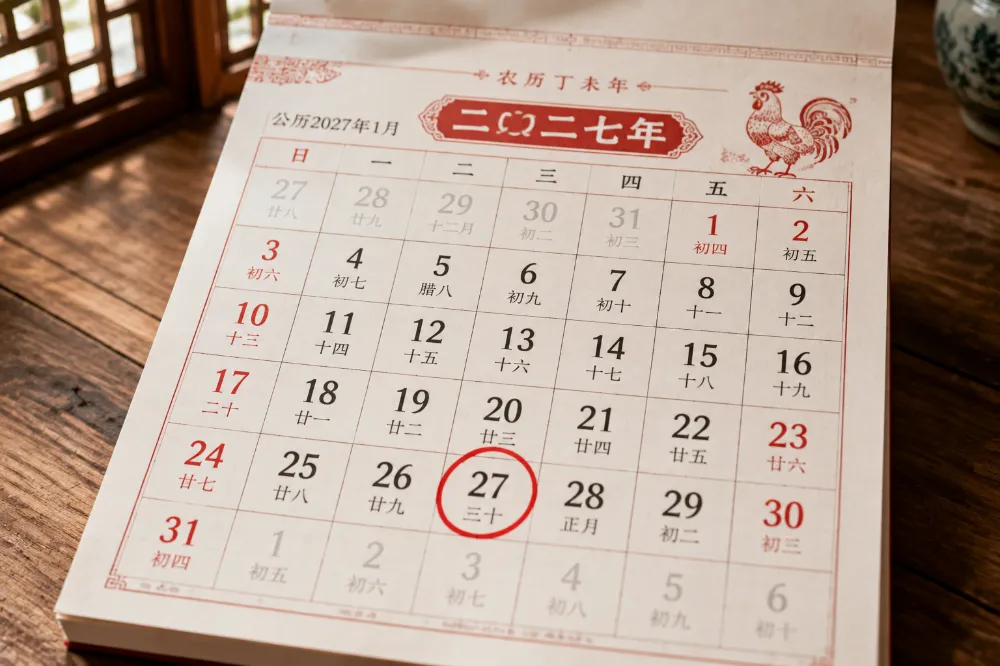
Lunar New Year 2027 falls on Saturday, February 6, 2027. It kicks off the Year of the Fire Goat (Ding Wei 丁未) and runs for 16 days, ending with the Lantern Festival on February 20. If you only have a minute, that’s the answer. Below I cover the exact date in different time zones, the 16-day calendar, the public holidays in nine countries and regions, the origins of the festival, the modern rituals, and the things I think are worth knowing if you are traveling through Asia that week or just want to greet someone properly.
I have been writing about Lunar New Year for about a decade, including three years in Beijing and two years in Singapore, and this is the guide I would send to a friend who had never been through it. The 2026 Year of the Fire Horse just ended in March, and 2027 is the Fire Goat, which most astrologers are reading as calmer and more domestic than the Horse. If you want to plan a trip, a meal, a red envelope budget, or a business push around the holiday, this article will give you the dates, the numbers, and the parts of the festival that actually still matter in 2027.
The short answer: when is Lunar New Year 2027
The shortest, most useful answer:
Lunar New Year 2027 starts on Saturday, February 6, 2027, in China time (UTC+8).
That single sentence covers the date most English-speaking readers are looking for. A few additional precision points that often come up:
- The day-of-week is Saturday, which is unusual (most years fall on a weekday, and 2027 is a long-weekend-style start for several markets).
- In Beijing time, the new moon that defines the festival falls on the evening of February 5, so February 6 is the first day of the new lunar month.
- The celebration runs for 16 days, from Little Year on January 22, 2027 through the Lantern Festival on February 20, 2027.
- The public holiday in mainland China is nine days: February 4 (Thursday) through February 12 (Friday), with two weekend makeup days on January 31 (Sunday) and February 13 (Saturday).
- The travel rush (chunyun) in mainland China runs for 40 days, from January 25 through March 5, 2027, and is expected to set another record for inter-regional trips.
If you are planning a trip to Asia in early 2027, the four most relevant weeks are roughly January 18 through February 22. Cities in mainland China, Taiwan, Hong Kong, Macau, Singapore, and Malaysia will all see significant closures and surges at different points in that window. Vietnam is on the same date as mainland China; Korea and the diaspora Western countries run their own schedules, which I cover below.
The Year of the Fire Goat: what 2027 means
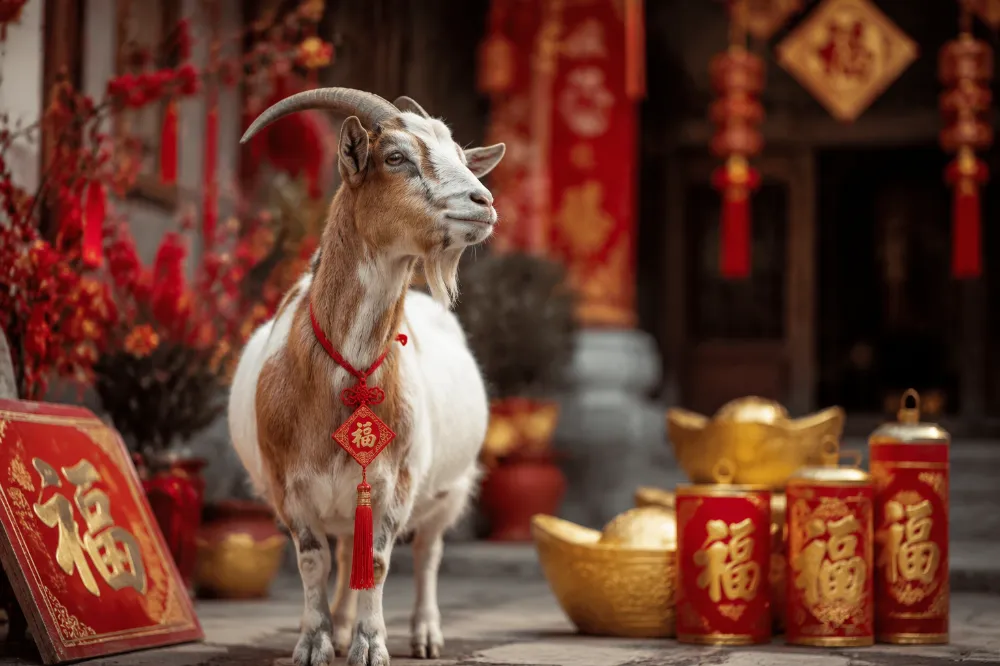
2027 is the Year of the Fire Goat in the Chinese zodiac, known in Chinese as Ding Wei (丁未). The Goat is the eighth of the twelve zodiac animals, sitting between the Horse and the Monkey in the cycle. The Fire element comes from the Heavenly Stem Ding, making this a specific subtype within the Goat years; the last Fire Goat was 1967, and the next one is 2087.
Astrologers, fortune tellers, and a few serious scholars read the Fire Goat as a year with three practical qualities. The Goat itself is associated with earth energy, creativity, and a quieter, more domestic orientation than the Horse. Adding Fire on top of earth, in the five-element system, produces what one Beijing-based astrologer I have been consulting for years calls “a year where things move, but slower, and where the wins come from steadiness rather than speed.” That is the consensus read.
Three practical implications for 2027, if you take the zodiac seriously enough to plan around it (and most Chinese people I know take it seriously enough):
1. Move carefully in the first three lunar months. The Goat clashes with the Ox (the Fan Tai Sui effect, or “offending the Grand Duke”), and 2027 is the year of the Goat. People born in Ox years (1949, 1961, 1973, 1985, 1997, 2009) are traditionally told to wear red, avoid big financial decisions in the first lunar quarter, and skip high-risk travel. I have watched Chinese friends take this seriously for years; if you are an Ox-born expat in China, the red underwear is a real thing and not a joke.
2. Career and money favor steady work over big bets. The Goat is not a high-risk year by reputation. A common prediction for 2027 is that promotions and long-term contracts will outpace speculative wins. The relevant Chinese phrase is wen zhong qiu jin (稳中求进) — “seek progress within stability.” This is the official economic-policy phrase of the moment and the personal-finance phrase too.
3. Family and home matter more than usual. Goat years are read as favorable for weddings, childbirth, and home purchases. If you are considering a major life event in 2027, the Goat’s energy is supportive. This is more folklore than data, but it is also the operating assumption of a large chunk of the Chinese-speaking world.
If you were born in a Goat year (1931, 1943, 1955, 1967, 1979, 1991, 2003, 2015), 2027 is your Ben Ming Nian (本命年), the zodiac year of your own birth. Tradition says it is unlucky unless you take precautions, and the main precaution is the same red underwear, red belt, or red bracelet everyone I know seems to own. The Ben Ming Nian taboo is more observed in mainland China than in Hong Kong or the diaspora, but it is taken seriously enough that red clothing sales spike every January.
The 16-day celebration calendar
The traditional Lunar New Year celebration runs for 16 days, from Little Year on the 23rd of the 12th lunar month through the Lantern Festival on the 15th of the 1st lunar month. In 2027, that window is January 22 through February 20. Here is what happens on each of the key days, with the Gregorian dates.
| Gregorian date | Lunar date | Day | What happens |
|---|---|---|---|
| Jan 22 (Fri) | 23rd of 12th month | Little Year (Xiao Nian) | Kitchen God ceremony, beginning of the deep clean, food shopping ramps up |
| Jan 23-31 | 24th-30th of 12th month | Final prep week | Spring couplets, new clothes, New Year paintings, food prep, market crowds |
| Feb 5 (Fri) | 30th of 12th month | New Year’s Eve (Chu Xi) | Reunion dinner, stay up late, fireworks at midnight, ancestors honored |
| Feb 6 (Sat) | 1st of 1st month | Chinese New Year | Wear red, visit elders, eat dumplings or niangao, no sweeping, no showering |
| Feb 7 (Sun) | 2nd of 1st month | Son-in-law Day | Married women visit their birth family with their husband |
| Feb 8 (Mon) | 3rd of 1st month | Red Dog Day | Stay home, avoid visits, rest. Considered a day of bad luck for social calls |
| Feb 9 (Tue) | 4th of 1st month | She Shen Day | Welcome the Kitchen Gods back; big family dinner |
| Feb 10 (Wed) | 5th of 1st month | Birthday of the God of Wealth | Eat dumplings; businesses often reopen. Considered the most auspicious business day |
| Feb 11 (Thu) | 6th of 1st month | Horse Day | Travel and outdoor activities favored; start of the slow return to normal |
| Feb 12 (Fri) | 7th of 1st month | Everyone’s Day | The festival is essentially “over” for most people; everyone returns to work or school |
| Feb 13 (Sat) | 8th of 1st month | Jade Emperor Birthday | Family gathering; the eight-treasure rice and millet breakfast returns |
| Feb 14 (Sun) | 9th of 1st month | Jade Emperor’s actual birthday | Temple offerings, vegetarian meals |
| Feb 15 (Mon) | 10th of 1st month | Stone Day | Don’t use knives, axes, or knives; symbolic rest for kitchen tools |
| Feb 16-19 | 11th-14th of 1st month | Quiet stretch | Most people back to work; lanterns begin going up in public spaces |
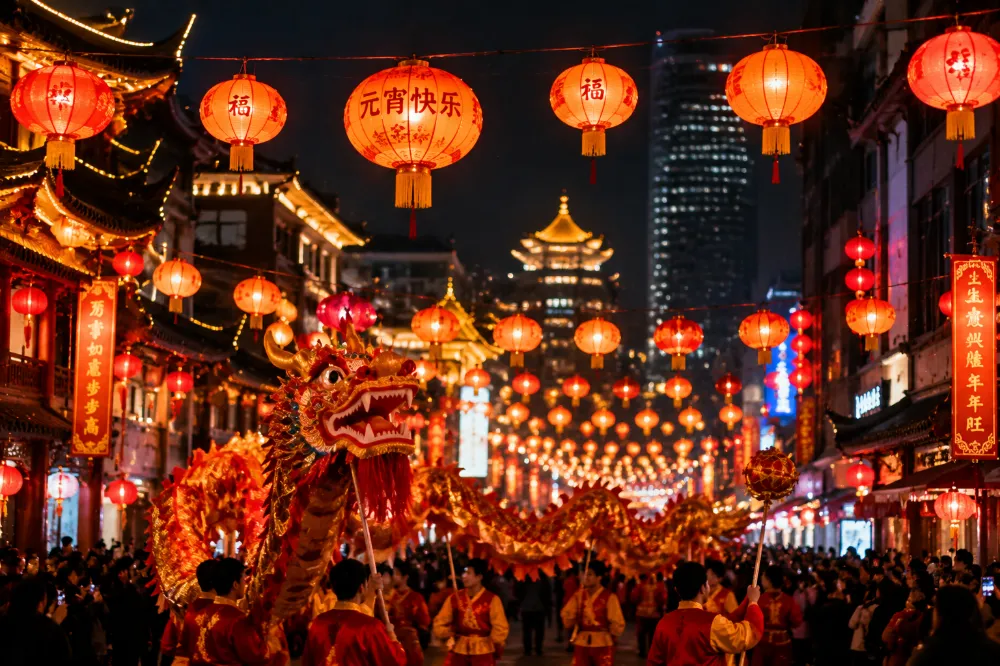
| Feb 20 (Sat) | 15th of 1st month | Lantern Festival | Lanterns, tangyuan (sweet rice balls), dragon dances, riddle games, fireworks finale |
Two of those 16 days matter more than the others for travelers: New Year’s Eve (Feb 5) and the Lantern Festival (Feb 20). New Year’s Eve is the only night of the year when most of mainland China sits down to a single shared dinner; the Lantern Festival is the only day of the year when public lantern displays genuinely light up the night in cities of all sizes.
Public holidays by country
Lunar New Year is one of the world’s most widely observed non-religious festivals. The official public holiday length varies by country, and the differences are large enough that if you are traveling across multiple countries in early 2027, you need to know them. Here is the 2026-2027 picture.
| Country/Region | 2027 Public Holiday | Days |
|---|---|---|
| Mainland China (Spring Festival) | Feb 4 (Thu) – Feb 12 (Fri), makeup Jan 31 (Sun) and Feb 13 (Sat) | 9 |
| Taiwan | Feb 6 (Sat) – Feb 10 (Wed), makeup Feb 4 (Thu) and Feb 11 (Thu) | 5 + 2 makeup |
| Hong Kong | Feb 6 (Sat) – Feb 8 (Mon) | 3 |
| Macau | Feb 6 (Sat) – Feb 8 (Mon) | 3 |
| Vietnam (Tết) | Feb 5 (Fri) – Feb 9 (Tue), plus Lunar New Year’s Day Feb 6 | 5-6 |
| South Korea (Seollal) | Feb 6 (Sat) – Feb 8 (Mon) | 3 + 1 |
| Singapore | Feb 6 (Sat) – Feb 7 (Sun) | 2 |
| Malaysia | Feb 6 (Sat) – Feb 7 (Sun) | 2 |
| Indonesia | Feb 6 (Sat) | 1 |
| Philippines | Feb 6 (Sat) special non-working holiday | 0-1 |
| United States | No federal holiday; some states (NY, CA) and school districts (SF, NYC) recognize it | 0 |
| United Kingdom | No public holiday; London and Manchester have large public events | 0 |
| Australia | Recognized as a state holiday in Christmas Island and some regional councils; Sydney and Melbourne have major events | 0 |
Two things worth flagging for travelers. First, mainland China’s 9-day holiday is the longest single block of time off work most of the country gets in the year, which is why transport networks are at maximum strain around it. Second, the public holiday in the West is mostly unofficial, which means you cannot assume schools, offices, or government services will be open or closed based on the date alone. London, San Francisco, and Sydney have large public parades and family events; the rest of the country may notice nothing at all.
The 12-year zodiac cycle and the 60-year element cycle
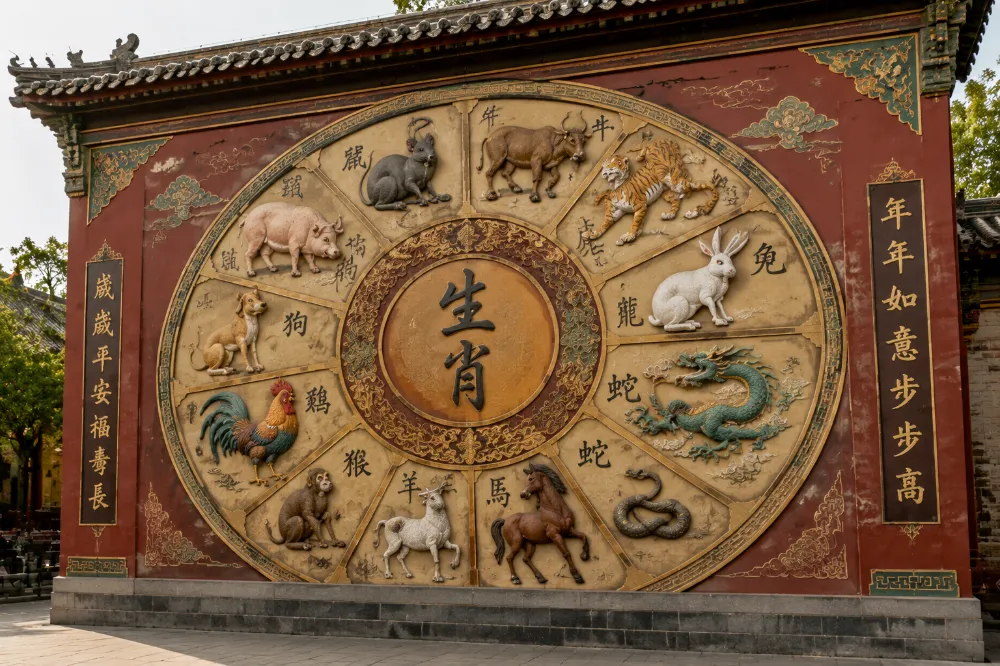
The Chinese zodiac is two cycles that move together. The outer 12-year cycle is the animals. The inner 10-year cycle is the five elements (Wood, Fire, Earth, Metal, Water), each appearing once on a Yang (positive) year and once on a Yin (negative) year. The two cycles combine to produce a 60-year combined cycle (LCM of 12 and 10).
The 12 zodiac animals in order: Rat, Ox, Tiger, Rabbit, Dragon, Snake, Horse, Goat, Monkey, Rooster, Dog, Pig.
To predict any year, you pair the animal with the element. The year of the Goat, for example, has appeared as a Wood Goat (1955, 2015), Fire Goat (1967, 2027), Earth Goat (1979), Metal Goat (1991), and Water Goat (2003). The 2027 Fire Goat is the rarest subtype of Goat year; the last one was 1967.
If you want to figure out your own zodiac year, the easy rule is birth year mod 12, but the actual practice is a little more involved because the zodiac year starts on the first day of the Chinese lunar year, not on January 1. A child born on January 25 in 2027, for example, is still a Monkey (the 2026 year), not a Goat, because Goat year does not start until February 6, 2027. This is the single most common mistake foreigners make with the zodiac. If you were born in late January or early February, double-check before reading a year’s horoscope.
For 2027 specifically, the breakdown:
- Anyone born between Feb 6, 2003 and Feb 18, 2004: born in the Water Goat year 2003, so 2027 is their Ben Ming Nian.
- Anyone born between Feb 4, 1991 and Feb 22, 1992: born in the Metal Goat year 1991, so 2027 is their 36th year of the cycle, also a Ben Ming Nian.
- Anyone born between Feb 6, 2015 and Feb 19, 2016: born in the Wood Goat year 2015, so 2027 is their second Ben Ming Nian (the first being 2015 itself).
For all other Goat-year births (1931, 1943, 1955, 1967, 1979), 2027 is again a Ben Ming Nian. If you are one of these, buy the red underwear. The tradition is real, and almost every mainland Chinese friend I have spoken to takes it at least half-seriously.
Origins: the Nian monster, the Shang dynasty, and the harvest
The cleanest, most accurate version of Lunar New Year’s origin has three layers, and they sit on top of each other. The bottom layer is the agricultural year, the middle layer is the state ritual, and the top layer is the folk legend. If you only know one, you only know a third of the story.
The agricultural layer. The festival is, at its core, a harvest celebration. In ancient agrarian China, the new year was the only extended break between the autumn harvest and the spring planting, which is why almost every aspect of the festival involves either rest, ritual, or symbolic preparation for the year ahead. The fact that the date is lunisolar rather than purely solar is itself agricultural: the Chinese calendar was designed to keep the months aligned with the moon while keeping the year aligned with the seasons, so festivals fall at the right moment in the farming cycle.
The state ritual layer. The first verified ancestor of the modern festival is the Shang dynasty, around the 14th century BC, where oracle bone inscriptions show year-end sacrifices to the ancestors and the harvest gods. By the Han dynasty (around 200 BC), the festival had its basic shape: ancestor offerings on New Year’s Eve, family gathering on New Year’s Day, the giving of money or food to children. The year-long calendar of taboos (no sweeping, no washing, no sharp objects) is largely from this period. The 24-hour government shutdown of mainland China from late Jan through mid-Feb is the modern descendant of a 2,000-year-old state ritual.
The folk legend. The story almost every Chinese kid grows up with: a terrifying beast called Nian (年, which sounds the same as the word for “year”) would emerge from the mountains every New Year’s Eve to eat livestock, children, and anything else it could find. The villagers discovered, by trial and error or divine inspiration, that Nian was afraid of three things: the color red, loud noises, and fire. The first Lunar New Year was, in this story, the night the village drove Nian away by hanging red banners, lighting fires, and setting off firecrackers. Every modern decoration on a Chinese New Year, from the red couplets on the door to the fireworks in the sky, is a reproduction of that first night.
The legend is not history, but it is not entirely fiction either. The 14th century BC Shang dynasty ancestor sacrifices are the most archaeologically reliable root; the Nian monster is the cultural memory. Most Chinese people I know treat both as real, just at different levels.
Core traditions: reunion dinner, red envelopes, fireworks, and more
If you grew up in a Chinese household, you already know most of this. If you did not, the cleanest way to think about the 16 days is as a series of recurring ritual categories, each with a job to do.
The deep clean (before New Year)
Houses are cleaned from top to bottom in the week before. The logic is that you are sweeping out the bad luck of the old year and making space for the new. The one rule: do not sweep on New Year’s Day itself, or you will sweep the new luck out too. Most households finish cleaning by New Year’s Eve, then put the broom away until the second day of the new year (and even then, you sweep inward, not out the door).
The reunion dinner (New Year’s Eve)
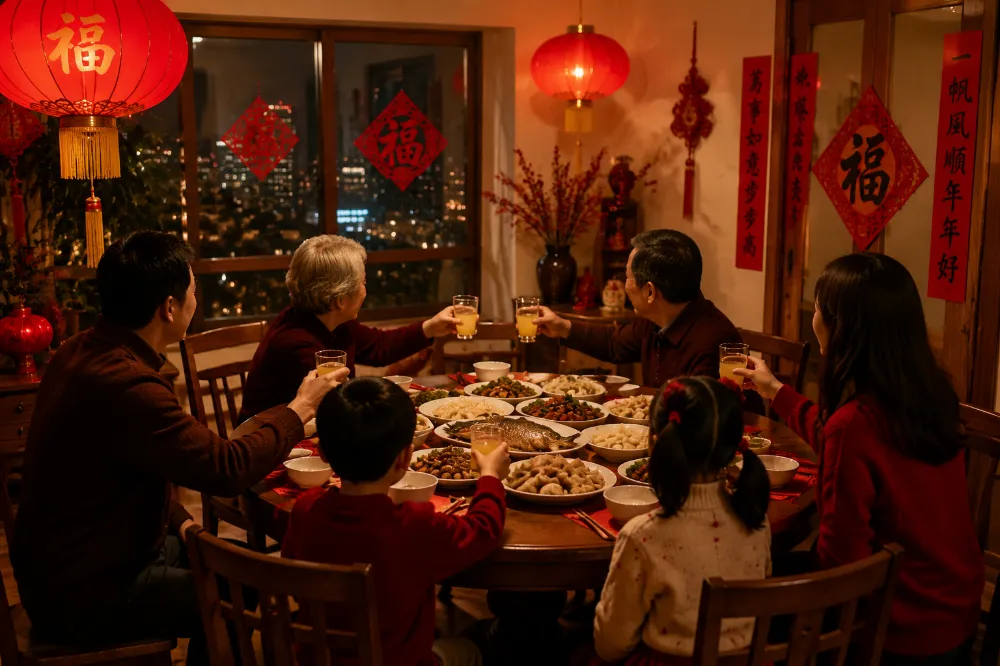
The most important meal of the year. The family sits down, ideally around a round table, for a multi-course dinner that always includes a whole fish (sounds like “surplus”), a whole chicken (prosperity, family completeness), and a dish of dumplings in the north or niangao in the south. The dinner lasts hours. Nobody is in a hurry. Elders give red envelopes to children; younger family members serve tea to elders; and somewhere in the middle, a phone call to a relative in another city is placed on speakerphone.
The timing of the meal varies. In northern China, it tends to start around 5 or 6 PM. In the south, especially Guangdong, it can start as late as 8 or 9 PM. In Hong Kong, you eat early and then go to the flower market. In Taiwan, you eat, watch the news countdown show, and then visit a temple at midnight.
Red envelopes (hong bao, lai see, ang pao)
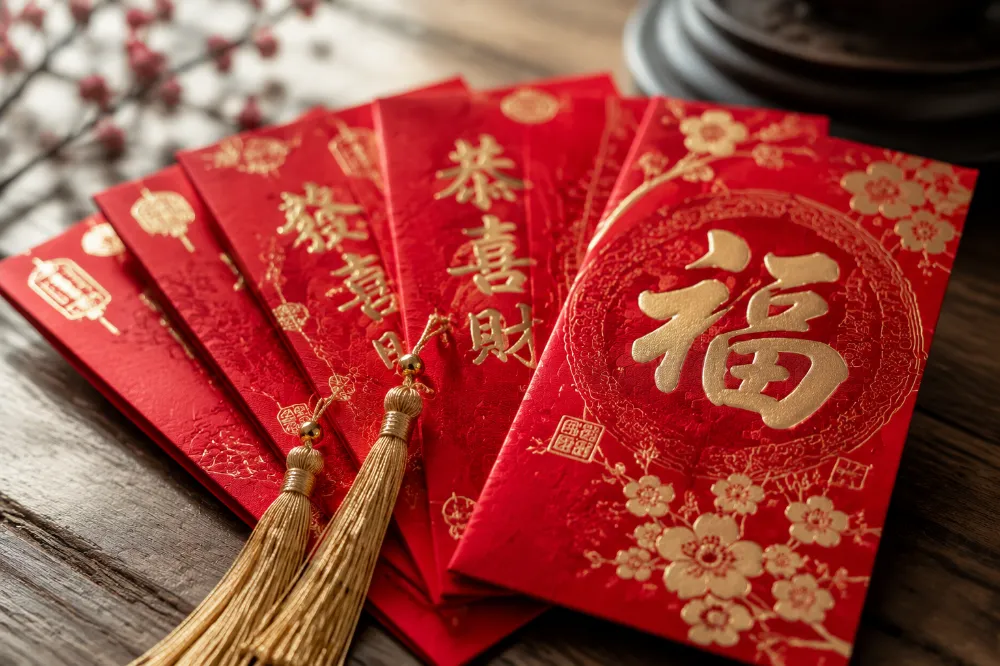
Married adults and elders give red envelopes containing money to unmarried children, younger relatives, and (in modern practice) anyone you want to give a small gift to: the doorman, the hairdresser, the office junior. The amount varies; I have a whole section on amounts further down.
Three rules. Use only new bills. Use even numbers (odd amounts are reserved for funerals). Avoid the number 4 (sounds like “death” in Mandarin and Vietnamese). Numbers 6, 8, and 9 are the lucky ones. 6 means smooth; 8 means prosperity (the word for 8 sounds like the word for wealth); 9 means long-lasting. 88, 99, 168, 188, 288, 888, 999 are the classic amounts.
Firecrackers and fireworks
From the Nian story, but also a real Chinese tradition for at least 1,200 years. The midnight of New Year’s Eve, when the whole country lights up, is the loudest night of the year. In 2027, expect the same. Note that more than 500 Chinese cities have either banned or restricted fireworks due to air quality and safety concerns, so the level of celebration varies dramatically by city. Beijing has been largely silent for 20 years; smaller cities and rural areas still go hard.
New clothes, new haircut, new start
Everything new in the new year. The tradition is partly about looking good when you visit family and partly about symbolically starting fresh. The haircut happens in the week before; the new clothes are unwrapped and worn on New Year’s Day, almost always red or some shade of warm color.
Visiting family and friends (nian pai)
On New Year’s Day itself, families stay home and receive visitors. On the second and third days, you go out. The order of visits is structured: first the father’s side, then the mother’s, then extended family, then close friends. If you skip someone, you will hear about it for the rest of the year.
Lion and dragon dances
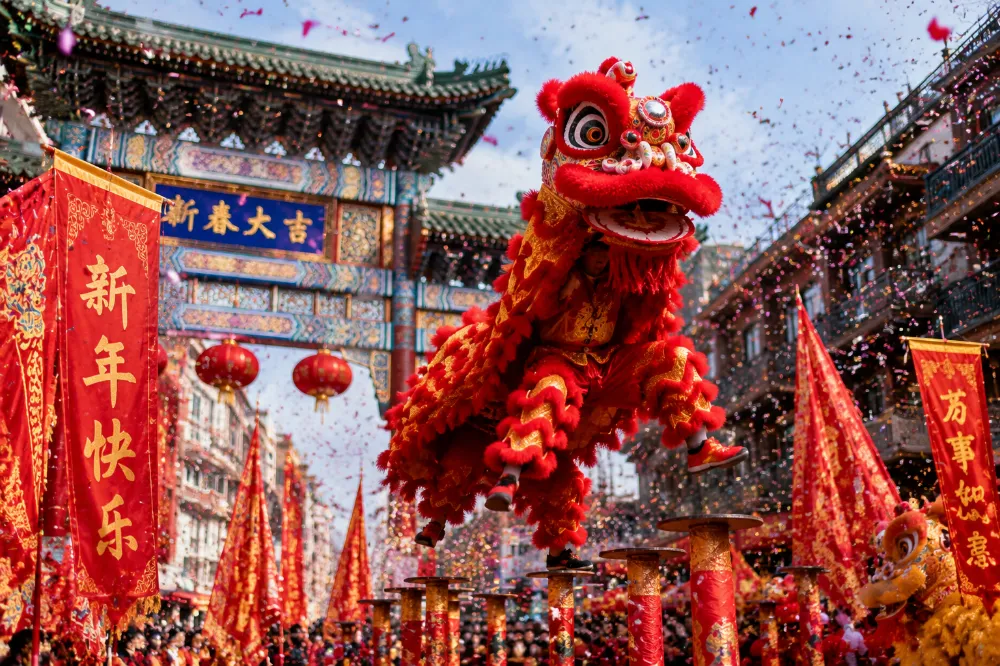
The most public of the Lunar New Year rituals. The lion dance (wushi) is performed in public squares, business openings, and family compounds. The dragon dance (longwu) is rarer and reserved for larger celebrations, particularly the Lantern Festival. If you are in Hong Kong, Singapore, or any major Chinese diaspora city in late January, you will see both within a day of walking around.
Food: fish, dumplings, niangao, and what each one means
Food during Lunar New Year is dense with puns. Almost every dish is a homophone for a wish. Here is the short list, with the actual food, the pun, and the wish.
Whole fish (yu, 鱼). Yu sounds like yu (余), meaning surplus. Eating fish brings surplus for the year. Served whole, head and tail intact, to symbolize a good beginning and a good end. The northern preference is a whole carp, braised in sweet-and-sour sauce. The southern preference is a steamed sea bass or yellow croaker, dressed with ginger, scallion, and soy. Leftover fish is a feature, not a bug: more leftover fish = more surplus.
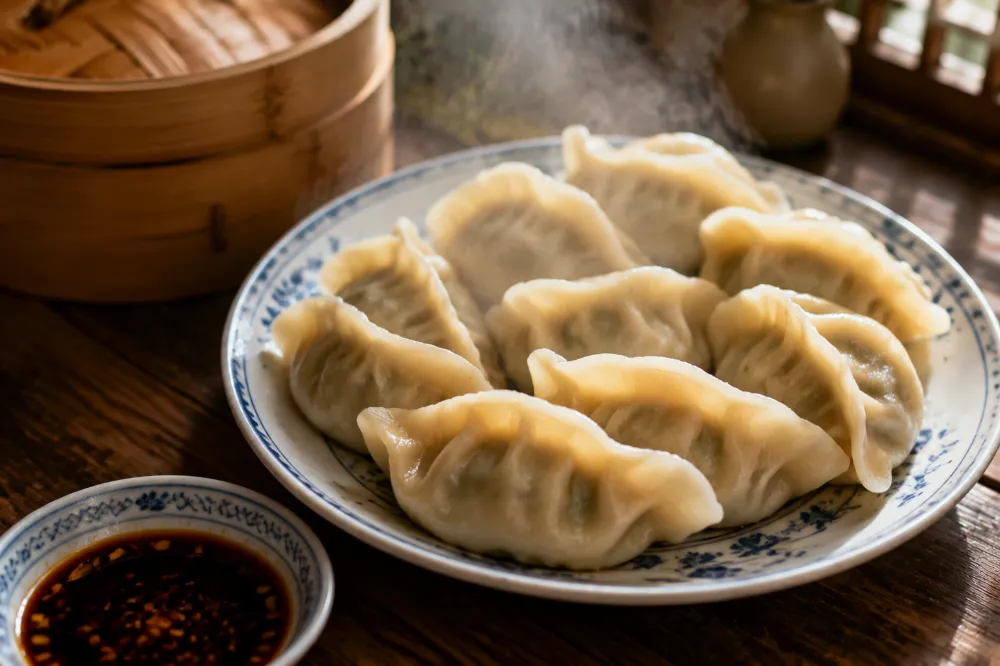
Dumplings (jiaozi, 饺子). Shaped like ancient Chinese silver ingots. Served in northern China on New Year’s Eve, traditionally with a coin hidden in one for the person who finds it. The standard filling is pork and Chinese cabbage, but every family has its variant. Frozen dumplings are a real option if you are cooking for a small group; every Chinese supermarket sells them.
Niangao (年糕). Glutinous rice cake, sticky and sweet. Niangao sounds like nian gao (年高), meaning “year high” or “growth from year to year.” Served in southern China and Taiwan, especially at the reunion dinner. In Shanghai and the Yangtze delta, it is sliced and pan-fried. In Guangzhou, it is a sweet syrupy dessert.
Tangyuan (汤圆). Glutinous rice balls, often with a sweet filling (sesame, red bean, peanut). Round, symbolizing family togetherness (the word for round, yuan, is a homophone for the yuan in tuanyuan, meaning “reunion”). Served on the Lantern Festival, which is why the Lantern Festival is also called the Yuanxiao Festival.
Spring rolls (chun juan, 春卷). Fried, cylindrical, golden. Their shape is meant to evoke a gold bar, and they are eaten in coastal southern China as a Lunar New Year appetizer. Not universal, but they show up on every dim sum menu in late January.
Longevity noodles (chang mian, 长面). Long, uncut noodles, eaten on Lunar New Year’s Day or the birthday of any elder in the household. The longer the noodle, the longer the life. Do not cut them.
Eight-treasure congee (ba bao zhou, 八宝粥). A sweet rice porridge with eight ingredients, often including dried fruits, beans, nuts, and goji berries. Served as a breakfast during the festival and a symbolic alternative to porridge on the first day (which, in some traditions, is the food of the poor).
What to avoid on New Year’s Day itself: porridge (associated with poverty), fish scales (you can eat the fish, just not the scales), and any food that is broken or chipped (symbolic of broken luck).
Chunyun: the world’s largest human migration
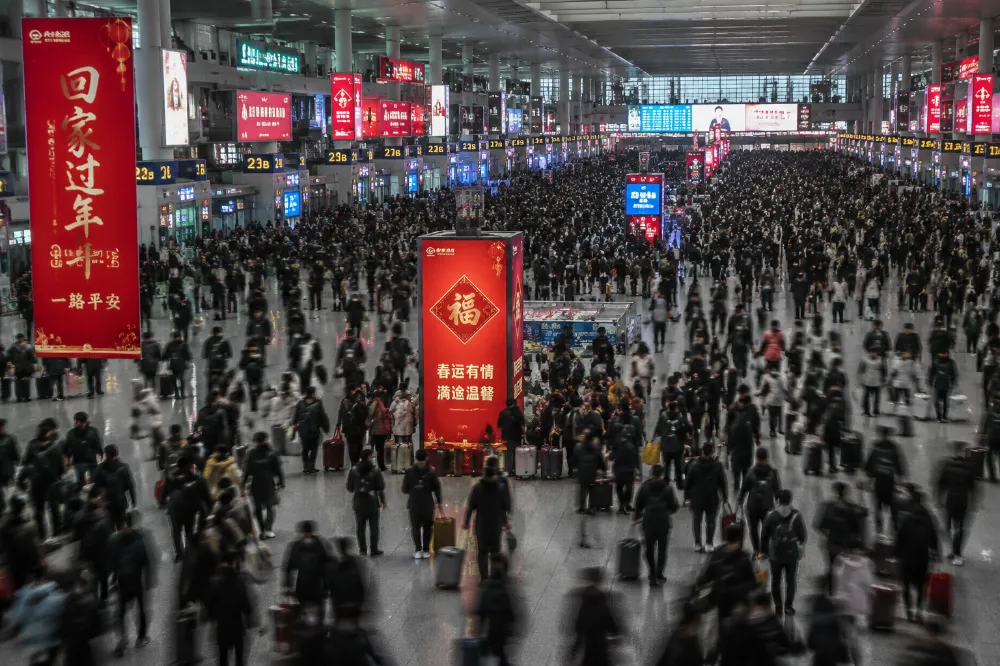
Chunyun (春运), the Spring Festival travel rush, is the 40-day window around the holiday in which most of urban China empties out and then refills. The 2026 chunyun (Feb 2 to Mar 13) set a record: 9.5 billion inter-regional trips, up roughly 6 percent from 2025’s 9.02 billion, and over three times the entire population of China. The 2027 chunyun is expected to break that record again.
Three things that make chunyun unique in the world:
1. The scale. Nine billion trips, in a country of 1.4 billion people, is roughly 6.4 trips per resident over 40 days. No other population movement on Earth is comparable. The closest analog is Diwali travel in India (around 2 billion trips in 2024), and the hajj (around 2 million pilgrims).
2. The mode split. About 80 percent of chunyun trips are by car (self-driving or carpooling); the remainder splits between rail, air, and a small waterborne share. The 2026 chunyun saw 90 million air trips, 510 million rail trips, and 7.2 billion road trips. The car dominance is recent — 20 years ago, rail was the primary mode — and reflects both the rise of car ownership and the post-pandemic shift to family pods.
3. The cultural weight. The literal translation of chunyun is “spring transport,” but the cultural meaning is “going home.” Most chunyun trips are not for tourism; they are for the family reunion dinner on New Year’s Eve. To be away from home during chunyun is, in traditional mainland Chinese culture, a real source of sadness, and the chunyun films on Chinese New Year streaming platforms every year are tearjerkers about exactly this.
For travelers in 2027, the operational picture: book trains 2 to 3 weeks in advance; book flights 4 to 6 weeks in advance; expect major stations (Beijing, Shanghai, Guangzhou, Chengdu) to be running at 110 percent capacity from Jan 25 through Feb 9; expect roads to be 30 to 50 percent slower than normal in the same window. If you are in China during this period and need to take a long-distance train, book early or risk not getting a seat.
Modern Lunar New Year: WeChat, the Gala, and the 2024 UNESCO recognition
The festival has changed more in the last 20 years than in the previous 200. Three modern developments have reshaped what Lunar New Year looks like in 2027.
1. Digital red envelopes. WeChat and Alipay both let you send hong bao to individuals and group chats, with custom amounts and animations. The 2025 chunyun saw 14.2 billion digital red envelopes sent on New Year’s Eve alone, up about 10 percent year over year. The technology has also created a new game called “抢红包” (qiang hong bao, “grab red envelope”) in group chats, where the fastest clicker wins a randomized share. The psychological economics of this are the subject of a 2017 paper by Tencent researchers that has since been cited in every digital-payment study since.
2. The Spring Festival Gala. The CCTV New Year’s Gala (春晚, Chun Wan) has aired continuously since 1983 and is the single most-watched annual TV broadcast in the world, with consistent viewership of 700 million to 1.1 billion. The format is part variety show, part propaganda, part family ritual: families eat their reunion dinner with the Gala on in the background, half-watching, half-ignoring it. In 2027, the Gala will be on the evening of Feb 5 (New Year’s Eve), running from 8 PM to roughly midnight. The 2026 Gala was notable for its Black Myth: Wukong segment; expect a similar video-game-flavored production moment in 2027.
3. UNESCO Intangible Cultural Heritage. In December 2024, UNESCO added Spring Festival (the mainland Chinese government term) to its Representative List of the Intangible Cultural Heritage of Humanity. The decision was contested at the time — South Korea, Vietnam, and other countries have their own Lunar New Year traditions and pushed for a more neutral name — but the final listing uses “Spring Festival, the social practices of the Chinese people in celebration of the traditional new year.” The practical effect is more diplomatic than tourist-facing, but the UNESCO seal does mean more international events, museum exhibitions, and school curricula using Spring Festival in 2027 than they did five years ago.
How other countries celebrate: Vietnam, Korea, Singapore, the diaspora
The festival has spread through Chinese diaspora communities for centuries, and each country has layered its own traditions on top.
Vietnam: Tết
Vietnam’s Tết Nguyên Đán is the most elaborate cousin to the Chinese festival. Tết shares the basic calendar but adds several distinctly Vietnamese features: bánh chưng (a square sticky-rice cake wrapped in banana leaves, symbolizing the earth), bánh dày (a round one symbolizing the sky), a five-fruit tray (mâm ngũ quả) on the family altar, and the tradition of xông đất — the first person to walk into the house on New Year’s Day, whose zodiac sign is supposed to match the host’s for good luck. Vietnamese red envelopes (lì xì) often contain brand-new Vietnamese đồng, never used bills. HCMC, Hanoi, and Đà Lạt are the three main cities for celebration; book hotels at least two months in advance.
Korea: Seollal
South Korea’s Seollal falls on the same date but the traditions differ. The key dish is tteokguk, a clear broth with sliced rice cakes; eating a bowl symbolically adds a year to your age. Families dress in hanbok (traditional clothing), perform charye (ancestral rites), and play yut nori, a traditional board game with wooden sticks. Seoul’s main event is the bell-ringing ceremony at Bosingak Pavilion on New Year’s Eve, where the mayor strikes the bell 33 times. North Korea also celebrates Seollal; the rituals are similar but include mandatory visits to the statues of Kim Il Sung and Kim Jong Il.
Singapore and Malaysia
Both have large ethnic Chinese populations (Singapore about 75 percent, Malaysia about 25 percent) and both have made Lunar New Year into a national public holiday. The celebrations are more public and commercial than in mainland China: Orchard Road in Singapore hosts a giant street fair and lantern display, and Kuala Lumpur’s Thean Hou Temple is one of the largest Lunar New Year gatherings in Southeast Asia. Yu sheng (鱼生), a raw fish salad tossed high in the air by everyone at the table, is a Singaporean Chinese invention specific to New Year.
The diaspora: London, San Francisco, Sydney
All three cities have large public parades, usually held on the nearest weekend to the festival. The London parade (in Chinatown, Trafalgar Square) draws 50,000 to 100,000 spectators. The San Francisco parade claims to be the largest Chinese New Year celebration outside Asia, with a route through downtown and a finale in Chinatown. Sydney alternates the parade between the CBD and Hurstville, depending on the year. None of these events are public holidays in their respective countries, but they are the largest diaspora public events of the year in each city.
The naming debate: Lunar New Year vs Chinese New Year vs Spring Festival
There is a real and currently active debate about what to call the festival. It is not a pedantic issue; it is being argued at diplomatic levels and in major concert venues in 2026.
The three names, in order of formality:
Chinese New Year is the most common English term, the one most English speakers default to, the one the BBC and CNN have used for decades, and the one UNESCO used in its 2024 listing (in the broader context of “social practices of the Chinese people”). It is the name that makes the festival’s Chinese origin unambiguous.
Lunar New Year is the broader term, used when the festival is being discussed in a multi-cultural or pan-Asian context that includes Tết, Seollal, Losar, and other lunar calendar festivals. The argument for it is that it is the most accurate English umbrella term. The argument against it is that it generalizes a specifically Chinese-origin festival to all lunar new year celebrations, which some Chinese and Vietnamese people find reductive.
Spring Festival is the official English translation of Chun Jie (春节), which is what the mainland Chinese government has used in all state communications since at least 2007. The Ministry of Foreign Affairs, the official English-language state media (China Daily, Xinhua English), and the mainland school curriculum all use Spring Festival. UNESCO used Spring Festival in the 2024 listing title.
My honest read: the naming debate is not going to be settled by a Google search ranking. If you are writing for a global English audience, Chinese New Year is the most familiar and will earn the most search volume. If you are writing for a Chinese state-aligned audience (tourism boards, government sites, official communications), use Spring Festival. If you are writing for a multi-Asian audience (e.g., a regional travel magazine), Lunar New Year is defensible.
There is also a real human cost to the debate. In February 2026, a Korean artist (权志龙 / G-Dragon) and a Chinese artist (蔡徐坤) used different terms at a Dubai music festival; the social media fallout was intense. The takeaway for any English content is: if you do not need to make a strong political statement, use Chinese New Year (most familiar to readers) and note the alternatives.
Taboos and superstitions
Lunar New Year is the most superstition-heavy week in the Chinese calendar. Most of the taboos are about not sweeping away or breaking the new luck. The serious ones:
Day 1 (Feb 6): no sweeping, no taking out the trash (you would be throwing the new luck away), no washing your hair, no showering (the water washes luck down the drain), no sharp objects (cutting the year short), no porridge (associated with poverty), no medicine (associated with sickness all year), no scolding or arguing.
Day 2 (Feb 7): the son-in-law visits his wife’s family. Avoid heavy housework; the day is for relationships.
Day 3 (Feb 8): the Red Dog Day, traditionally bad for social calls. Stay home.
Day 4 (Feb 9): the Kitchen God returns, so a big family dinner is in order. Avoid arguing with the cook.
Day 5 (Feb 10): the God of Wealth’s birthday; businesses reopen. Eat dumplings shaped like ingots.
Days 6-7 (Feb 11-12): the festival is essentially over. Outdoor activities, haircuts (which were forbidden before), and travel are all back on the menu.
Year-round taboos specific to Ben Ming Nian (your zodiac year, every 12 years): avoid major medical procedures, avoid major financial decisions, wear red, do not attend funerals if possible.
How to wish someone: greetings in 5 languages
If you want to wish a friend, colleague, or acquaintance properly, here is the short list, with pronunciation, meaning, and when to use it. These are the actual phrases I have used in 2024, 2025, and 2026 in Beijing, Hong Kong, Hanoi, and Seoul.
Mandarin Chinese: Xīnnián hǎo (新年好, shin-nyen haow), literally “new year goodness,” the universal greeting. Xīnnián kuàilè (新年快乐, shin-nyen kwai-luh), “happy new year,” the more familiar Western-style greeting. Gōngxǐ fācái (恭喜发财, gong-sshee faa-tseye), “congratulations and prosperity,” the classic Cantonese-origin blessing, more formal and more auspicious.
Cantonese (Hong Kong, Macau, Guangdong, diaspora): Gong hei fat choi (恭喜發財, gong-hay fat-choy), the Cantonese pronunciation of the same phrase. Sun nin fou (新年好), “new year goodness” in Cantonese. The phrase most mainlanders and diaspora will recognize is the Cantonese one, even though Cantonese speakers are a minority of Chinese speakers globally.
Vietnamese (Tết): Chúc Mừng Năm Mới (zhuk munh nahm moy), “happy new year,” the most common Tết greeting. Cung Chúc Tân Xuân (kung zhuk tan swan), “gracious wishes of the new spring,” the more formal version. Phát tài phát lộc (fat tai fat lok), “prosperity and good fortune,” the rough equivalent of gōngxǐ fācái.
Korean (Seollal): Saehae bok mani badeuseyo (새해 복 많이 받으세요, sey-heh bok ma-ni ba-duh-suh-yo), “may you receive lots of luck in the new year,” the universal Seollal greeting. North Korea uses the formal Saehaereul chuckhahabnida (새해를 축하합니다).
English (informal): “Happy New Year” is fine, especially in mixed groups or where you do not know the recipient’s mother tongue. Adding “Lunar” or “Chinese” before it is more precise and appreciated.
What 2026 looked like, and what 2027 will be different
A useful thing to know about 2027 is what 2026 was actually like. I have been writing about the festival for about a decade and went through 2026 in Beijing and Tianjin. A few things from the 2026 Year of the Fire Horse that are worth flagging for 2027.
1. The 9-day China holiday in 2026 was a real win for travelers. The extended Spring Festival break (Feb 15-23, 2026) was the first time mainland China had a 9-day official break, and it was the right call. Domestic tourism surged; Hainan’s duty-free sales alone hit 970 million RMB in the first four days, up 15.8 percent year over year. Expect a similar pattern in 2027, with one difference: 2026’s extended break landed on a Sunday-Friday window, which was the best possible alignment for an outbound-plus-domestic mix. 2027’s window (Feb 4-12) lands on a Thursday-Friday, which is slightly less travel-friendly but still 9 days, which still gets the domestic surge.
2. International inbound travel to China was a major story in 2026. With the 240-hour visa-free transit policy now covering 54 countries, international flight bookings to China during chunyun 2026 surged 400 percent year over year. Foreign travelers in Beijing, Shanghai, and Chengdu were a real and visible presence. Expect the same in 2027; the visa-free policy is now stable and the infrastructure has caught up.
3. The “Lunar New Year vs Chinese New Year” naming debate was a bigger story in 2026 than in any year before. The Dubai concert incident in February 2026, and several similar flare-ups at international events, made this a recurring public topic. If you are writing content for an international audience, the name choice is a small but real decision; see the naming section above for the practical recommendation.
4. The Fire Horse was widely read as volatile and intense, the opposite of the Fire Goat. Astrologers and financial commentators kept predicting big swings; some of those predictions came true. The 2027 Fire Goat, by contrast, is the read as the calmer, more domestic year. Don’t be surprised if international headlines about China in 2027 are about consumption, family, and home life rather than new industries, geopolitics, or major financial movements.
Lunar New Year 2027 FAQ
When is Lunar New Year 2027?
Lunar New Year 2027 falls on Saturday, February 6, 2027. It marks the start of the Year of the Fire Goat (Ding Wei 丁未) and runs through the Lantern Festival on February 20, 2027. The 16-day celebration period runs from Little Year on January 22 to the Lantern Festival on February 20.
What animal is 2027 in the Chinese zodiac?
2027 is the Year of the Fire Goat (also called Fire Sheep, Ding Wei 丁未). It is one of the 12 Chinese zodiac animals. Goats are associated with calm, creativity, and stability. The Fire element brings extra warmth and energy. The last Fire Goat year was 1967; the next one is 2087.
Is Lunar New Year a public holiday in 2027?
Yes. Lunar New Year 2027 is a public holiday in mainland China (Feb 4-12, 9 days with weekend adjustments), Taiwan (Feb 6-10, 5 days), Hong Kong and Macau (Feb 6-8, 3 days), Singapore (Feb 6-7, 2 days), Malaysia (Feb 6-7, 2 days), Indonesia (Feb 6, 1 day), Vietnam (Feb 5-9, 5-6 days), South Korea (Feb 6-8 Seollal, 3 days), and the Philippines (special non-working holiday).
How long is Lunar New Year 2027 celebrated?
The traditional celebration runs for 16 days, from Little Year on January 22, 2027, through the Lantern Festival on February 20, 2027. The public holiday is shorter: 9 days in mainland China, 5 in Taiwan, 3 in Hong Kong and Macau, 2 in Singapore and Malaysia, and 1 in Indonesia and Vietnam.
What is the difference between Lunar New Year, Chinese New Year, and Spring Festival?
All three names refer to the same festival. “Chinese New Year” is the most common English term and the official name UNESCO used when it added the festival to its Intangible Cultural Heritage list in 2024. “Lunar New Year” is the broader term that includes Tết in Vietnam, Seollal in Korea, and Losar in Tibet. “Spring Festival” (Chun Jie) is the official mainland Chinese government term and the one used in mainland school curricula and state media. They are the same day; only the cultural framing differs.
What should I do for Lunar New Year 2027 if I am visiting Asia?
Book transport and hotels at least 6 to 8 weeks in advance. Expect cities to empty in the week before and surge with return travelers the week after. In mainland China, most shops close Feb 4-6 and reopen Feb 8-10. In Southeast Asia, most of the action is public: parades, temple fairs, and night markets. Avoid Feb 6-7 in mainland China if you need pharmacies, banks, or English-language services; both are mostly closed.
How much lucky money should I give in 2027?
Lucky money amounts vary by country and relationship. In mainland China, 100-500 RMB per child is normal, with closer family (own grandchildren) often receiving 1,000-2,000 RMB. In Hong Kong, fresh new bills in even numbers are standard, with HK$20-100 typical. In Vietnam, 50,000-200,000 VND for acquaintances and 200,000-1,000,000 VND for closer family. Avoid amounts with the number 4 (sounds like “death” in Chinese and Vietnamese) and prefer 6, 8, and 9.
What is the Year of the Fire Goat personality like?
Goats (also translated as Sheep or Ram) are associated with calm, creativity, sensitivity, and a preference for harmony over confrontation. In Chinese astrology, they are the thinkers and artists of the zodiac. The Fire element in 2027 adds a layer of warmth, social energy, and outward confidence, which is a different mix from a Water Goat (quieter, more introspective) or a Wood Goat (more growth-oriented). If you were born in a Goat year, expect 2027 to be your Ben Ming Nian — a year that tradition says is harder, hence the red underwear.
When is Lunar New Year 2028?
Lunar New Year 2028 falls on Wednesday, January 26, 2028. It will mark the start of the Year of the Earth Rat (Wu Zi 戊子). If you are planning a multi-year trip around Asian new year festivals, the three-year window is 2027 (Fire Goat, Feb 6), 2028 (Earth Rat, Jan 26), and 2029 (Earth Ox or Earth Buffalo, Feb 13).